
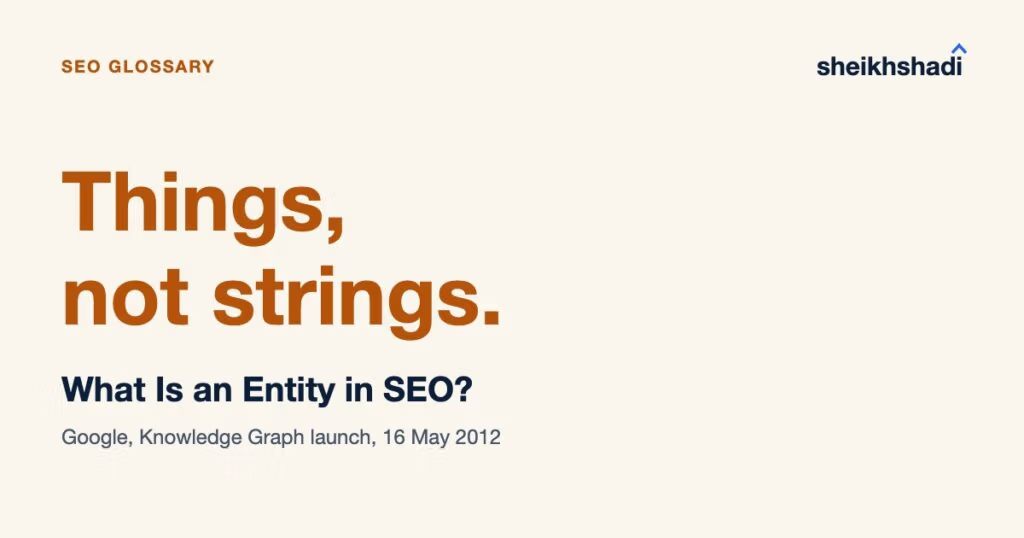
In SEO, an entity is a specific, identifiable thing that a search engine can tell apart from everything else: a person, a company, a product, a place or a concept. Google stores entities and the links between them in its Knowledge Graph. That is how it can tell that “Apple” means the company in one query and the fruit in another.
Here’s the part that matters for your site: entity SEO is clarity work, not a ranking trick. Your first job is to find out whether Google already has an ID for your brand. Then you make every signal about it agree.
What counts as an entity?
Anything that is distinct and can be described on its own counts. Taylor Swift is an entity. So are Paris, the iPhone, HubSpot, the Eiffel Tower and abstract ideas like inflation or machine learning. A keyword such as “best project management software” is not an entity. It is a string of words that may mention several entities.
A useful way to sort them is into two broad groups:
- Named entities: specific, real things with a proper name, like a person, a company, a city or a product model.
- Concept entities: ideas and topics, like “content marketing” or “customer churn”, that still have a clear, agreed meaning.
Yes, a person can be an entity. Most well-known people are, which is why searching a famous name often shows a panel with their photo, job and birth date.
Entity vs entity type
An entity is the individual thing. An entity type is the category it belongs to. Taylor Swift is the entity; Person is the type. Google’s own Knowledge Graph Search API shows this split in its sample result: the entity “Taylor Swift” comes back with the types Thing and Person plus the short description “Singer-songwriter”. Types follow schema.org, the same vocabulary you use in structured data.
What “entity” means in business
Outside SEO, the word usually means a legal entity: a company, partnership or other body that has a legal identity separate from its owners. That is a different meaning. Your company is a legal entity on paper. Whether Google treats it as a search entity depends on whether its systems can identify and describe it.
How does Google turn words into entities?
Google announced the Knowledge Graph in May 2012 with a line that still sums up the idea: “things, not strings.” The launch post used the query [taj mahal] as its example. Do you mean the monument, the musician or the casino in Atlantic City? A string-matching engine sees two words. An entity-aware engine sees three possible things and uses context to pick one.
That process has three moving parts:
- Recognition: spotting that a word or phrase on a page or in a query names a thing.
- Disambiguation: deciding which thing it is, based on the words around it. “Jaguar top speed” points to the car or the animal; “Jaguar dealer near me” settles it.
- Linking: connecting that mention to a known record with its facts and relationships.
Google’s data for those records comes from many places. In a 2020 explainer, Google listed Wikipedia, licensed databases and information that content owners supply through markup among its sources. It also put the graph at over 500 billion facts about five billion entities. That scale is why your brand either has a record in there or is competing with things that do.
Entities vs keywords: what actually changes?
Keywords don’t go away. People still type words. You still need to know which words they use. You can see this in any search query report: real phrasing, typos and all. What changes is how you write and structure a page around those words.
| Keyword thinking | Entity thinking | |
|---|---|---|
| Unit of work | A phrase to rank for | A thing to describe clearly |
| On the page | Repeat the phrase and close variants | Name the thing, its attributes and related things |
| Ambiguity | Mostly ignored | Resolved with context, markup and consistent naming |
| Across the site | One page per phrase | Pages linked by how their topics relate |
In practice, a page about “CRM for small business” written with entities in mind names the actual products, the features they share and the problems they solve. It doesn’t just repeat the phrase. Your secondary keywords often turn out to be the related entities and attributes that belong on the page anyway.
What is semantic SEO?
Semantic SEO is the practice of writing and structuring content around meaning: the entities on a page, their attributes and how they relate. Entity SEO is the narrower slice that focuses on making specific things, especially your brand, people and products, easy to identify.
It rests on how Google describes its own systems. Google’s guide to its ranking systems says RankBrain helps it understand how words relate to concepts. Neural matching works on representations of concepts in queries and pages, while BERT reads how combinations of words express meaning and intent. None of those descriptions reward repeating a phrase. They reward pages that make their subject clear.
A practical semantic page usually does four things. It answers the main question early, covers the subtopics a reader expects, names related entities in plain words and links to your other pages on those subtopics. A clear internal linking structure is how you show those relationships across the whole site, not just on one page.
Do entities directly affect rankings?
Google has not published “entities” as a ranking factor. The same ranking systems guide talks about concepts and meaning but doesn’t use the words “entity” or “Knowledge Graph” at all. So treat entity work as a way to help Google understand your pages and brand, not as a dial that moves positions on its own.
The same caution applies to salience scores. Google’s Cloud Natural Language API rates each entity it finds with a salience score between 0 and 1.0, for the text you submitted. It describes that document, not your site or your rankings. Google has not said that its search ranking uses that score, so chasing a higher number for its own sake is wasted effort.
You may also see a popular definition that calls an entity something unique, well-defined and easy to tell apart from everything else. That wording comes from a 2016 Google patent filing, not from Google’s search documentation. It is a fair working definition, but a patent shows an idea Google filed, not proof of how live search works today.
How do you check if Google sees your brand as an entity?
This is the step to do before any content or markup work, because the answer decides what you fix first. Three checks cover it.
1. Search your brand name
Search your exact brand name, then your brand plus what you do. A knowledge panel with your logo, description and profiles is a strong sign Google has a record for you. No panel doesn’t prove there is no record; plenty of entities exist in the graph without showing a panel for every query.
If a panel appears, Google’s get verified on Google help page explains how to claim it. You sign in through an official profile it lists, such as Search Console or YouTube. After that you can suggest changes. Google notes that not all panels can be claimed yet.
2. Query the Knowledge Graph Search API
The Knowledge Graph Search API takes a name and returns matching entities. Each one comes with an ID such as kg:/m/0dl567 (Taylor Swift’s), its types, a short description and a result score. Run your brand name through it with an API key. You are looking for three things:
- Does an entity with your name come back at all?
- Is it actually you, or a different company, person or place with the same name?
- Do the type and description match what you do?
Google warns that this API is not suitable as a production-critical service. Its documentation also says the API is being migrated to Cloud Enterprise Knowledge Graph and points new users there. Either way, use it as a spot check, not a dashboard. It returns individual entities, not the full web of relationships.
3. Run your About page through the Natural Language API
Send the text of your homepage or About page to Google’s Cloud Natural Language API for entity analysis. For entities it can link to a known record, the result includes a Knowledge Graph ID (mid) and often a Wikipedia URL. Say your brand shows up as a plain “Organization” with no ID while your competitors’ names come back linked. That tells you the text alone isn’t enough for Google to connect you to a record.
What to do with the result
| What you find | What it means | Your next step |
|---|---|---|
| An ID that is clearly you, with a correct description | Google knows who you are | Claim the panel if one shows; keep details consistent; build topic depth |
| An ID with your name that belongs to someone else | Your name is ambiguous | Add context everywhere: what you do, where you are, who runs it; use Organization markup with sameAs links |
| No ID at all | Google has no record it can match | Build a clear About page, consistent profiles and real mentions on relevant sites; recheck in a few months |
How do you make your entity clear to Google?
Here is a worked example. Say your company is called Northwind Analytics, a B2B reporting tool. Your checks show no Knowledge Graph ID. Worse, “Northwind” returns a well-known sample database instead. Here is what you would do, in order.
- Write one canonical description. One sentence that says what Northwind Analytics is, who it serves and where it is based. Use the same wording on your About page, LinkedIn, Crunchbase, G2 and any directory listing.
- Add Organization markup to your homepage or About page. Google’s Organization structured data documentation lists recommended properties such as name, url, logo, description, foundingDate and sameAs. It says the markup helps Google disambiguate your organization in results. It also says to put this markup on your home page or on a single page about your organization, such as your About page. You don’t need it on every page. Use sameAs to point to your official profiles.
- Test the markup with the tools Google lists today. Use the Rich Results Test for Google-specific checks and the Schema Markup Validator for general schema.org validation. Google removed its own checks from the old Structured Data Testing Tool, so it can no longer tell you whether Google can use your markup.
- Connect people to the brand. Give founders and authors their own pages, link them to their profiles and link their articles back to those pages.
- Build topic depth around what you do. Cover the core subtopics of your product area in linked articles, so the relationship between “Northwind Analytics” and “B2B reporting” shows up across many pages, not one.
- Earn real mentions. Coverage on relevant industry sites that names you alongside your category gives Google more evidence of what you are.
Keep your expectations honest about step 2. Google’s documentation states plainly that it does not guarantee that features using structured data will appear in results. Markup makes your facts machine-readable. It does not force a knowledge panel.
The same checks help you understand what a SERP is showing you. When a query triggers a knowledge panel or a “People also ask” box full of named things, Google is telling you which entities it connects to that topic. Those are the entities your page should cover.
My take: fix identity before you chase topics
In my SEO work since 2012, the sites that struggle with entities rarely lack content. They lack a consistent identity. The brand name is written three ways, the About page is vague and the social profiles describe three slightly different companies. More topic coverage doesn’t fix that.
So do the work in this order: run the three checks, write one canonical description, add Organization markup with sameAs, then build topic depth. This suits any brand with a name that could be confused with something else, which is most new SaaS and B2B companies. It matters less for a large brand that already has a correct panel. For that brand, the next gain usually comes from deeper topic coverage, not more identity work. Skip tools that sell you an “entity score” as if it were a ranking metric. Google has not published any such metric.
Not sure whether Google can tell your brand apart from a namesake? Ask us for a free SEO audit and we’ll show you what Google currently knows about your site.