
Keyword density is how often a keyword or phrase appears on a page compared with the page’s total word count, shown as a percentage. Google doesn’t treat it as a target: it has said it has no notion of an optimal keyword density. What helps is making your topic obvious in the title, the main heading and the opening lines. A density check is still worth running for one reason, which is catching a draft that repeats itself.
How do you calculate keyword density?
Count how many times the exact keyword or phrase appears, divide by the total number of words on the page, then multiply by 100:
Keyword density = (keyword occurrences ÷ total words) × 100
If “email marketing” appears 8 times in a 1,000-word post, its density is 0.8%. Yoast’s plugin uses the name keyphrase density for the same measure.
Some sources use a second method for phrases. The phrase formula on Wikipedia’s keyword density page multiplies the occurrences by the number of words in the phrase, so the same 8 uses of a two-word phrase would score 1.6%. Neither method is wrong, but they give different numbers for the same page. Check which one your tool uses before you compare its score with any rule of thumb.
Does keyword density matter for Google rankings?
Not as a number to hit. When asked in Google’s January 2023 office hours whether Google considers keyword density, John Mueller said no: Google has no notion of an optimal keyword density. He added that its systems have become good at recognizing what a page is about even when the keywords aren’t mentioned at all.
He followed that with the part that still matters: be explicit. A home page that only says a business adds pizazz to places leaves both people and search engines guessing. If the business paints houses, the page should say so in plain words. So the useful question isn’t how many times you used a phrase but whether a searcher would recognise the page as the answer.
AI search points the same way, with a caveat. In the GEO study (Aggarwal et al., KDD 2024), the researchers rewrote source pages to include more keywords from the query, a method they labelled keyword stuffing. On their benchmark it gave little to no improvement in how visible those pages were inside generative engine answers. That test used 2023 systems, so read it as a sign that adding query keywords doesn’t help, not as a rule for every AI tool today.
What is a good keyword density?
Google doesn’t publish one. The ranges you see in tools and articles come from plugin scoring rules or from habit:
| Range | Where it comes from |
|---|---|
| 0.5% to 3% | The green light in the free Yoast SEO plugin (Premium and the Shopify app allow up to 3.5%) |
| 1% to 1.5% | Rank Math’s guidance, which calls it enough in most cases while saying no perfect density exists |
| 1% to 2% | A range some SEO blogs give, with no Google source behind it |
Treat these as settings inside a tool. They tell you how that plugin scores a draft, not how Google ranks it.
How many times should a keyword appear in 1,000 words?
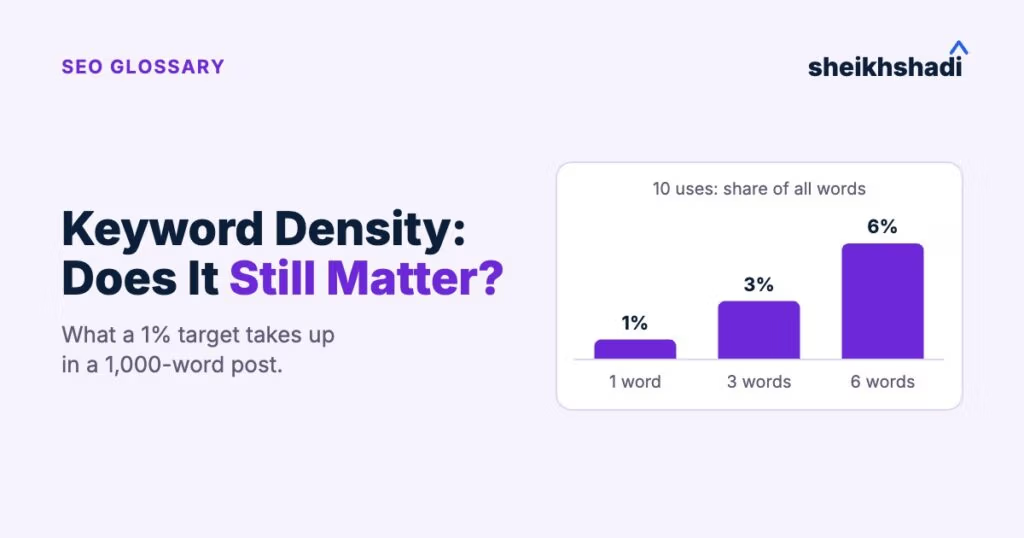
There is no required count. What a percentage target asks of you also depends on how long the keyword is. Here is what a 1% target means in a 1,000-word article for three keywords of different lengths:
| Keyword | Uses needed for 1% | Words those uses take up | Share of the whole article |
|---|---|---|---|
| backlinks (1 word) | 10 | 10 | 1% |
| keyword density checker (3 words) | 10 | 30 | 3% |
| what is keyword density in seo (6 words) | 10 | 60 | 6% |
Ten repeats of a single word can blend into the text. Ten repeats of a six-word question fill 6% of the article and read like a script. That is why Yoast weights longer keyphrases so they need fewer uses.
For a long phrase, use the full wording where a reader expects it, such as the title and the main heading, then use shorter natural forms in the body. Choosing long-tail keywords for a page is useful for planning what it covers, but each one doesn’t need its own quota of repeats.
What counts as keyword stuffing?
Google’s spam policies (updated 28 August 2026) describe keyword stuffing as filling a page with keywords or numbers to manipulate rankings. Those keywords often appear in a list or group, unnaturally or out of context. Google lists three examples:
- Lists of phone numbers without substantial added value
- Blocks of text that list the cities and regions a page is trying to rank for
- Repeating the same words or phrases so often that it sounds unnatural
Sites that break the policy may rank lower or not appear at all. The policy describes behavior; it gives no percentage that triggers it. Google’s own sample of the third kind shows why a percentage can’t settle the question:
“Unlimited app store credit. There are so many sites that claim to offer app store credit for $0 but they’re all fake and always mess up with users looking for unlimited app store credits. You can get limitless credits for app store right here on this website. Visit our unlimited app store credit page and get it today!”
That paragraph has 58 words. Counting only the exact phrase “unlimited app store credit”, it appears twice, a density of 3.4%. Count the plural as well and it reaches 5.2%. Use the word-based phrase formula and the same paragraph scores between 13.8% and 20.7%. Under the simplest count, Google’s own example of stuffing scores 3.4%, inside the 3.5% limit in Yoast Premium.
The phrase “limitless credits for app store” counts toward none of those numbers, yet it is part of what makes the passage read badly. Google’s SEO Starter Guide makes the same point when it warns against repeating the same words over and over, even in variations. Swapping in synonyms doesn’t fix a page that keeps saying the same thing.
What should you do instead of chasing a percentage?
Google’s Search Essentials put it simply: use the words people would use to look for your content and place them in prominent spots, such as the title, the main heading, alt text and link text. A practical version for any draft:
- Title and main heading. Make the topic clear in both. Use your main phrase where it reads naturally.
- Opening. Say plainly what the page is about in the first two or three sentences.
- Images and links. Write alt text that describes what each meaningful image shows. Point internal links at the page with anchor text that names its topic.
- Related wording. Use the other terms a person would naturally use. The Starter Guide notes that writing naturally with varied wording gives you more chances to show up in Search, because the page covers more of the terms people use. Picking secondary keywords before you write gives you that vocabulary up front.
- Read it out loud. Rewrite any sentence where the keyword sounds bolted on.
Here is that last step on a hypothetical product page for freelancers:
- Before: “Our invoicing software for freelancers is the invoicing software freelancers choose when they need invoicing software.”
- After: “Send an invoice in two minutes, see who has paid and get a reminder when a client is late.”
The rewrite drops the phrase completely, yet it tells a reader far more about the product. Keep the phrase where it labels the page, in the title and main heading. Let descriptive sentences like the After version do the rest. Google can match that kind of wording to many different search queries.
When is a keyword density check worth running?
Two situations justify the minute it takes:
- Reviewing outsourced or AI-assisted drafts, where one phrase can creep into every paragraph.
- Cleaning up older pages that were written to hit a density target.
For a quick check, search the draft for the exact phrase (Ctrl+F or Cmd+F) and divide by the word count your editor shows. Browser search also matches plurals and longer words that contain the phrase, so its count can run higher than an exact-phrase count. In WordPress, Yoast and Rank Math run the same count in the editor sidebar. Use the result only to find paragraphs worth rereading. If they read naturally, leave them alone, whatever color the plugin shows.
If a page reads well and still doesn’t rank, the keyword count is not where to start. Check whether it matches what searchers want, how it compares with the pages ranking now, whether your other pages link to it and whether Search Console’s URL Inspection shows it as indexed. Want a second pair of eyes on a page that isn’t performing? Request a free audit.