
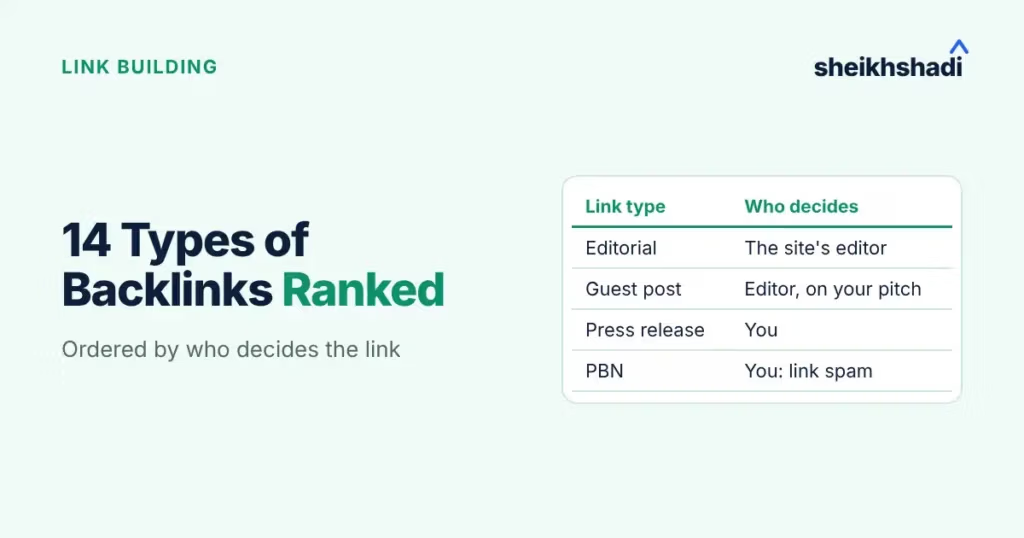
The main types of backlinks are editorial, digital PR, resource-page, reclaimed, niche edit, guest post, partner, nofollow, directory, press-release, UGC, reciprocal, unqualified paid and PBN or spam links. Editorial links rank first because the linking site chooses to link to you without being asked. The order holds when the linking page covers your topic, since relevance is one of the three questions behind it.
How this list is ranked
Each type is ordered by the same three questions. This is an editorial framework for comparing types, not a score from Google, Ahrefs or any other tool.
- Who decides the link? The more the linking site’s editor decides on their own, the higher the type sits. Types where you write the page or place the link yourself sit lower.
- Is the linking page about your topic? Types that start from a page on your subject sit above types where the link can land on any page.
- What do Google’s documents say about it? Types Google doesn’t flag sit highest. Types marked with a rel label, or named as spam only under stated conditions, sit in the middle. Types Google names as link spam sit at the bottom.
Not being named by Google is not a pass. Google’s spam policies define link spam by its purpose. In Google’s words, it is “the practice of creating links to or from a site primarily for the purpose of manipulating search rankings.” Any type on this list can cross that line if manipulation is why the link exists.
Google wording in each entry comes from two Google pages: the spam policies (updated 28 August 2026) and the guide to qualifying outbound links (updated 10 December 2025). Both were checked on 8 November 2026.
| # | Type | Who decides | Google’s wording |
|---|---|---|---|
| 1 | Editorial | The linking site | Not flagged |
| 2 | Digital PR and expert quotes | Journalist or editor | Not flagged |
| 3 | Resource page | Page curator | Not flagged |
| 4 | Reclaimed and unlinked mentions | Site that mentioned you | Not flagged |
| 5 | Niche edit | Site owner, on request | Named if bought for ranking |
| 6 | Guest post | Editor, on your pitch | Named with optimized anchors |
| 7 | Podcast, webinar, partner | Host or partner | Named if only for cross-linking |
| 8 | Nofollow editorial | The linking site | Labelled |
| 9 | Directory or listing | Directory, on submission | Named if low quality |
| 10 | Press release | You | Named with optimized anchors |
| 11 | UGC and community | You | Labelled; named if optimized |
| 12 | Reciprocal exchange | You and a partner | Named if excessive |
| 13 | Paid, unqualified | You, by paying | Named as link spam |
| 14 | PBN, automated, spam | You | Named as link spam |
Dofollow, nofollow, sponsored and ugc are labels, not types
These four words describe how a link is marked in the HTML, not how you got it. Any type in the ranking can carry one of them.
- sponsored: Google’s guide to qualifying outbound links asks sites to mark ads and paid placements with this value.
- ugc: recommended for links inside user-generated content such as comments and forum posts.
- nofollow: for links where the other values don’t apply and the site would rather Google not associate it with the linked page or crawl that page from the site.
- “Dofollow”: not a real attribute. It is shorthand for a link that carries none of the three values.
Sites can combine values in one rel attribute. Google says links marked with these values will generally not be followed, though the linked page can still be found through other routes. The guide to dofollow vs nofollow backlinks covers what each label means for a link’s value.
The 14 types of backlinks, ranked from strongest to weakest
1. Editorial links
An editorial link is one a site adds on its own because your page helps its readers. You didn’t pitch, pay or trade for it, which makes it the clearest yes on question one.
Example (illustrative): a product analytics blog links your original churn data in a post about retention benchmarks.
Google’s wording: not flagged. A link an editor chose for readers is not a link created primarily to manipulate rankings. The guide to editorial links covers what earns them.
2. Digital PR and expert-quote links
These come from journalists or editors who cite your data, survey or expert comment in a story. You supply the material, while they decide whether to use it and whether to link.
Example (illustrative): a trade publication quotes your head of security in a piece on breach costs and links your report.
Google’s wording: not flagged. Original data or tools built to attract citations, sometimes called link baiting, give journalists a reason to link.
3. Resource-page links
Resource pages are curated lists of useful tools, guides or references on one subject. You can suggest your page, but the curator decides whether it belongs on the list.
Example (illustrative): a marketing association’s page of free planning templates adds your budget calculator.
Google’s wording: not flagged. The weak version is a “resource” page that lists any site that asks, which looks more like the low-quality directories Google does name.
4. Reclaimed links and unlinked mentions
Reclaimed links restore links that broke, for example after a site moved its pages. Unlinked mentions are pages that already name your brand without linking, where you ask the author to add the link.
The site has already chosen to write about you, so the editor still decides. That keeps both close to editorial links on question one.
Example (illustrative): a review site restructured its URLs, which broke its link to your pricing page. You ask them to update it.
Google’s wording: not flagged. The guides to link reclamation and unlinked brand mentions walk through finding both.
5. Niche edits (link insertions)
A niche edit adds your link to an article that’s already published on another site. You request the placement, then the site owner decides whether it fits the existing piece.
Example (illustrative): an existing post on remote-team tools gains a sentence pointing to your time-zone planner.
Google’s wording: niche edits aren’t named as a type. The link spam examples do include buying or selling links for ranking purposes, so how a placement was arranged matters more than the label. The guide to niche edits covers what separates a relevant insertion from a forced one.
6. Guest post links
A guest post is an article you write for another site, with a link back to you in the body or author bio. The editor accepts or rejects the pitch, but you choose the topic, the link target and the anchor.
Example (illustrative): a SaaS founder writes about onboarding emails for a marketing blog and links a template page.
Google’s wording: guest posts aren’t named on their own. Google’s link spam examples include links with optimized anchor text in guest posts or press releases distributed on other sites. They also list “Advertorials or native advertising where payment is received for articles that include links that pass ranking credit” as link spam.
The conditions are the anchor text, the payment and whether the link passes ranking credit, not the guest post format itself. The guest posting guide goes deeper on pitching and anchors.
7. Podcast, webinar and partner links
These come from appearances and relationships: show notes after a podcast interview, a co-hosted webinar page or an integration partner’s app listing. The host or partner decides what to publish.
They rank under guest posts because the linking page is about the show or the partnership rather than your subject. That lowers the answer to question two.
Example (illustrative): a CRM’s integrations page lists your app with a short description and a link.
Google’s wording: Google names partner pages made exclusively for the sake of cross-linking. A link tied to a real integration or a real appearance doesn’t fit that description.
8. Nofollow editorial links
A nofollow editorial link is chosen by an editor but marked rel=”nofollow”. Some publishers mark every outbound link this way by policy.
Example (illustrative): a national news site cites your survey with a nofollow link.
Google’s wording: labelled. Google says links with these values will generally not be followed. It sits below types 5 to 7 because its label asks Google not to associate the linking site with your page. The link still sends readers to you from a relevant page, which is why it sits above the types where you place the link yourself.
9. Directory and business listing links
These are profiles on business directories, industry listings and software review platforms. You submit the listing, then the directory approves it.
Example (illustrative): your product profile on a category review platform links to your site.
Google’s wording: Google lists low-quality directory or bookmark site links among its link spam examples. The condition is low quality, so one practical test, ours rather than Google’s, is whether real buyers in your field use the directory to find vendors.
10. Press-release links
These are links inside a press release you write and send through a distribution service, which republishing sites then copy. You decide every word, so question one scores low.
Example (illustrative): a funding announcement syndicated to dozens of newswire pages.
Google’s wording: links with optimized anchor text in press releases distributed on other sites are in Google’s link spam examples. The real value comes when a journalist picks up the news and writes their own story, which turns it into type 2.
11. UGC and community links
These are links you post yourself in forums, Q&A threads, community groups or blog comments. Sites are asked to mark them with rel=”ugc”.
Example (illustrative): you answer a question in a SaaS founders’ forum and link a guide that solves it.
Google’s wording: labelled when marked ugc. Google also lists forum comments with optimized links in the post or signature as link spam, so helpful answers with plain links are the version worth keeping.
12. Reciprocal link exchanges
What it is: two sites agree to link to each other, sometimes through a three-way swap that hides the trade.
The risk: Google’s link spam examples include excessive link exchanges along with partner pages that exist only for cross-linking. The condition is “excessive”, so two related sites citing each other for their readers is not the same as a swap arrangement.
The safer alternative: link out when it helps your readers, then earn links through types 1 to 4. The guide to reciprocal links explains where the line sits.
13. Paid links without rel=”sponsored” or rel=”nofollow”
What it is: a link exchanged for money, goods or services that passes ranking credit because it carries no rel label.
The risk: Google lists buying or selling links for ranking purposes as link spam. Its policy also says links bought for advertising or sponsorship are not a violation as long as they are qualified with rel=”nofollow” or rel=”sponsored”.
The safer alternative: when a placement is an ad or a sponsorship, mark it rel=”sponsored”. For ranking value, rely on links a site gives by choice.
14. PBNs, automated links and profile or comment spam
What it is: a private blog network (PBN) is a group of sites one owner controls to point links at target pages. Automated links come from tools that post links at scale. Profile and comment spam drops links into user profiles and comment fields across many sites.
The risk: Google lists using automated programs or services to create links as link spam. A PBN exists to manipulate rankings, which is the definition of link spam itself. Google’s spam policies also cover user-generated spam added through channels meant for user content.
The safer alternative: check whether links like these already point at your site, then monitor your backlinks so new ones don’t build up unnoticed.
How to use this ranking on your own profile
Start with a backlink audit. Tag each referring page by type, then see how much of your profile sits in types 1 to 6 compared with types 10 to 14.
Weigh relevance alongside type. We prefer relevant linking pages updated within the last two years, though age alone doesn’t make a link weak. That’s our practice, not a Google rule.
Third-party scores such as Ahrefs’ Domain Rating or Moz’s Domain Authority are not Google metrics. Treat them as rough filters rather than the value of a link.
Then put your effort where the editor decides. Our link building services are built on editorial placements: 15,000+ editorial links on DR 50–90+ sites, for 50+ brands.
Curious which of these 14 types your current links fall into, or which ones your competitors have that you don’t? A free link gap analysis compares your backlink profile with theirs so you can see the editorial and PR gaps worth closing first. Request your free link gap analysis.