
Guest posting can still grow your brand and bring referral traffic from relevant audiences. It is not a dependable way to boost Google rankings: Google asks that links in contributed articles be qualified with nofollow or sponsored, and treats large-scale guest posting with keyword-rich anchors as link spam.
But success requires more than writing a blog and sending a cold email.
This comprehensive guide provides templates, tools, and actionable strategies you can implement immediately.
So, let’s get started.
What Is Guest Posting (and Why It Still Works in 2026)?
Guest posting involves writing and publishing articles on external websites or blogs within your industry. Think of it as being a guest speaker at a conference – you share expertise with new audiences while building reputation and authority in your field.
The Simple Definition: You create valuable content for another website’s audience, earning backlinks to your site, exposure to new readers, and opportunities to showcase expertise.
Guest posting works best as a brand and audience tactic, with links in contributed articles qualified as nofollow or sponsored.
How Guest Posts Help with SEO (E-E-A-T, Backlinks, Traffic, Credibility)
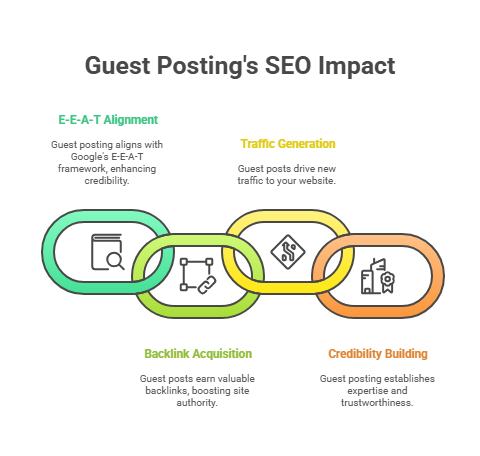
Google’s algorithm evolution hasn’t diminished guest posting effectiveness – it has refined what works. Guest posting aligns perfectly with Google’s E-E-A-T (Experience, Expertise, Authoritativeness, Trustworthiness) framework.
Backlinks That Matter: Publishing on reputable industry sites earns contextual, relevant links from trusted sources – exactly what Google considers “votes of confidence.”
Traffic That Converts: Guest posting drives targeted traffic from audiences already interested in your topic, resulting in higher engagement rates and better conversion potential.
Authority Building: Each high-quality guest post positions you as an industry expert. When people see your byline on respected publications, trust builds before they visit your website.
Experience and Expertise Signals: Consistently contributing valuable content across multiple platforms demonstrates both knowledge depth and experience breadth – key E-E-A-T components.
What Google Says About Guest Posting
Guest posting is fine for exposure, but Google does not treat it as a ranking shortcut. Google’s spam policies list large-scale guest posting campaigns with keyword-rich anchor text links as link spam. The distinction lies in quality, intent and how the link is qualified.
In 2020 Google’s John Mueller said that links in guest posts you supply should be qualified with nofollow or sponsored, and that links placed purely for SEO carry little to no value (Search Engine Journal). The real payoff of a good guest post is audience, referral traffic and brand recognition.
Editorial, earned links count as genuine endorsements. Links you place yourself inside a contributed article should be nofollow or sponsored. High-quality guest posts that give readers real value and match the host site’s editorial standards still make sense as a brand and thought leadership tactic.
How to Find High-Quality Guest Posting Opportunities
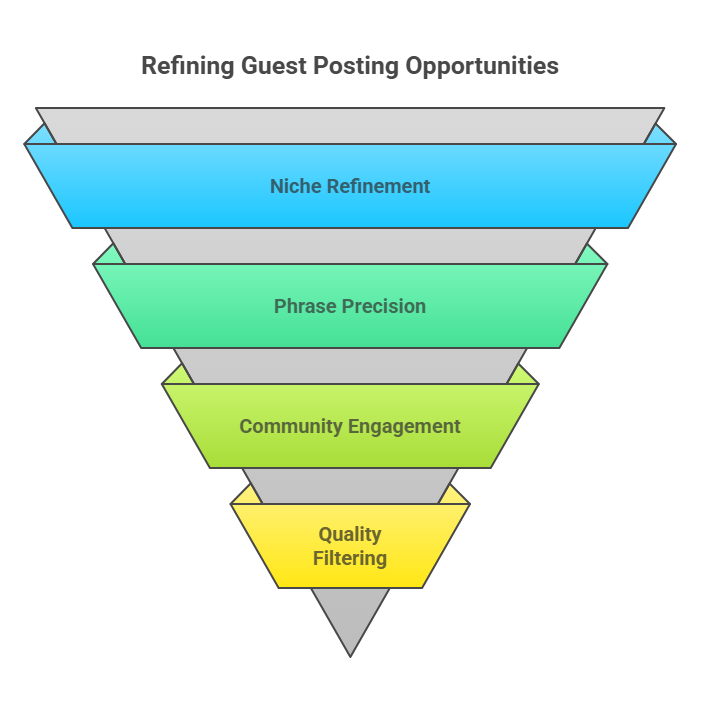
Finding valuable guest posting opportunities requires strategic prospecting. Success comes from separating high-value opportunities from time-wasting pitfalls. Here are three proven methods that work in 2026.
1. Use Google Search Operators
Google search operators help uncover guest posting opportunities competitors might miss. These specific commands find sites actively seeking contributors.
Essential Search Operators:
- “write for us” + [your niche] – Example: “write for us” digital marketing
- “guest post” + [your niche] – Example: “guest post” fitness
- “submit a guest post” + [your niche]
- “guest author” + [your niche]
- “accepting guest posts” + [your niche]
- inurl:guest-post + [your niche]
- inurl:write-for-us + [your niche]
Pro Tip: Try niche term variations. If you’re in “content marketing,” also search “digital marketing,” “online marketing,” and “marketing strategy” to expand opportunity pools.
Advanced Operator Techniques:
- Use quotation marks for exact phrases
- Add site:reddit.com to find guest posting discussions in your niche
- Use minus operator (-) to exclude low-quality sites
2. Reverse Engineer Competitor Backlinks
Your competitors have already identified quality guest posting sites. Analyze where they publish and approach those sites with superior content.
Free Tools:
- Ubersuggest: Limited free backlink analysis perfect for beginners
- Google Search Console: View referring domains if competitors link to your site
- Ahrefs Free Backlink Checker: Free backlink data for any domain
Paid Tools (Worth the Investment):
- Ahrefs: Industry standard for backlink analysis with excellent Content Explorer feature
- SEMrush: Superior competitive analysis and linking domain discovery
- Majestic: Outstanding link quality and authority metrics
Step-by-Step Process:
- Enter competitor domains into your chosen tool
- Look for links inside blog posts or articles rather than sitewide or footer links
- Look for links from blog posts or articles (avoid directory listings)
- Check if linking domains accept guest posts via “write for us” pages
- Create spreadsheets to track promising opportunities
3. Leverage AI-Powered Prospecting Tools
AI-powered tools have revolutionized guest posting by automating tedious prospecting work. These tools find opportunities and help manage entire outreach processes.
Top AI-Powered Tools:
- Respona: Uses AI for prospect discovery and personalized outreach angle suggestions
- Pitchbox: Combines prospecting with relationship management and interaction tracking
- BuzzStream: Excellent for building long-term editor and site owner relationships
- OutreachMama: Specializes in guest posting with extensive opportunity databases
Scaling Outreach with AI + CRM Integrations:
- Automated Prospect Scoring: Set rules for automatic scoring based on domain authority, traffic, and relevance
- Personalized Email Sequences: AI personalizes outreach based on recent posts, social activity, and mutual connections
- Follow-up Automation: Create sequences with optimal interval follow-ups without being pushy
- Performance Tracking: Monitor open rates, response rates, and conversions for continuous improvement
How to Qualify Guest Posting Sites (Avoid Wasting Time)
Not all guest posting opportunities provide value. Publishing on wrong sites can actually harm SEO efforts. Use this qualification process before investing time in content creation or relationship building.
5-Question Quick Checklist
1. Is it in your niche or relevant industry?
Relevance remains crucial in 2026. Backlinks from highly relevant industry sites tend to be more useful than links from unrelated high-authority sites.
What to Look For:
- Content directly relating to your expertise area
- Audiences that would genuinely benefit from your knowledge
- Topics naturally allowing expertise demonstration
Red Flag: General “business” or “lifestyle” blogs accepting content on any topic – often low-quality link farms.
2. Does the site have traffic (check with SimilarWeb)?
Beautiful websites mean nothing without readers. Ensure guest posts reach real people, not just search engine crawlers.
Traffic Checking Tools:
- SimilarWeb: Free basic traffic estimates
- Ahrefs: Site Explorer shows organic traffic estimates
- SEMrush: Traffic analytics and trending data
Target Numbers:
- Minimum 2,000+ monthly organic visitors (our vetting rule at Sheikh Shadi)
- Consistent or growing traffic trends over 6 months
3. Is the content editorially sound (not spammy)?
Spend 10 minutes reading site content. This audit prevents association with low-quality sites harming your reputation.
Quality Indicators:
- Well-written, grammatically correct content
- Articles providing genuine reader value
- Proper formatting with headers, bullet points, images
- Author bios and publication dates
- Engaged reader comments
4. Does it have a real audience or email list?
Social media engagement and email signup forms indicate genuine audiences. Look for:
- Active social profiles with real engagement (not just followers)
- Newsletter signup forms or lead magnets
- Regular publication schedules
- Comments on recent articles
- Author responses to comments and social mentions
5. Will your link be editorial and clearly disclosed?
Google asks that links in articles you contribute be qualified with nofollow or sponsored, so judge a site by its audience, not by link attributes. Confirm upfront that:
- Your link follows the site’s editorial policy (nofollow or sponsored is normal and expected)
- You can include 1-2 contextual links within article content
- Links won’t be relegated to author bios only
- You are not asked to use keyword-rich anchor text
How to Pitch Guest Posts That Get Accepted (Free Template Below)
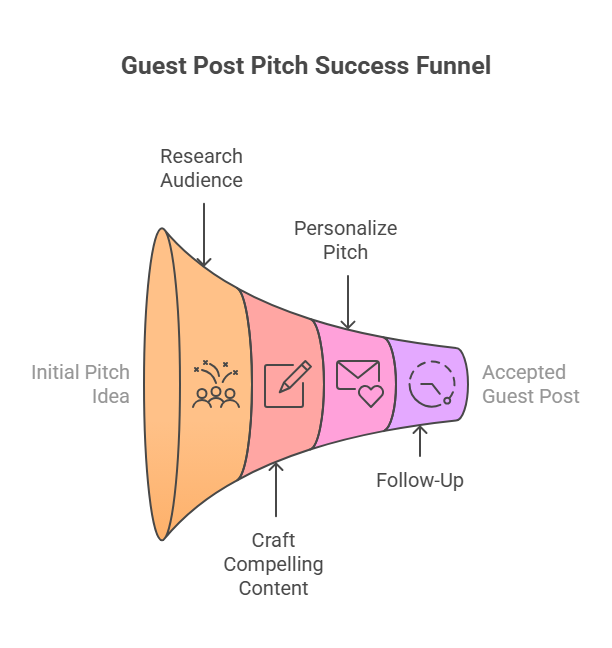
The difference between ignored and enthusiastically accepted guest post pitches comes down to key elements. Here’s what to include.
1. What Makes a Great Guest Post Pitch?
Great guest post pitches share three characteristics: they’re personal, valuable, and respectful of editor time.
Personalize it: Reference Their Recent Posts
This demonstrates you’re not sending mass emails. Spend 5-10 minutes browsing recent content and find genuinely interesting commentary points.
Good Personalization Examples:
- “I loved your recent piece on AI content tools – especially the point about maintaining human creativity.”
- “Your article about email deliverability issues resonated with our recent client challenges.”
- “I noticed you haven’t covered [specific topic] yet, which might be perfect for your audience.”
Offer Ideas That Fit Their Audience + SEO Goals
Your pitch should clearly show how content benefits their readers. Think like an editor: what would increase audience engagement and sharing?
Strong Angle Examples:
- “5 [Current Year] Updates to [Topic] That Most Experts Miss”
- “How [Your Industry] Professionals Can [Achieve Specific Outcome] in [Timeframe]”
- “The [Tool/Strategy] That Helped Us [Specific Result] (With Screenshots)”
Short, Respectful, and Clear
Editors are busy. Initial pitches should be skimmable and direct. Save detailed explanations for after they express interest.
2. Guest Post Pitch Email Template (Copy + Paste)
Here’s a template that consistently gets positive responses:
Subject: Quick guest post idea for [Blog Name]Hi [First Name],I've been reading [Site Name] for a while - loved your recent post on [Specific Topic]! I had a few guest post ideas I thought your audience might find valuable:1. [Specific, Actionable Title That Addresses Reader Pain Point]2. [Data-Driven Title With Concrete Numbers or Results]3. [Timely Topic That Builds on Your Recent Content]Each would be 1,500-2,500 words, include original examples/case studies, and provide actionable takeaways your readers can implement immediately.Happy to write something detailed, actionable, and 100% original. I can also provide writing samples if helpful.All the best,[Your Name][Your Website or LinkedIn Link]P.S. I noticed [site name] hasn't covered [specific gap] recently - I'd love to fill that gap if useful for your audience.
Why This Template Works:
- Personal opener: Shows you actually read their content
- Multiple options: Provides choice and demonstrates strategic thinking
- Specific benefits: Focuses on audience value, not your SEO goals
- Professional but friendly tone: Builds rapport without being overly casual
- Clear next steps: Makes it easy to say yes
3. How to Follow Up (Without Being Annoying)
Most successful guest post placements require at least one follow-up email. Here’s the right approach:
Wait 5-7 Days Before Checking In
Give editors time to review pitches. They manage multiple contributors and have editorial calendars to consider.
Keep it Short and Friendly
Follow-ups should be shorter than original pitches:
Hi [First Name],Just wanted to follow up on my guest post ideas from last week. I know you're probably swamped with editorial planning.If none of those topics hit the mark, I'm happy to brainstorm other angles that might work better for [Site Name]'s audience.Thanks for your time![Your Name]
Follow-up Best Practices:
- Only follow up once, maximum twice
- Add value in follow-ups (new angles, recent industry news)
- Always provide easy outs (“No worries if timing isn’t right”)
- Consider social media engagement with their content
Best Practices for Writing High-Quality Guest Posts
Getting pitches accepted is just the beginning. Real success comes from creating content that exceeds expectations and builds lasting relationships with editors and audiences.
According to Google’s latest content guidelines, helpful content should demonstrate first-hand expertise and satisfy user intent completely.
1. Align with Their Editorial Guidelines
Think of yourself as a temporary team member, not an outsider sneaking in promotional content. The best guest posts feel like they were written by regular contributors.
Read 2-3 Existing Posts to Match Format & Tone
Every publication has unique voice and style. Analyze:
- Sentence structure: Short, punchy sentences or longer, complex ones?
- Heading style: Conversational questions or straightforward topic statements?
- Content depth: Comprehensive guides or quick tip lists?
- Example usage: Real-world case studies or general advice?
- Call-to-actions: How do posts typically end?
Don’t Over-Optimize Anchor Text – Keep it Natural
Many guest posts fail here. Resist keyword-heavy anchor text urges. Instead:
- Use natural, contextual anchor text making sense to readers
- Link to most relevant, helpful content (not just homepages)
- Limit to 1-2 total content links
- Ensure every link genuinely adds reader value
Good Example: “For detailed content planning strategies, check out our editorial calendar guide.”
Bad Example: “Learn more about content marketing strategies and SEO optimization techniques.”
2. Use AI Tools (The Right Way)
AI can accelerate guest post creation when used strategically. The goal is enhancing efficiency and creativity, not replacing unique expertise and voice.
Draft Fast with ChatGPT, Jasper, or Copy.ai
Smart AI Workflows for Guest Posting:
- Outline Generation: Create detailed outlines based on topic and target audience
- Research Assistance: Generate statistics lists, examples, or exploration questions
- First Draft Creation: Overcome blank page syndrome with rough drafts
- Alternative Angles: Request different topic approaches
Effective AI Prompts for Guest Posting:
- “Create detailed outline for 2,000-word guest post about [topic] for [target audience] including actionable tips and real-world examples.”
- “Suggest 10 compelling [industry] statistics for guest post in [publication type].”
- “Rewrite this section matching [specific publication] tone while maintaining key information.”
Edit for Voice, Accuracy, and Originality
AI-generated content is your starting point. Your expertise, unique perspective, and personal voice create value. Always:
- Fact-check every statistic and claim
- Add personal anecdotes and specific experience examples
- Ensure content matches your authentic voice and perspective
- Verify all information is current and accurate
- Add original insights only someone with your expertise could provide
3. Format to Win (Google + Reader Friendly)
Great formatting improves readability for humans and crawlability for search engines.
Short Paragraphs, Bullet Points, and Clear Headings
Online readers scan before reading. Make information easy to find:
- Paragraph length: Keep most to 1-3 sentences
- Heading hierarchy: Use H2s for main sections, H3s for subsections
- Bullet points and lists: Break dense information into digestible chunks
- Bold key points: Highlight important takeaways for scanners
- White space: Don’t fear empty space – it helps readability
Internal Links to Their Posts (Build Credibility)
This subtly shows you understand their content and audience:
- Link to 2-3 relevant posts from their site within content
- Ensure links are genuinely helpful and contextually relevant
- Use natural anchor text flowing with writing
- Shows editors you’ve researched and respect existing content
How to Track Performance from Guest Posts
Creating great guest posts is half the battle. Building sustainable guest posting strategies requires tracking what works and what doesn’t.
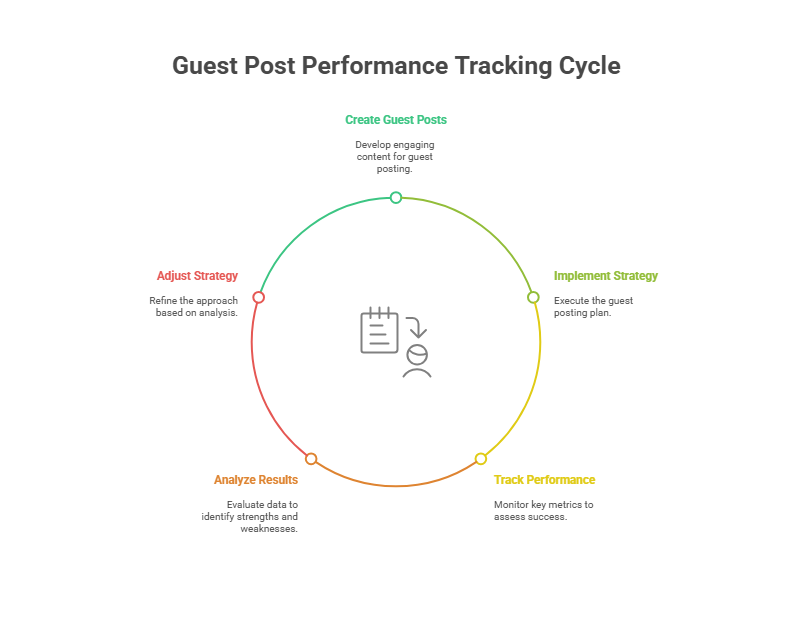
1. Use UTM Parameters for Links
UTM parameters turn vague traffic reports into actionable insights about exactly how much traffic and value each guest post generates.
Build with Campaign URL Builder
Google’s free Campaign URL Builder simplifies this process. For each guest post, create trackable links with these parameters:
- utm_source: Website name (e.g., “contentmarketinginstitute”)
- utm_medium: Always use “guest-post” for consistency
- utm_campaign: Specific article title or date
- utm_content: Which article link (if multiple)
Example URL:
yoursite.com/landing-page?utm_source=marketingland&utm_medium=guest-post&utm_campaign=seo-guide-q1&utm_content=mid-article-link
Track Traffic via Google Analytics
With UTM parameters set up, see exactly which guest posts drive the most valuable traffic:
- In GA4, go to Reports > Acquisition > Traffic acquisition and filter Session medium by guest-post
- Filter by “guest-post” medium to see all guest post traffic
- Compare bounce rates, session duration, and conversion rates across publications
- Identify which content types and publications drive highest-quality traffic
2. Monitor Backlinks
Not all publications keep links live forever. Regular monitoring catches issues early and measures long-term SEO impact.
Track with Ahrefs, Google Search Console, or Monitor Backlinks
Google Search Console (Free):
- Check “Links” section monthly for new referring domains
- Monitor link profile changes
- Identify most frequently used anchor text
Ahrefs (Paid but Powerful):
- Set alerts for new and lost backlinks
- Track “Domain Rating” of linking sites
- Monitor overall link profile health changes
Monitor Backlinks (Specialized Tool):
- Automated daily backlink checks
- Instant alerts when links are removed or changed to nofollow
- Detailed reports on link quality and anchor text distribution
3. Measure ROI
The ultimate question: are guest posting efforts actually moving business needles?
Leads / Traffic / Domain Rating / Keyword Lift
Traffic Metrics:
- Direct referral traffic from each guest post
- Overall organic traffic growth
- Quality metrics like time on site and pages per session from guest post traffic
Lead Generation:
- Email signups attributed to guest post traffic
- Demo requests or sales inquiries from referred visitors
- Social media followers gained from guest post exposure
SEO Impact:
- Domain Rating (Ahrefs) or Domain Authority (Moz) changes, checked monthly (Google does not use either metric)
- Keyword ranking improvements for target terms
- Overall organic visibility growth
Common Guest Blogging Mistakes (and How to Avoid Them)
Even experienced marketers make guest posting mistakes that waste time, damage relationships, or hurt SEO. Here are the most common pitfalls and complete avoidance strategies.
Poor Targeting (Wrong Audience or Site Quality)
The Mistake: Focusing on high domain authority numbers instead of audience relevance and engagement.
Why it Happens: It’s tempting to chase impressive DA scores, but high-authority sites in wrong niches won’t drive meaningful results.
How to Avoid It:
- Prioritize audience alignment over authority metrics
- Look for sites where ideal customers actually spend time
- Check social media engagement, not just follower counts
- Read comments on recent posts to gauge audience quality
Over-Promotion or Keyword Stuffing = Penalty Risk
The Mistake: Treating guest posts like advertorials instead of valuable content.
Warning Signs You’re Over-Promoting:
- More than 2-3 links back to your site (a practical rule of thumb, not a Google rule)
- Keyword-heavy anchor text sounding unnatural
- Content reading like sales pitches
- Author bios longer than paragraphs
The Safe Approach:
- Focus on providing value, with only subtle promotion
- Use natural anchor text enhancing reader understanding
- Link to genuinely helpful resources (not just service pages)
- Let expertise speak through valuable insights
Duplicate Content – Always Write Unique Material
The Mistake: Republishing same content across multiple sites or using content from your own blog.
Why it’s Dangerous: Duplicate content wastes the host site’s time. Google filters duplicates rather than penalizing them, and editors blacklist contributors submitting previously published material.
Best Practices:
- Write completely original content for each guest post
- Even covering similar topics, use different angles and examples
- Don’t republish guest posts on your site (wait several months minimum)
- Use plagiarism checkers like Copyscape before submitting
No Link Diversity – Relying Only on Guest Posts is Risky
The Mistake: Making guest posts your only link building strategy.
Why it’s Problematic: Google values diverse, natural link profiles. Too many guest post links can appear manipulative.
How to Diversify:
- Combine guest posting with resource page outreach
- Earn links through original research and data studies
- Build relationships leading to natural mentions and citations
- Create linkable assets like tools, templates, or comprehensive guides
Advanced Tips to Take Guest Posting to the Next Level
Once you’ve mastered basics, these advanced strategies help build guest posting programs that consistently drive results and position you as true thought leaders.
1. Build Guest Posting Partnerships
Instead of constantly prospecting for new opportunities, focus on building lasting relationships with core groups of high-quality publications.
Create Recurring Contributions with Trusted Blogs
How to Build Partnerships:
- Start with one exceptional guest post exceeding expectations
- Propose regular columns or series (monthly or quarterly)
- Offer help with their content needs beyond just your posts
- Share and promote their content on your channels
- Provide feedback and suggestions when requested
Benefits of Recurring Partnerships:
- Consistent, predictable backlink opportunities
- Stronger author authority through regular association
- Deeper audience relationships as readers recognize you
- Less time spent on outreach and relationship building
2. Use Structured Data (When Applicable)
Structured data is not a ranking boost, but Article schema can help search engines understand the page when host sites support it.
Offer Article Schema Where Allowed
When to Suggest Structured Data:
- Tutorial content with specific procedures
- Review or comparison articles
How to Approach It:
- Don’t assume host sites will implement it
- Offer to provide structured data markup
- Explain that it helps search engines understand the page, not that it boosts rankings
- Test markup before suggesting it
3. Turn Guest Posts into Evergreen Assets
Don’t let guest posting efforts exist in isolation. Smart marketers repurpose and amplify guest content across multiple channels.
Republish in Newsletters, LinkedIn Posts, or Lead Magnets
Repurposing Strategies:
- Newsletter series: Break comprehensive guest posts into weekly newsletter segments
- LinkedIn articles: Adapt guest post insights for LinkedIn’s professional audience
- Social media content: Turn key points into Twitter threads or Instagram carousels
- Lead magnets: Combine insights from multiple guest posts into comprehensive guides
- Speaking content: Use guest post research as foundation for conference presentations
Final Thoughts: Is Guest Posting Worth Your Time?
After exploring every guest posting aspect, the ultimate question remains: should you invest time and energy in guest posting in 2026?
The answer: Absolutely, if executed correctly.
Guest posting isn’t just about building backlinks anymore. It’s about building relationships, demonstrating expertise, and creating value for communities you want to join. When approached with this mindset, SEO benefits become natural byproducts of quality work.
Successful guest posting in 2026 is strategic, value-focused, relationship-driven, diverse, and measurable. The investment delivers high-quality backlinks improving search rankings, targeted traffic from interested audiences, industry recognition and thought leadership positioning, networking opportunities with experts and potential partners, and content assets for repurposing across multiple channels.
However, guest posting requires patience, persistence, and genuine expertise. It’s not a quick SEO hack or overnight traffic generation method. Brands and individuals succeeding with guest posting treat it as long-term relationship-building and authority-establishment strategies, understanding each post invests in reputation and industry standing.
Start small, focus on quality, and build from there. Your first guest post might not drive hundreds of visitors or dramatically improve rankings, but consistent, value-driven approaches can transform business online presence over time.
Prefer to have placements handled for you? See our guest posting service for done-for-you editorial guest posts.