
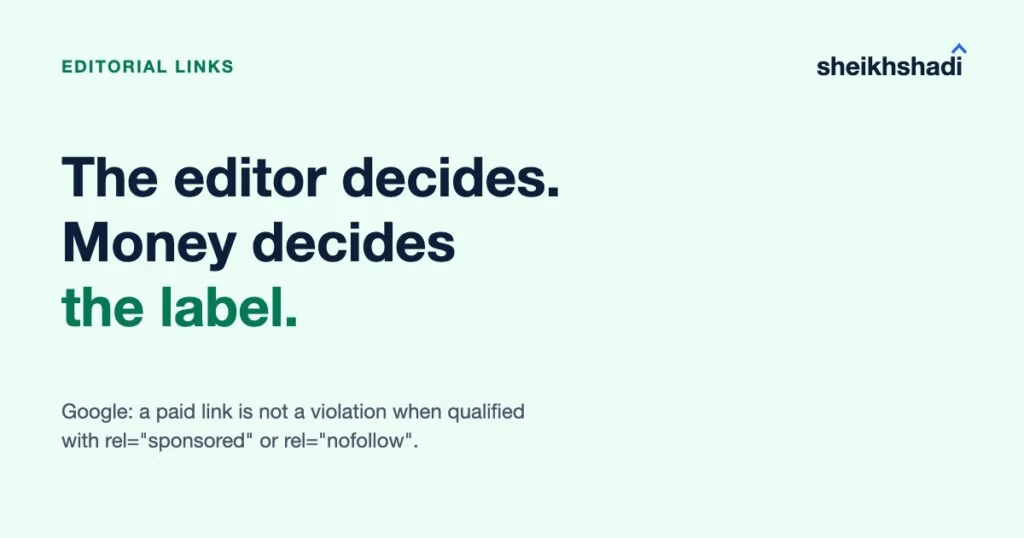
An editorial link is a link a publisher’s editor chooses to place in their own content because it helps their readers, with no money, goods or link swap given in return. That last part is what Google’s link spam rules focus on: Google’s spam policies list “Buying or selling links for ranking purposes” as link spam, while your outreach email asking for the link is not on that list.
So the first test is not “did anyone ask?” but “was anything exchanged?”. (Links can still be spam without payment, such as automated links or links in low-value content, but the exchange is where most people get it wrong.) And in my experience, the editorial link worth chasing hardest is the one on a page that already ranks.
What is an editorial link?
An editorial link sits inside the body of an article, review, study or news story and the site’s own editor decides it stays there. It is one type of SEO link (a backlink is any link from another site to yours); what makes it editorial is who controls it and why it is there.
Google’s own advice on earning links describes the same idea. Its Search Central help page says: “The key to getting links to your site naturally is to create unique, compelling content that other people want to link to.” The same answer warns that Google is good at detecting unnatural links “(for example, those that come from link-exchange schemes, paid links schemes, or are auto-generated)”.
Three traits mark a genuine editorial link:
- In-content placement: the link sits in a sentence that cites your data, tool, quote or page, not in a footer, sidebar or “partners” block.
- Editor control: the publisher’s editor can say no, change the anchor or remove the link.
- No exchange: nobody received money, a product or a reciprocal link for that link.
If you see “editorial backlinks” used as a service label, it usually means links placed inside editorial content through outreach, with the publisher’s editor approving them. I cover how we run that process on our link building service page.
Editorial links vs acquired links
Editorial links are often contrasted with links that are asked for, traded or paid for. For Google’s policies, the line sits somewhere else. Here is that split, mapped to what Google’s documentation says:
| How the link happened | Who decides it goes live | What Google’s documentation says |
|---|---|---|
| A writer finds and cites your page on their own | The publisher’s editor | Matches Google’s advice to create content “that other people want to link to” |
| You pitch a resource or expert quote, the editor accepts it, nothing is exchanged | The publisher’s editor | Asking is not on the link spam list |
| Money, goods or services change hands for the link | Varies | “Buying or selling links for ranking purposes” is link spam, unless the link is qualified with rel=”sponsored” or rel=”nofollow” |
| “Link to me and I’ll link to you” | Both sites | “Excessive link exchanges” are listed as link spam |
Notice row two. By that test, an accepted pitch with no exchange is still an editorial decision: the editor could have said no. That matters because most practical ways to earn these links involve asking someone.
Why editorial links matter for SaaS and B2B sites
For a SaaS or B2B site, editorial links do two jobs: they send readers who are already researching your category and they help the pages they point to compete in search. One example from our work: Testsigma grew from 8.9K to 256K monthly visits (+2,776%) over 23 months, with 575 links as a core part of the work alongside their content, documented in the Testsigma case study.
Not every editorial link is equal, though. In my experience, the outstanding find is a link on a page that already ranks: a page with its own keywords and organic traffic in Ahrefs. That page keeps getting read, so the link can keep sending readers. Most agencies skip these because finding them is hard work and doesn’t scale. A link on a strong domain, inside a page that gets zero search traffic, is weaker than its domain metrics suggest.
What is an example of an editorial link?
Editorial content is what a publication’s own team writes, edits and stands behind. Google’s spam policies use the phrase “Columns, opinion pieces, articles, and other work of an editorial nature” when describing content that does not break its site reputation policy. A link inside that kind of content, placed because it supports a point, is the classic example.
Real placements from my agency’s work include HubSpot, Namecheap and Canva. HubSpot’s guide to earning backlinks quotes me as the founder of Backlink Express, my link building marketplace. Across our client work, we have built 15,000+ editorial links on DR 50–90+ sites, for 50+ brands.
Other common forms:
- A journalist cites a statistic from your original study and links to the study.
- A how-to article links to your free calculator or template as the tool to use.
- A roundup quotes your founder and links to the company site.
- A writer who mentioned your brand adds a link after you point out the mention (see my guide to unlinked brand mentions).
How do you earn editorial links?
Editors link to things that make their article better. Every method below starts from that.
- Publish something worth citing. Original data, a free tool, a template or the clearest explanation of a hard topic. My link baiting guide covers which formats pull links and which don’t.
- Find pages that already link to similar resources. In Ahrefs, check who links to the older or weaker version of your asset, then show those editors the better one. Prioritise pages that already rank and get traffic.
- Answer journalist requests. Expert quotes on query platforms can put your name and link into news content. Pitch only queries where you have real expertise.
- Claim your unlinked mentions. If a site already names your brand, the editor has already judged you relevant. A short, polite note pointing to the right page is often enough.
- Build relationships with writers in your niche. Writers who know your work cite it when it fits their next piece.
Budget for several months. In my experience, first signs of improvement take at least 3 months and stronger results about 6 months and links work better once the site’s basic issues are fixed. My white hat link building guide goes deeper on outreach that stays inside Google’s rules.
Is buying backlinks illegal?
For search, this is a Google policy question, not a criminal one. Google’s spam policies class buying or selling links for ranking purposes as link spam, including “Exchanging money for links, or posts that contain links”. The same page also says Google “does understand that buying and selling links is a normal part of the economy of the web for advertising and sponsorship purposes” and that it is not a violation of its policies to have such links “as long as they are qualified with a rel=”nofollow” or rel=”sponsored” attribute value to the <a> tag.” Advertising disclosure rules are a separate legal matter that varies by country; I’m not a lawyer, so check those locally.
How much do backlinks cost?
A link an editor gives freely has no link fee; its cost is the content, data or tool that earned it, plus outreach time. Agency outreach costs depend on volume and site strength and you can see our current packages on the pricing page.
How to tell if a link is really editorial
Two practical checks tell you whether a link is editorial. One recent change affects how you earn them.
1. The first test is the exchange, not the ask
Pitching journalists, bloggers or other sites is normal outreach. Google’s policy does not draw the line at asking. Its link spam list is about exchanges: “Exchanging money for links”, “Exchanging goods or services for links” and “Sending someone a product in exchange for them writing about it and including a link”.
Where people go wrong:
- Mixing paid links into an otherwise natural profile does not make them safe. Neither does sending bloggers free products for reviews that link back: Google lists the product-for-link swap by name as link spam.
- “Editorial links” and “niche edits” are not the same thing, even though the terms are sometimes used as synonyms.
- No link type is safe by its label alone. What was exchanged matters most.
- Paid links need rel=”sponsored” (Google’s preferred value) or rel=”nofollow”.
Use this three-question test on any link, yours or a vendor’s:
- Who decided the link goes live? If not the publisher’s editor, it isn’t editorial.
- Was anything exchanged for the link? Money, a product, a service or a link back. If yes, Google’s link spam list applies.
- If something was exchanged, is the link qualified? Google’s policies say paid links are not a violation “as long as they are qualified” with rel=”nofollow” or rel=”sponsored”. An unqualified link that was paid for is exactly what the policy describes.
Google’s policy is about links that pass ranking credit, so changing a paid link’s anchor to your brand name does not fix it. The fix is removal or the rel qualifier. If you are vetting vendors, my guide to link building scams lists the red flags.
2. You can check a link’s label in under a minute
You can check how a link is labelled. Google’s guide to qualifying outbound links defines the labels: “Mark links that are advertisements or paid placements (commonly called paid links) with the sponsored value”; “ugc” is recommended for user-generated content such as comments and forum posts; and “nofollow” is for “when other values don’t apply”. It also notes that links marked with these rel attributes “will generally not be followed”.
To check: right-click the link, choose Inspect and read the rel attribute on the <a> tag. Then read the page around it for “sponsored”, “partner” or “advertisement” labels. An editorial link can carry nofollow (some publishers apply it sitewide), so nofollow alone doesn’t prove a link was paid. A sponsored label does tell you the publisher treats it as a paid placement. My dofollow vs nofollow guide explains what each attribute means for SEO.
3. HARO is back, under new owners
HARO used to be a free Cision service that emailed sources three times a day. That changed: Featured.com announced on 16 April 2025 that it had acquired HARO from Cision, saying HARO “will be revived” and “will remain free for journalists and sources, supported by newsletter ads.” Check the current sign-up process on HARO’s own site before you build a journalist-request routine around old instructions.
My verdict on editorial links
Earn editorial links with assets editors want to cite, judge every link by the three-question test and put your effort into pages that already rank. That suits SaaS and B2B teams with real expertise, data or a product people can write about. It doesn’t suit anyone who needs a fixed number of links next week; editors say no and that is the point.
If you’d rather hand the outreach to a team, that’s what we do. Our fee covers the work: research, content and outreach. It doesn’t buy the link. We don’t pay publishers for placements and the publisher’s editor decides whether each link is published. You pay upfront per link or package; a link that doesn’t go live is replaced or refunded in full and every live link has a 6-month replacement guarantee.
Want to know which editorial links your competitors have that you don’t? Request a free link gap analysis.