
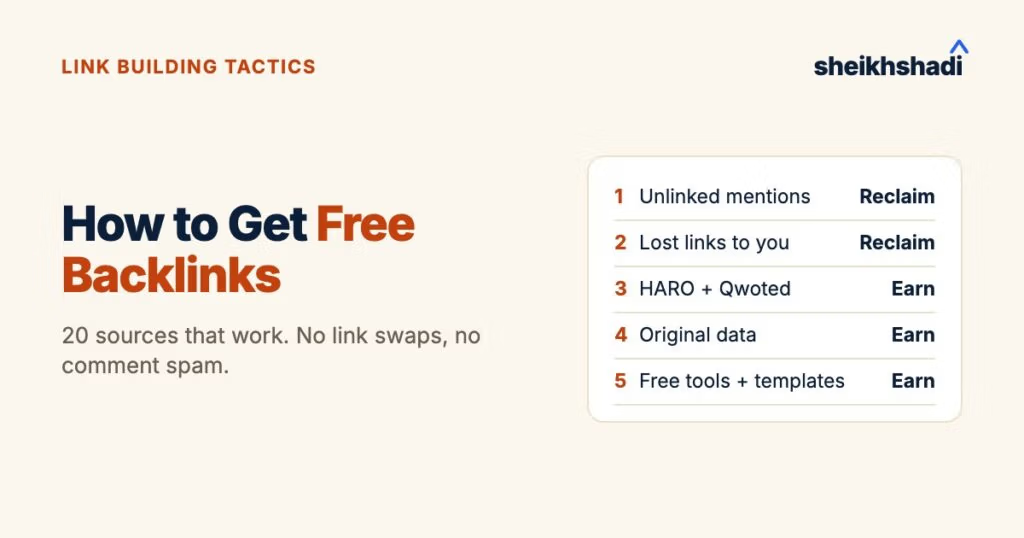
You get free backlinks by giving another site a reason to link to you: a brand mention you can claim, an expert answer a journalist needs, a useful asset or a real business relationship. They cost time instead of money. The catch: profile, directory and comment links from bulk “free backlink site” lists can carry a nofollow or ugc label, or match the link spam examples in Google’s spam policies.
The 20 sources that hold up are grouped by what you need to get them. Each one is worth more to a SaaS or B2B team than a bulk list of profile sites.
| # | Source | What you need |
|---|---|---|
| 1 | Unlinked brand mentions | A brand people already write about |
| 2 | Lost and broken links to your pages | Access to your redirects |
| 3 | Integration and partner directories | A real integration or partnership |
| 4 | Vendors you already pay | An honest testimonial |
| 5 | HARO | Fast, specific expert answers |
| 6 | Qwoted and #journorequest | The same, on more channels |
| 7 | Podcast guest spots | Something worth 30 minutes of talk |
| 8 | Guest articles on real publications | Writing time and a fresh angle |
| 9 | Speaker pages | A talk, panel or webinar slot |
| 10 | Co-marketing with partners | A partner with an overlapping audience |
| 11 | Interviews and expert roundups | Contacts and editing time |
| 12 | Original data | Data or a survey others can cite |
| 13 | Free tools and templates | Something small that solves one job |
| 14 | Images and charts | Original visuals people reuse |
| 15 | Resource pages | A page that deserves the list |
| 16 | Broken link building | A live page that replaces a dead one |
| 17 | Open-source projects and docs | Code or documentation developers use |
| 18 | Software review and launch sites | A product and real customers |
| 19 | Company profiles | Consistent company details |
| 20 | Community answers | Genuine expertise and patience |
What counts as a free backlink
A free backlink is one a site gives you because your brand, answer or asset deserves it, with nothing sent in return. Watch the grey area of “free” product reviews: Google’s spam policies list sending someone a product in exchange for a write-up that includes a link as an example of link spam. A link like that should carry rel="sponsored" or rel="nofollow". Google’s guide to qualifying outbound links names sponsored as the preferred value.
The same guide covers two other labels you will meet on free links. Google recommends ugc for user-generated links such as comments and forum posts. It suggests nofollow where no other value fits. It adds that links with these values will generally not be followed. That doesn’t make them worthless, since a nofollow link on a busy page can still send visitors. It does mean you should check the label before you count a link as an SEO win. In Chrome, right-click the link, choose Inspect and look for rel= in the highlighted code.
Links you can reclaim
Start here. These sources already know your brand, which keeps the ask short and easy to say yes to.
1. Unlinked brand mentions
Writers sometimes mention a tool, company or founder without linking to it. Set up a free Google Alert for your brand, product and founder names, then search Google for "YourBrand" -site:yourbrand.com once a month. When a positive mention has no link, email the author, thank them and suggest the exact page that would help their readers. Our guide to unlinked brand mentions covers the email itself.
2. Lost and broken links to your own pages
Sites that once linked to you may now point at a page you deleted or moved. Verify your site in Ahrefs Free (formerly Ahrefs Webmaster Tools; free for sites you own) and look for backlinks pointing at URLs that now return a 404 error. Redirect each dead URL to its closest live replacement, or ask the linking site to update the URL if the page is gone for good. This is link reclamation: it recovers links you already earned once.
3. Integration and partner directories
If your product integrates with another tool, check whether that tool has an app marketplace or integrations page. Expect to supply a description, a logo and a link to your setup docs. Agencies and resellers can ask for a listing on a vendor’s partner directory. Keep these real: Google’s spam policies name partner pages built “exclusively for the sake of cross-linking” as link spam, so a listing should exist because users need to find the integration.
4. Vendors you already pay
The software, hosting or service providers you use publish customer stories and testimonial pages. Offer a short testimonial or a case study with a real result. The vendor decides whether to credit you with a link, which keeps it a normal business mention instead of a trade.
Links you earn with expertise
These take time each week, but they put your name on publications you couldn’t reach by asking for a link directly.
5. HARO
Help a Reporter Out is back as an email of journalist requests. Featured.com bought it from Cision in April 2025 and relaunched it. The HARO site still offers free daily media queries to sources. Answer only the requests where you have first-hand knowledge, lead with the quotable line and keep it short enough to paste. Some outlets credit sources with a mention or a nofollow link, so judge the result by where your name appears as well as by the link.
6. Qwoted and #journorequest
Qwoted lets experts sign up at no cost; its paid plans add more pitch credits and remove a two-hour delay on pitches. Journalists in the UK also post requests on X under #journorequest. The same rules apply on every platform: answer fast, stay in your lane and add one detail the writer can’t get from a press release.
7. Podcast guest spots
Interview podcasts need a steady supply of guests. Before you pitch, check whether the show publishes show notes with links to its guests. Pick shows your buyers listen to, listen to one episode first and pitch two or three specific topics. Ask the host to link the page you discuss on air rather than only your homepage, but leave the anchor text to them.
8. Guest articles on real publications
Writing for an industry publication still earns editorial links when the site has an editor, real readers and a reason to publish you. Pitch an angle the site hasn’t covered and write the best piece you can. Google’s spam policies list links with optimized anchor text in guest posts distributed on other sites as an example of link spam, so keep the author bio link to your brand name. Our guest posting guide covers pitching and site selection.
9. Speaker pages for conferences, meetups and webinars
Events list their speakers with a bio, which can include a link to the speaker’s company. Local meetups and online summits are easier to join than large conferences. If you host a webinar with a partner, the partner’s event page becomes a link too.
10. Co-marketing with partners
A joint report, webinar or template with a company that sells to the same buyers gives both sides a reason to link to the shared asset. The link follows the content, so each partner links to the piece because their audience wants it. That is very different from swapping links between unrelated pages.
11. Interviews and expert roundups
Interview a respected practitioner, publish it well and let them know when it goes live. Experts featured in a piece have a reason to share it. Some will link to it from their own site or newsletter. Going the other way, accept interview requests from blogs in your niche and ask whether the published Q&A will link to your site.
Links you earn with assets
Assets take the most effort up front. The upside is that a good one keeps attracting links after the outreach stops.
12. Original data
Writers need numbers to back their claims. A survey of your customers, anonymised product usage data or a benchmark you update each year gives them something to cite. Publish the method and the sample size, put the key findings near the top and make each statistic easy to quote. Our guide to link baiting covers which formats earn citations.
13. Free tools, calculators and templates
A focused calculator, checker or template solves one job well enough that bloggers recommend it. It doesn’t need to be big. For a SaaS company, the best candidates sit next to the product: an ROI calculator for the problem you solve, a template your onboarding team already uses, a checker built on your own API.
14. Images and charts others reuse
Original diagrams, charts and screenshots can end up in other articles without credit. Run your best images through a reverse image search such as Google Lens. Where a site uses one without credit, ask politely for an attribution link to the source page.
15. Resource pages
Universities, associations, communities and niche blogs keep curated lists of useful resources. Search for "your topic" "useful resources" or "your topic" inurl:resources, check that the list is maintained and suggest a page that genuinely fits. A glossary, a free guide or a tool works better here than a sales page.
16. Broken link building
Find a dead outbound link on a relevant page, check what the missing page covered and offer your live page as a replacement. Ahrefs has a free broken link checker that flags dead outgoing links on a page or site. The pitch works only when your page truly replaces what was lost, so compare the two before you write.
17. Open-source projects and documentation
For developer tools, a small open-source library, an SDK or clear public docs earn links from tutorials, Stack Overflow answers and other projects’ READMEs. Developers link to the tools they rely on. Keep the docs on your own domain where possible, so the links build your site rather than a third-party host.
Profiles and listings: useful, small link value
These are worth setting up once, mainly because buyers look you up in these places. Treat any link value as a bonus.
18. Software review and launch sites
G2, Capterra and Product Hunt are where software buyers compare options, so a complete profile with real reviews matters for sales. Check the rel attribute on your profile link before you count it toward SEO; the main value is the buyers reading those reviews.
19. Company profiles
Your LinkedIn company page, Crunchbase profile and the few industry directories that review listings by hand let people find the same name, address and description wherever they look you up. Fill each one in completely and keep the details identical. Skip directories that accept anyone and exist only to sell listings.
20. Community answers
Reddit, Quora, Stack Exchange and niche Slack or Discord groups reward people who answer well. Share a link only when it answers the question better than a reply alone could. Follow each community’s self-promotion rules too. Google recommends that sites mark comment and forum links with rel="ugc", so inspect any link you get here and count it as traffic and visibility first.
Free backlink tactics to skip
Lists of “1,000+ free backlink sites” and backlink generators look like a shortcut. The tactics behind them match examples in Google’s spam policies.
| Skip | Do this instead |
|---|---|
| Mass directory and bookmark submissions. Google lists low-quality directory or bookmark links. | Hand-reviewed industry listings (source 19) |
| Profile, comment and forum signature links. Google lists forum comments with optimized links in the post or signature. | Helpful community answers (source 20) |
| Backlink generators. Google lists automated programs or services that create links to your site. | Reclaim mentions and lost links (sources 1 and 2) |
| Link exchanges. Google lists excessive exchanges and partner pages made only for cross-linking. | Co-marketing on a shared asset (source 10) |
| Web 2.0 networks and PBNs. They exist to pass links, which falls under Google’s link schemes and link spam policies. | One strong asset on your own site (sources 12 to 14) |
| Free products for a linked review. Google lists a product sent in exchange for a write-up that includes a link. | Disclose it and accept rel=”sponsored” or nofollow |
None of these need money, which is why they show up on free lists. The risk is that they build a pattern of links you didn’t earn. If you are unsure about a specific swap, our explainer on reciprocal links covers where normal linking ends and an exchange scheme starts.
How to judge a free link before you spend time on it
Free links still cost hours, so run four checks before you spend them:
- Relevance. Would your buyers read this page? We prefer relevant linking pages that have been updated within the last two years. Age alone doesn’t make a link weak, so we also look at relevance, current usefulness and site quality.
- Visibility. Look the page up in Ahrefs or a similar tool. Our practice is to look for linking pages with their own search visibility, judged alongside relevance and editorial quality. Don’t count on the link itself to send visitors.
- The rel label. Inspect the link. A nofollow or ugc label means the link is for visitors and brand exposure, so weigh it on that basis.
- The anchor. Where you get to choose, use your brand name. Most of the links we build use branded anchors and point to the homepage and landing pages, with about 20% going to blog posts. That is our allocation, not a rule you have to copy.
For the client placements my agency builds, the filters are stricter. When I vet a site, I check for at least 2,000 real monthly organic visitors, mainly from tier-1 English-speaking countries, with a stable or growing traffic trend. Those are our placement criteria, not a Google rule. A free link doesn’t have to clear that bar. A relevant link from a small, real site is still a good link.
How to track the free links you earn
Google Search Console’s Links report shows your top linking sites, top linked pages and top linking text. Google notes that it isn’t a comprehensive list of every link, so treat it as a sample. Ahrefs Free gives you a second view of the backlinks Ahrefs has found for sites you verify. Check monthly, thank the people who link to you and fix any link that lands on a broken page. For more options, see our comparison of backlink checker tools.
Treat free sources as a weekly habit: a few worked on steadily beat twenty tried once.
Not sure which of these 20 sources your competitors are already using? Ask for a free link gap analysis and we’ll show you the sites linking to them but not to you, so you know where to start.