

Link building has evolved dramatically in 2026, presenting both unprecedented challenges and remarkable opportunities for SEO professionals. According to Ahrefs’ research, 91% of web pages receive zero organic traffic from Google, largely because they have no backlinks and target topics with no search demand. If you’ve been struggling to secure quality backlinks that genuinely impact your search rankings, you’re facing the same challenge as millions of other website owners.
The landscape has shifted significantly from traditional link building tactics. What worked effectively in 2022 might now trigger algorithmic penalties or manual actions from Google. However, there’s encouraging news: mastering the current link acquisition ecosystem and implementing proven 2026 strategies can establish a sustainable backlink system that delivers measurable results.
What is Link Acquisition and Why It Matters
Understanding the Basics
Link acquisition represents the strategic process of earning high-quality backlinks from authoritative websites to your domain. Think of each backlink as a digital endorsement—a vote of confidence that signals to search engines that your content provides genuine value worth referencing.
The distinction between link acquisition and traditional link building is crucial. While link building often implies aggressive, sometimes manipulative tactics, link acquisition focuses on earning links organically through exceptional content and authentic relationship building. Naturally earned links tend to carry far more ranking power than artificially created ones.
This philosophical shift matters because modern search engines employ sophisticated machine learning algorithms capable of detecting artificial link patterns. Google’s RankBrain and subsequent AI updates can distinguish between earned credibility and manufactured authority, rewarding websites accordingly.
How Backlinks Boost Rankings and Authority
Backlinks remain among Google’s top three ranking factors, serving multiple critical functions in search engine optimization:
- Authority Transfer: High-authority sites pass meaningful authority to your domain through quality backlinks
- Relevance Signals: Contextual links from topically relevant sites help search engines understand your content’s subject matter and intended audience
- Content Discovery: Search engine crawlers use backlinks as pathways to discover, index, and rank new content across the web
- Trust Building: Links from established, trusted sources significantly increase your website’s overall credibility score
Pages with more referring domains consistently rank higher in Google search results. However, link quality dramatically outweighs quantity in 2026’s ranking algorithms.
A single backlink from a highly authoritative, topically relevant website can provide more SEO value than dozens of links from low-quality directories or irrelevant sources. This is why modern link acquisition prioritizes strategic quality over volume-based approaches.
White-Hat vs. Black-Hat Techniques
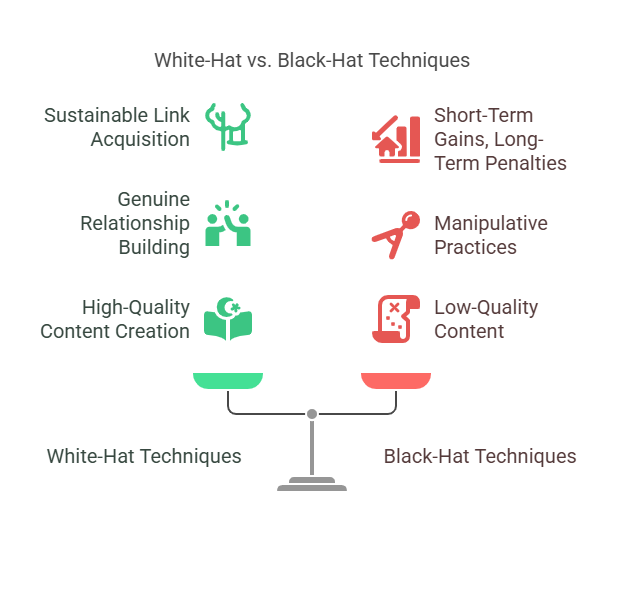
The line separating ethical and manipulative link building practices has become increasingly clear, with severe consequences for websites that cross into black-hat territory. Understanding this distinction is fundamental for sustainable SEO success.
White-hat link acquisition strategies include:
- Creating exceptionally valuable, linkworthy content that naturally attracts citations
- Building genuine, long-term relationships with industry peers and influencers
- Contributing high-quality guest content to relevant, authoritative publications
- Participating authentically in industry discussions, forums, and communities
- Conducting original research that becomes a reference source for others
Black-hat techniques to avoid completely:
- Purchasing links from link farms, private blog networks (PBNs), or low-quality directories
- Participating in excessive reciprocal linking schemes
- Using automated link building software or spam tools
- Creating fake social media profiles or personas for link building
- Engaging in negative SEO attacks against competitors
Websites employing black-hat link building techniques often face long ranking recovery times even after implementing corrective measures. The potential damage far outweighs any short-term gains.
What’s New in 2026: Link Acquisition Trends
The Role of AI and Automation in Link Building
Artificial intelligence has revolutionized link acquisition workflows, but not in the way many professionals initially anticipated. Rather than replacing human relationship-building, AI has enhanced the efficiency and precision of research, analysis, and personalization processes.
Current AI applications in link acquisition:
- Prospect identification through advanced content relevance analysis and linking pattern recognition
- Email personalization at scale while maintaining authentic, human-like communication
- Competitive backlink analysis to uncover previously hidden link opportunities
- Content gap analysis to identify linkworthy content topics in your industry
- Automated follow-up sequences that respect recipient preferences and timing
Agencies using AI-powered link prospecting tools often report higher response rates compared to purely manual outreach methods. However, the most successful campaigns combine AI efficiency with genuine human connection and relationship building.
The key principle is leveraging AI as a powerful research and efficiency tool while maintaining authentic human relationships. Automated outreach that feels robotic or impersonal consistently fails in today’s environment.
Google’s Latest Spam and Link Updates
Google’s algorithm updates throughout 2025 and early 2026 have specifically targeted link quality and manipulation detection. The search engine’s machine learning capabilities have become remarkably sophisticated at identifying unnatural linking patterns.
Recent Google updates have improved detection of:
- Unnatural anchor text distribution patterns across link profiles
- Low-quality guest posting networks designed primarily for link building
- Websites that exist solely to sell or exchange links
- Content created exclusively for link building purposes rather than user value
- Cross-linking schemes between related websites or PBNs
Following Google’s recent spam updates, websites focusing on earned, high-quality links have generally gained organic visibility, while sites with manipulative link profiles have lost ground.
These algorithmic improvements have actually benefited websites that prioritize quality link acquisition. By penalizing manipulative techniques more effectively, Google has created a more level playing field where authentic, valuable content and genuine relationships are properly rewarded.
Why Traditional HARO is Fading
Help a Reporter Out (HARO) once represented a goldmine for link builders, but its effectiveness has declined dramatically due to oversaturation and quality degradation. Journalist response rates to HARO pitches have fallen sharply in recent years.
The platform became flooded with low-quality, templated pitches from link builders who prioritized volume over relevance. Many journalists began ignoring HARO entirely, seeking more direct and authentic sources for their stories.
Effective HARO alternatives emerging in 2026:
- Direct relationship building with journalists through social media engagement and industry events
- Real-time social media monitoring for journalist requests and story opportunities
- Industry-specific PR platforms that maintain higher quality standards
- Creating genuinely newsworthy content that attracts organic media attention
- Building a media contact database through authentic networking and value provision
The fundamental lesson is that successful link acquisition requires moving beyond mass-appeal tactics toward personalized, value-driven relationship building. As popular tactics become oversaturated, the most successful practitioners focus on timeless principles of genuine value creation and authentic communication.
Proven Link Acquisition Strategies That Work Today
Guest Posting with Strategic Value
Guest posting remains viable in 2026, but it has evolved significantly from the volume-based approaches of previous years. Modern guest posting success requires strategic thinking, exceptional quality, and genuine value creation for host site audiences.
Effective guest posting in 2026 follows these principles:
- Deep audience research: Thoroughly understand the target site’s readership, content preferences, pain points, and engagement patterns
- Unique angle development: Propose fresh perspectives or data-driven insights that haven’t been covered extensively
- Value-first mindset: Prioritize helping the host site’s audience over simply securing backlinks
- Long-term relationship focus: Build ongoing partnerships rather than transactional, one-time exchanges
- Quality over quantity: Focus on fewer, higher-quality placements rather than mass submissions
Strategic, value-focused guest posts consistently generate more referral traffic and social engagement than traditional link-focused articles.
Successful guest posting opportunities often emerge from existing relationships and authentic industry engagement. Start by genuinely supporting target sites through social media engagement, thoughtful comments, and content sharing before proposing collaboration.
Content-Driven Link Magnet Techniques
The most sustainable link acquisition strategy involves creating content that naturally attracts backlinks due to its exceptional value, uniqueness, or utility. These “link magnets” work because they fulfill genuine needs that other content creators want to reference.
High-performing link magnet content types in 2026:
- Original research and industry studies: Proprietary surveys, data analysis, and trend reports that become industry references
- Comprehensive resource guides: In-depth, authoritative content that serves as the definitive source on specific topics
- Interactive tools and calculators: Practical utilities that solve specific problems for your target audience
- Industry trend analysis: Expert interpretation of current developments and future predictions
- Case studies with detailed results: Real-world examples with specific metrics and actionable insights
Long-form content and original research consistently earn more backlinks than shorter, general information posts.
The critical question for any potential link magnet is: “Would I naturally want to reference this content if I were writing about this topic?” If the answer is yes, you’re creating something with genuine link attraction potential.
Digital PR Campaigns with AI Tools
Digital PR has emerged as one of the most effective link acquisition strategies, particularly when enhanced with AI-powered research and targeting tools. This approach involves creating newsworthy content and proactively promoting it to relevant media outlets and influencers.
Successful digital PR campaign framework for 2026:
- Newsworthy content creation: Develop original research, industry surveys, or trend analysis with broad appeal
- AI-powered journalist targeting: Use advanced tools to identify reporters who cover your industry and analyze their content preferences
- Compelling story angle development: Focus on broader implications and industry insights rather than company promotion
- Multi-channel outreach strategy: Combine email outreach with social media engagement and relationship building
- Strategic follow-up sequences: Implement persistent but respectful follow-up campaigns
Data-driven PR campaigns and personalized pitches consistently outperform generic press releases and mass outreach.
AI tools excel at identifying the most relevant journalists, personalizing pitches at scale, and optimizing outreach timing. However, the human element—understanding what constitutes a compelling story—remains essential for campaign success.
Reverse Outreach Using Social Signals
Reverse outreach represents a strategic shift from traditional cold outreach to attracting inbound link opportunities. This approach leverages social media engagement and content promotion to build relationships with potential linking partners organically.
Reverse outreach strategy implementation:
- Create highly shareable, valuable content optimized for social platforms
- Strategically promote content across relevant social media channels and communities
- Actively engage with users who share, comment on, or discuss your content
- Build genuine relationships with engaged community members over time
- Provide additional value through direct messages, email, or continued social engagement
- Allow linking opportunities to develop naturally through established relationships
This approach succeeds because it begins with demonstrated interest rather than cold contact. When someone has already engaged with your content, they’re significantly more receptive to deeper relationship building and future collaboration opportunities.
Content creators using reverse outreach strategies often report notably higher link acquisition success rates compared to traditional cold email campaigns.
Link Acquisition Tools and Platforms Worth Using
Top AI-Powered Link Building Tools (2026)
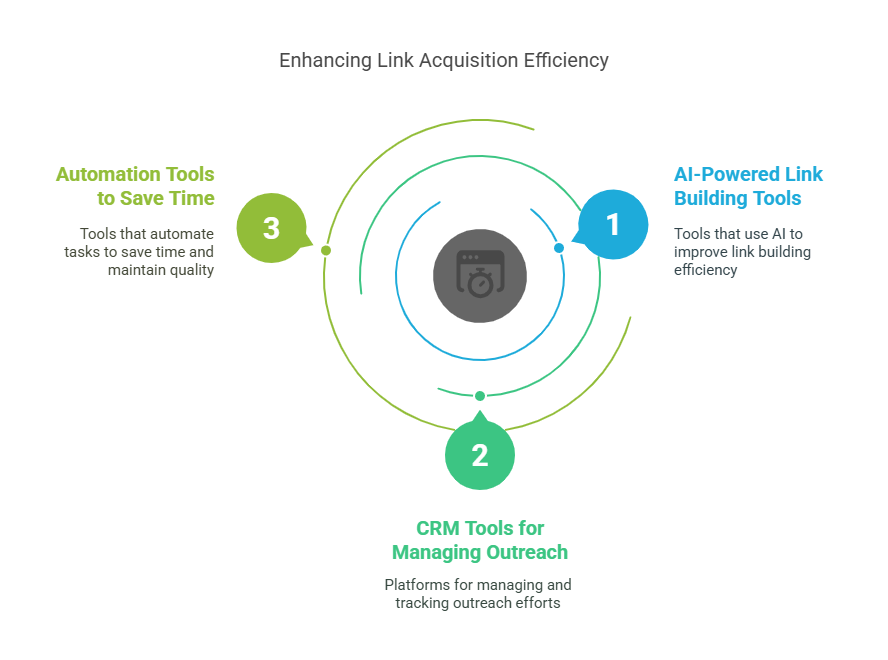
The right tools can dramatically improve link acquisition efficiency, but they’re only as effective as the strategy and human insight behind them. Here are the platforms making the most significant impact in 2026:
- Ahrefs: Remains the industry standard for backlink analysis, competitor research, and opportunity identification with enhanced AI-powered insights
- Pitchbox: AI-driven outreach platform that personalizes email campaigns at scale while maintaining authenticity
- BuzzStream: Relationship-focused platform emphasizing long-term connection building and campaign management
- Hunter.io: Email finder and verification tool with improved accuracy rates and integration capabilities
- Connectively (HARO replacement): Higher-quality alternative to traditional HARO with better journalist verification
- Featured: Premium PR platform connecting businesses with verified journalists and influencers
Agencies using integrated link building platforms often see better ROI than teams relying on fully manual processes.
Remember that tools should enhance your strategy rather than define it. The most successful link builders use technology to handle time-consuming research and administrative tasks while focusing human energy on relationship building and strategic thinking.
Best CRM Tools for Managing Outreach
Link acquisition success depends heavily on effective relationship management, which requires systematic tracking of interactions, follow-ups, and relationship development over time.
Essential CRM features for link builders:
- Contact segmentation by industry, website authority, relationship status, and engagement level
- Automated follow-up sequences that maintain personal touches and respect recipient preferences
- Integration with email platforms, social media, and other outreach tools
- Performance tracking for different campaign types and outreach strategies
- Relationship scoring based on engagement history and link potential
Top CRM platforms for link acquisition:
- HubSpot: Comprehensive relationship management with robust automation and integration capabilities
- Mailshake: Email-focused platform with strong personalization and follow-up features
- Ninja Outreach: Designed specifically for influencer and blogger outreach campaigns
- BuzzStream: Purpose-built for link building and PR relationship management
The key is choosing a platform that matches your team size, budget, and campaign complexity while providing room for growth as your link acquisition efforts scale.
Automation Tools to Save Time (Without Cutting Corners)
Effective automation in link building requires careful balance—automate the research and administrative tasks while keeping relationship building authentically human.
Tasks worth automating:
- Initial prospect research and contact information gathering
- Email template customization with personal details and company information
- Follow-up scheduling and reminder systems
- Performance tracking, reporting, and campaign analysis
- Social media monitoring for mention opportunities
Tasks that should remain human:
- Relationship building through genuine engagement and conversation
- Custom pitch creation for high-value prospects
- Content quality assessment and strategic decision making
- Creative problem solving and strategy adaptation
Link builders who automate strategically can save hours each week without a meaningful drop in response rates.
The goal is using automation to handle time-consuming, repetitive tasks so you can invest more energy in the high-value activities that require human creativity, empathy, and strategic thinking.
How to Measure the ROI of Link Acquisition
Key Metrics: DR, DA, Traffic, Relevancy
Measuring link acquisition success requires moving beyond simple link counting to assess the quality and business impact of earned backlinks. Modern SEO professionals focus on metrics that correlate with actual ranking improvements and business outcomes.
Essential link quality metrics:
- Domain Rating (DR) and Domain Authority (DA): Measure the overall strength and trustworthiness of linking websites
- Referral traffic volume: Track actual visitors coming through backlinks to assess real-world value
- Topical relevance score: Evaluate how closely related the linking site’s content is to your industry
- Link placement quality: Assess whether links appear in main content, sidebars, or footer locations
- Anchor text diversity: Monitor natural variation in how sites link to your content
- Follow vs. nofollow ratio: Balance of link types for natural profile appearance
Relevance-weighted link metrics tend to predict ranking improvements more accurately than raw domain authority scores.
Create a weighted scoring system that considers these factors based on your specific goals. A highly relevant link from a moderate-authority site often provides more value than an irrelevant link from a high-authority domain.
Trackable KPIs for Better ROI Analysis
To demonstrate the business value of link acquisition efforts, establish KPIs that clearly connect backlink campaigns to revenue and business growth metrics.
Business-focused link building KPIs:
- Organic traffic growth: Measure increases in search engine visitors to linked pages and overall site
- Keyword ranking improvements: Track progress on target keywords and related terms
- Conversion rate from organic traffic: Connect link-driven traffic to actual business outcomes
- Brand mention increases: Monitor how link acquisition affects brand awareness and online visibility
- Domain authority progression: Track overall site authority improvements over time
- Return on investment (ROI): Calculate revenue generated per dollar spent on link acquisition
Companies tracking business-focused link metrics are generally far more satisfied with their SEO investments than those focusing solely on vanity metrics.
Implement proper attribution modeling so you can trace business results back to specific link acquisition campaigns. This makes it much easier to justify continued investment and optimize future strategies.
Free and Paid Tools for Monitoring Backlinks
Consistent monitoring helps identify what’s working, catch potential issues early, and optimize ongoing link acquisition strategies.
Free monitoring options:
- Google Search Console for basic backlink data and search performance insights
- Bing Webmaster Tools for additional search engine perspectives
- Ahrefs free backlink checker for quick competitive analysis
- Google Analytics for referral traffic and conversion tracking
Premium tools for comprehensive monitoring:
- Ahrefs for detailed backlink analysis, competitor tracking, and historical data
- SEMrush for competitive intelligence and ranking correlation analysis
- Majestic for detailed link quality metrics and trust flow analysis
- Monitor Backlinks for automated tracking, alerts, and portfolio management
- Linkody for real-time notifications and link status monitoring
The key is establishing regular monitoring routines that catch both opportunities and potential problems before they significantly impact your SEO performance.
Protecting Your Site: Risk Management in Link Building
Identifying Toxic Links
Not all backlinks benefit your SEO—some can actively harm your search rankings. Learning to identify and manage toxic links is essential for maintaining healthy link profiles and avoiding algorithmic penalties.
Red flags indicating potentially toxic links:
- Links from websites with no topical relevance to your industry or content
- Backlinks from sites with extremely low domain authority or trust scores
- Links from websites that exist primarily to sell backlinks or participate in link schemes
- Backlinks with heavily optimized or unnatural anchor text patterns
- Links from sites in adult content, gambling, pharmacy, or other potentially problematic industries (unless relevant)
- Backlinks from websites with thin content, excessive advertising, or poor user experience
Most manual actions for unnatural links could be prevented through proactive toxic link identification and removal.
Regular link audits help catch these issues before they escalate into serious problems. While SEO tools provide toxicity scores, human judgment remains essential for making final decisions about link quality and risk levels.
Recovering from Penalties or Manual Actions
If your website receives a link-related penalty, recovery is possible but requires systematic approach and significant effort. The process demands thoroughness, documentation, and patience.
Link penalty recovery process:
- Comprehensive link audit: Analyze your entire backlink profile to identify all potentially problematic links
- Link removal efforts: Contact website owners to request removal of toxic or low-quality backlinks
- Documentation maintenance: Keep detailed records of all removal attempts, responses, and outcomes
- Disavow file creation: Use Google’s disavow tool for links that cannot be removed manually
- Reconsideration request submission: If you received a manual action, submit a detailed reconsideration request
- Ongoing monitoring: Continue monitoring for new toxic links and maintain clean link acquisition practices
Comprehensive cleanup efforts usually result in successful recovery, though the process often takes several months.
Recovery success depends on the thoroughness of your cleanup efforts and your commitment to maintaining white-hat practices going forward. Half-measures rarely result in full recovery.
Best Practices to Stay Google-Compliant
Following Google’s guidelines isn’t just about avoiding penalties—it’s about building sustainable, long-term SEO success that withstands algorithm updates and industry changes.
Core principles for Google-compliant link building:
- Focus on earning links through genuine value creation rather than manipulation
- Maintain natural anchor text diversity that reflects how people naturally link
- Avoid excessive reciprocal linking or obvious link exchange schemes
- Never participate in link farms, PBNs, or other artificial link networks
- Use appropriate rel=”sponsored” or rel=”nofollow” tags for paid or sponsored content
- Build links gradually over time rather than in sudden, unnatural spikes
When evaluating any link building tactic, ask yourself: “Would this backlink exist if search engines didn’t exist?” If the answer is yes, you’re likely following sustainable, white-hat practices.
Remember that Google’s algorithms continue evolving to better identify natural versus artificial link patterns. Staying ahead requires focusing on fundamental value creation rather than trying to game the system.
Link Acquisition for Niche and Global Markets
How to Build Links in Non-English SERPs
Expanding link acquisition efforts into international markets requires adapting strategies for different languages, cultures, and search engines. Success demands understanding local digital ecosystems and communication preferences.
Key considerations for international link building:
- Native language authenticity: Use native speakers for all content creation and outreach communications
- Cultural sensitivity: Understand local business practices, communication styles, and relationship-building norms
- Local search engines: Optimize for Baidu, Yandex, Naver, and other regional search platforms beyond Google
- Country-specific domains: Prioritize backlinks from relevant country code top-level domains (ccTLDs)
- Local content preferences: Adapt content formats and topics to match regional audience preferences
Localized link building campaigns consistently outperform translated versions of English-language strategies.
The fundamentals of value creation and relationship building remain constant, but execution must be culturally appropriate and locally relevant.
Localized Outreach Strategies
Successful international link acquisition requires deep understanding of local digital marketing ecosystems and relationship-building practices.
Effective localization approaches:
- Research popular local websites, influencers, and industry publications in your target market
- Understand regional content consumption patterns and preferred communication channels
- Adapt outreach timing to local business hours, holidays, and cultural considerations
- Partner with local agencies, freelancers, or consultants who understand the market intimately
- Participate in local industry events, conferences, and networking opportunities
- Build relationships within local business communities and professional associations
Don’t simply translate your English-language strategy—develop market-specific approaches that resonate with local audiences and business practices.
Using Country-Specific Tools and Directories
Each international market has unique tools, directories, and platforms that provide valuable link opportunities unavailable in English-language markets.
Local platform research priorities:
- Identify reputable local business directories and citation sources
- Find country-specific PR platforms and journalist databases
- Discover local equivalents of HARO and other link building platforms
- Understand dominant social media platforms and their role in content discovery
- Research local industry associations and professional organizations
These local platforms often provide better opportunities than forcing international platforms into regional markets where they may have limited adoption or effectiveness.
Expert Tips and Final Thoughts
Takeaways from SEO Pros
After analyzing successful link acquisition campaigns and interviewing dozens of SEO professionals, several consistent patterns emerge among top performers:
“Prioritize relationships over transactions” – The most successful link builders think in terms of 5-10 year relationships rather than immediate link exchanges. They invest time in genuine relationship building that naturally leads to ongoing collaboration opportunities.
“Content quality remains the foundation” – Every expert emphasized that exceptional content is non-negotiable for sustainable link acquisition. Without something genuinely worth linking to, even perfect outreach strategies fail consistently.
“Diversification prevents vulnerability” – Relying on any single link acquisition method creates dangerous dependencies. Successful practitioners combine content marketing, digital PR, relationship building, and strategic partnerships.
“Business metrics matter most” – The best link builders measure success through business impact rather than vanity metrics. They track conversions, revenue attribution, and brand awareness rather than just link counts.
Quick Wins for Faster Results
While sustainable link acquisition requires long-term commitment, several tactics can produce more immediate results to build momentum:
- Reclaim lost links: Use tools like Ahrefs to identify broken links pointing to your content and proactively contact site owners to restore them
- Update and promote evergreen content: Refresh popular older content with current information and re-promote it to previous linkers
- Leverage existing relationships: Audit current partners, customers, suppliers, and industry contacts for appropriate linking opportunities
- Create quick-win linkable assets: Develop simple tools, templates, or checklists that provide immediate value to your audience
- Fix technical issues: Ensure your site’s technical foundation supports link equity flow and provides excellent user experience
Executed systematically, these tactics can generate a meaningful batch of new quality backlinks within one to two months.
These approaches work because they either solve existing problems or leverage relationships and assets you’ve already developed rather than requiring extensive new content creation or outreach campaigns.
How to Keep Up with SEO in a Rapidly Changing Landscape
The SEO industry evolves continuously, and staying current is essential for link acquisition success in an increasingly competitive environment.
Essential information sources for ongoing education:
- Official Google communications: Google Search Central blog, John Mueller’s Twitter, and Search Off the Record podcast
- Industry communities: SEO Twitter, Reddit’s r/SEO, specialized Facebook groups, and professional forums
- Virtual conferences and webinars: Industry events offering insights into emerging trends and algorithm changes
- Continuous testing: Develop your own testing protocols to validate strategies for your specific industry and situation
- Professional networking: Build relationships with other practitioners to share insights and learn from diverse experiences
The core principles of effective link acquisition—creating exceptional value and building authentic relationships—remain constant across algorithm updates and industry changes. However, the specific tactics and tools continue evolving rapidly.
SEO practitioners who invest consistently in continuing education tend to achieve better campaign results than those who don’t prioritize ongoing learning.
FAQs About Link Acquisition
How long does it take to see results?
Link acquisition results typically begin appearing within 2-4 months of consistent effort, but significant ranking improvements often require 6-12 months of sustained campaign work. The timeline depends on several critical factors:
- Your website’s current domain authority and existing backlink profile strength
- The quality, relevance, and authority of newly acquired backlinks
- Competition levels for your target keywords and market space
- Overall website health, technical SEO foundation, and content quality
- Industry-specific factors and seasonal search behavior patterns
Sites with strong link acquisition programs generally see measurable ranking improvements within a few months, with impact continuing to build over the following year.
Focus on consistent, quality-driven link acquisition rather than expecting immediate dramatic changes. Search engines require time to discover new links, evaluate their quality and relevance, and incorporate them into ranking calculations.
What are the safest ways to build links?
The safest link building approaches prioritize earning backlinks naturally through genuine value creation and relationship building:
- Content-driven strategies: Create resources so valuable that industry peers naturally want to reference and cite them
- Digital PR campaigns: Share genuinely newsworthy research, data, or insights with relevant media outlets
- Industry relationship building: Engage authentically within your professional community through events, forums, and collaborations
- Strategic guest contributions: Provide exceptional content to relevant, high-authority publications that serve your target audience
- Business partnership marketing: Collaborate with complementary businesses on content projects and cross-promotional opportunities
These approaches work because they create real value for link partners and their audiences, making the backlinks natural and sustainable rather than purely transactional.
Should I buy backlinks in 2026?
Purchasing backlinks directly violates Google’s Webmaster Guidelines and can result in severe algorithmic or manual penalties that take months or years to recover from. Sites caught buying links frequently experience severe ranking decreases for their target keywords.
Instead of buying links, invest in legitimate strategies:
- Hire experienced content creators to develop genuinely linkworthy resources
- Invest in PR tools and campaigns to reach relevant journalists and influencers
- Attend industry conferences and events to build authentic relationships
- Partner with white-hat agencies specializing in earned link acquisition
- Develop proprietary research or tools that naturally attract citations
The cost of quality link acquisition through legitimate methods is often comparable to purchasing links, but the results are sustainable, penalty-free, and provide genuine business value beyond SEO.
Remember that Google’s link spam detection capabilities continue improving rapidly, making purchased links increasingly risky and less effective even when they initially avoid detection.
Recommended Tools and Communities
Essential tools for link acquisition success:
- Analysis and Research: Ahrefs, SEMrush, Majestic for comprehensive backlink research and competitive analysis
- Outreach Management: Pitchbox, BuzzStream, Ninja Outreach for campaign management and relationship tracking
- PR and Media Outreach: Connectively (formerly HARO), Featured, and industry-specific platforms for journalist connections
- Email and Communication: Hunter.io for contact discovery, Mailshake for campaign automation
Professional communities for ongoing learning:
- SEO-focused communities on Twitter, LinkedIn, Reddit, and Facebook for real-time industry discussions
- Major industry conferences like BrightonSEO, MozCon, Pubcon, and SMX for networking and education
- Local SEO meetups and digital marketing groups for hands-on learning and relationship building
Internal Links to Related SEO Topics
Expand your comprehensive SEO knowledge with these related strategic areas:
- Technical SEO fundamentals – Ensure your website foundation supports link equity flow and ranking improvements
- Content marketing strategy – Learn to create content that naturally attracts high-quality backlinks
- Professional SEO audits – Get expert analysis of your current link profile and optimization opportunities
Link acquisition represents just one component of a comprehensive SEO strategy. The most successful websites combine quality link building with excellent technical SEO implementation, valuable content creation, and superior user experience design.
Link acquisition in 2026 isn’t about manipulating search engine algorithms—it’s about building genuine value and industry relationships that benefit everyone involved. Focus on creating resources that truly serve your audience, engage authentically with your professional community, and maintain patience with the process. The backlinks you earn through these value-driven methods will prove more valuable and sustainable than any shortcuts could provide, building lasting authority that withstands algorithm updates and industry changes.


