
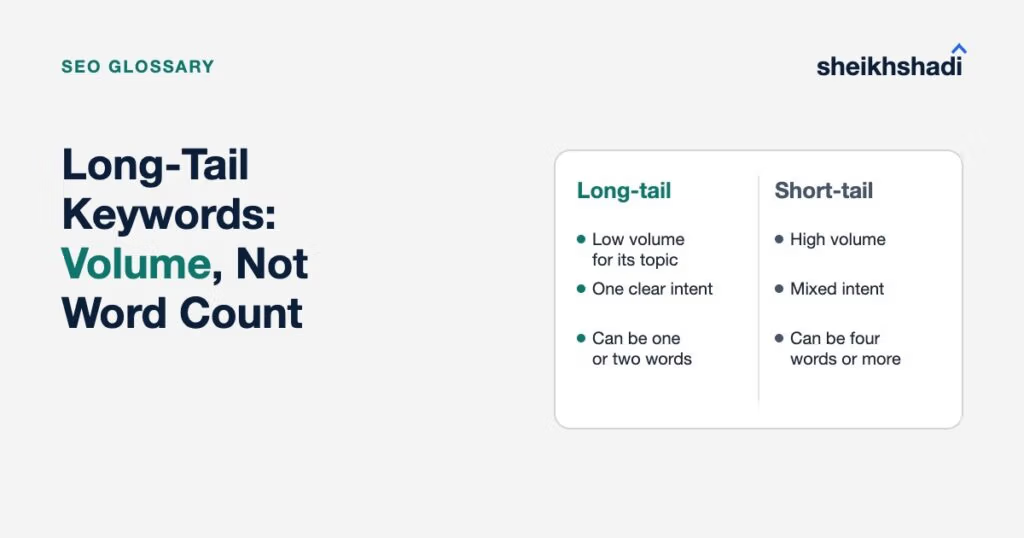
Long-tail keywords are search queries with low monthly search volume and a specific intent. The part that trips people up: “long-tail” describes volume, not word count and the “long-tail converts 2.5x better” figure you see repeated traces back to a 2011 study of three retailers, not to anything measured on a SaaS or B2B site.
I have worked in SEO since 2012 and my view is simple: treat long-tail keywords as a volume-and-intent filter you check in your own data, not a word-count rule. And when you build links, the pages that already rank for a cluster of these small queries are the ones worth chasing.
What are long-tail keywords?
A long-tail keyword is a query that gets few searches per month compared with the broad “head” term of the same topic. Ahrefs’ long-tail keyword guide uses “meditation” (211,000 searches a month) as the head term and “can meditation make you smarter” (50 a month) as a long-tail query. It also says there is no fixed search volume threshold. Long-tail is relative to the topic.
The name comes from Chris Anderson’s article “The Long Tail” in the October 2004 issue of Wired, later expanded into a book. Anderson described how niche products with small individual demand add up to a large share of total sales online. In search, the same curve applies: a few head terms get huge volume and millions of specific queries each get a handful of searches.
Semrush’s knowledge base splits keywords into three bands along that curve:
- Head (short-tail): broad, high volume, mixed intent. Example: “crm”.
- Body (middle): narrower, moderate volume. Example: “crm for small business”.
- Long tail: specific, low volume, one clear job to be done. Example: “crm for insurance agents with quoting”.
Long-tail vs short-tail keywords: what is the difference?
Short-tail keywords (also called head terms) carry the volume. Long-tail keywords carry the specificity. Here is how they compare for a SaaS or B2B site:
| Factor | Short-tail keywords | Long-tail keywords |
|---|---|---|
| Monthly volume | High | Low, often under 10 |
| Intent | Mixed or unclear | Usually one clear intent |
| Who ranks | Large, authoritative domains | Smaller sites can compete with a precise answer |
| Page type | Category, service or pillar page | Blog post, comparison, integration or use-case page |
| SaaS example | “project management software” | “project management software for architecture firms” |
| Agency example | “link building” | “how to vet a guest post site in ahrefs” |
Length and volume often line up, which is why guides use word count as a shortcut. But they don’t always line up and the exceptions matter. More on that below.
Why long-tail keywords matter for SaaS and B2B sites
Three reasons, each with a caveat.
- Most keywords live in the tail. Ahrefs reports that keywords with fewer than 10 searches a month make up almost 93% of its U.S. keyword database. Google has said that 15% of the queries it sees every day are new, a figure Pandu Nayak repeated in Google’s October 2019 BERT announcement and John Mueller restated at Search Central Live NYC in 2025, as Search Engine Journal reported.
- Specific queries are easier to match. A page built for “soc 2 compliance software for startups” can answer that query better than a generic compliance page. The advantage is the precise match, not the length of the query.
- B2B deals are large and audiences are small. A query with 20 searches a month can still be worth a lot if one of those searchers signs an annual contract. Low volume is a reason to check value, not a reason to skip.
If you are building a keyword plan from scratch, my SaaS SEO guide covers how long-tail pages sit next to your commercial pages.
How to find long-tail keywords
Use more than one source. Each one sees a different slice of the tail.
- Start in Google Search Console. Open Performance, then Queries and sort by impressions. Filter for question words (how, what, why, can, does, best, vs) and for your product’s feature names. These are long-tail queries Google already shows your site for. Read the limits in the section below before you trust the totals.
- Use a keyword tool and filter by volume, not word count. In Ahrefs Keywords Explorer or the Semrush Keyword Magic Tool, enter a seed term, then filter to low volume and low difficulty. Then check the parent topic or the SERP (step 5) before you plan a page.
- Read Google’s own suggestions. Autocomplete, People Also Ask and related searches show phrasing real searchers use. For this topic, the related searches are “long tail keywords examples” and “long tail keywords list”.
- Mine your sales and support conversations. Demo call notes, support tickets and onboarding questions contain the exact phrases your buyers use. Many of them will show zero volume in tools. That doesn’t mean nobody searches them.
- Check the SERP before writing. Search the query. If the top results are the same pages that rank for the head term, the long-tail query belongs on that existing page. If the results are different pages answering a different question, it deserves its own page.
Before you add any new page, check how it will link to and from your existing pages. My internal linking guide for SaaS sites shows how to connect a cluster of long-tail posts to the page that sells.
What are the four types of keywords?
The common way to sort keywords is by search intent. Long-tail keywords can fall into any of the four:
| Intent | What the searcher wants | Long-tail example |
|---|---|---|
| Informational | To learn or solve a problem | “how to track ai referral traffic in ga4” |
| Navigational | To reach a specific site or page | “hubspot crm pricing page” |
| Commercial | To compare options before buying | “best crm for b2b saas startups” |
| Transactional | To buy, sign up or book | “book a demo payroll software for remote teams” |
Commercial and transactional long-tail queries sit closest to pipeline on a B2B site. The B2B SEO guide goes deeper into mapping these to the buying stages.
4 long-tail keyword myths to drop
Four common beliefs about long-tail keywords don’t hold up.
1. Long-tail is about volume, not word count
Long-tail keywords are usually defined by length: “three or more words” or “3 or 4 words”. That is a shortcut and it breaks. Ahrefs’ own data says “there are many one-word keywords that get fewer than 100 monthly searches” and “there are keywords five words long (or more) with hundreds of thousands of monthly searches.” Its glossary gives the example of “restaurants near me”, which has far more volume than “restaurants” and concludes that short-tail and long-tail “have nothing to do with the keyword length.”
What to do differently: When you filter a keyword list, set a volume ceiling relative to your head term, not a word-count floor. A two-word SaaS feature query with 30 searches a month is long-tail. A four-word query like “best crm software 2026” may be a head term in disguise.
2. The 2.5x conversion claim is a 2011 retail stat
“Long-tail keywords convert better” is repeated everywhere, usually as “2.5x”. That figure comes from Conductor’s “The Long Tail of Search” study, which Search Engine Watch covered in December 2011. The study looked at more than 7 million visits to three major retailers and defined long-tail as three or more words.
That is useful history, but it is retail data from 2011, using the word-count definition criticized above. It tells you nothing reliable about a SaaS free-trial page or a B2B demo request in 2026. Even Ahrefs answers “do long-tail keywords convert better?” with “It depends.”
What to do differently: Don’t put “2.5x” in a business case. Measure it on your own site: in GA4, compare conversion rate by landing page, then match those pages to the queries they get in Search Console. If your long-tail pages convert better, you have your own number. If they don’t, you have saved yourself a content plan built on a 15-year-old retail stat.
3. Search Console hides part of the long tail
Search Console is the right place to find your long-tail queries, but it hides part of the tail. Google’s troubleshooting page for the Performance report says “anonymized (rare) results are omitted from the table, but are included in the chart totals unless a query filter is applied,” and that “the table can display a maximum of 1,000 rows.” The same page warns that “some rare or long-tail rows might be omitted from the table, but included in the chart total.”
Add the 15% of daily queries Google says are new and part of your long tail won’t show up in keyword tools and will only partly show in Search Console.
What to do differently:
- Filter by page first, then look at queries. A smaller slice is less likely to hit the 1,000-row cap.
- With a page filter and no query filter applied, compare the chart total with the sum of the table rows. A big gap means much of that page’s traffic comes from queries the table doesn’t list. Once you add a query filter, such as the question-word filter above, Google drops anonymized queries from the chart total too.
- Don’t judge a page as “no demand” because tools show 0 to 10 searches. Check its impressions instead.
4. Not every long-tail keyword needs its own page
Finding long-tail keywords is the easy part. Deciding which ones need their own page is where sites create cannibalization. Ahrefs splits long-tail keywords into “supporting” and “topical”. Supporting long-tail keywords are “less popular variations of a more popular query” and Ahrefs advises: “You don’t need a separate page for each one.” For topical long-tail keywords, which are distinct topics, Ahrefs says “You can safely target it with a dedicated page.”
What to do differently: Use the SERP test from step 5 above. Same results as the head term: add the query to the existing page as a section or FAQ-style answer. Different results: write a new page. This check helps you avoid keyword cannibalization before it starts.
My verdict
Target long-tail keywords, but define them by volume and intent. Check them in your own Search Console and GA4 data. Then decide page by page with the SERP test whether they need a new URL. This approach suits SaaS and B2B sites with small, high-value audiences and lean content teams. It suits less well a site that only wants raw traffic volume, because long-tail pages win on fit, not reach.
Not sure which long-tail queries your pages already get, or which ones need a page of their own? Ask us for a free audit.