

In the fast-paced world of SEO, most beginners fall into one of two camps: those who chase high-authority backlinks aggressively and risk penalties, or those who avoid link building entirely out of fear. But there’s a strategic middle ground that savvy SEO professionals have been using quietly for years—pillow link building.
Think of pillow links as the foundation stones of your digital presence. They’re not the towering monument everyone notices, but without them, your entire SEO strategy becomes unstable. This comprehensive guide will teach you how to build these crucial foundation links safely, systematically, and effectively.
What Is Pillow Link Building?
Pillow link building is the strategic practice of acquiring low-risk, branded backlinks from legitimate websites that establish your domain’s credibility without triggering Google’s spam detection algorithms. These links primarily use your brand name, naked URLs, or generic anchor text like “visit website” or “learn more.”
Unlike aggressive link building tactics that target high-authority sites with exact-match commercial keywords, pillow links focus on creating a natural, diverse backlink profile that appears organic to search engines. They serve as a protective buffer—hence the term “pillow”—that cushions your more aggressive SEO efforts against potential penalties.
Why They’re Called “Pillow” Links
The term “pillow” perfectly captures their protective function. Just as a pillow cushions your head during rest, these links cushion your website against algorithmic penalties and manual actions. They create a natural-looking foundation that makes your overall link profile appear legitimate and earned rather than manipulated.
When Google’s sophisticated algorithms analyze your backlink profile, they look for patterns that indicate natural link acquisition. A healthy mix of branded mentions, social profiles, and directory listings signals that your website represents a real business with genuine online presence across multiple platforms.
How They Fit Into a Natural Link Profile
Real businesses naturally acquire pillow links through everyday operations. When you register for social media platforms, submit to business directories, or engage in community forums, you’re organically building pillow links without even realizing it.
A common rule of thumb for a healthy link profile looks like this distribution (a rough guide, not a researched standard):
- 75-80% branded and low-risk links (pillow links from social profiles, directories, citations)
- 15-20% medium-authority contextual links (guest posts, resource pages, industry mentions)
- 5-10% high-authority editorial links (news mentions, authoritative site features, viral content links)
This kind of mix looks like how real businesses pick up links over time. It is not a guarantee, and no mix makes a link profile immune to Google’s spam systems.
Why Pillow Links Matter for SEO
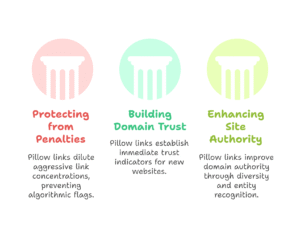
Protecting Your Website from Link Penalties
Google’s machine learning algorithms have become increasingly sophisticated at identifying manipulative link schemes. When your backlink profile consists primarily of high-authority links with commercial keywords, it creates suspicious patterns that can trigger algorithmic filters or manual reviews.
Pillow links act as algorithmic camouflage, diluting the concentration of aggressive links in your profile. Consider this scenario: if 90% of your links come from guest posts with money keywords, that’s a red flag. However, if 75% are branded links from legitimate social profiles and business directories, with only 25% being commercial links, the profile appears naturally diverse.
Building a Trustworthy Domain from Day One
Google says there is no “sandbox” that holds new sites back. New websites still tend to rank slowly because they have few links, little history and few brand signals, so it takes time for Google to see that the site is real.
Pillow links solve this cold-start problem by establishing immediate trust indicators. When you create comprehensive business profiles, submit to vetted directories, and build local citations, you’re sending clear signals to Google that your website connects to a legitimate entity with real-world presence.
These early trust signals can dramatically accelerate the indexing process and reduce the time required for your content to begin ranking competitively.
How They Improve Site Authority and Rankings
While individual pillow links may not carry the raw ranking power of a guest post on a Domain Rating 70+ website, they contribute to overall domain authority through several mechanisms:
- Link diversity enhancement: Multiple sources and anchor text variations signal natural acquisition patterns
- Entity recognition improvement: Consistent brand mentions across platforms strengthen Google’s understanding of your business
- Geographic relevance signals: Local directories and citations boost location-based search visibility
- E-E-A-T consistency: Professional profiles across platforms show real people and a real business behind the site (Experience, Expertise, Authoritativeness, Trustworthiness)
When (and When NOT) to Use Pillow Link Building
Best Time to Use: New Sites, Pre-Link Campaigns
Pillow link building delivers maximum value in specific strategic scenarios. Understanding these situations helps optimize your time investment and expected outcomes.
Brand new domains (0-6 months old): Fresh websites should prioritize pillow links before attempting any aggressive link building tactics. This creates a natural foundation that makes future high-value links appear earned rather than purchased or manipulated.
Pre-campaign preparation: Before launching guest posting, niche edit, or broken link building campaigns, establish 25-40 pillow links. This preparation makes subsequent high-value links significantly more effective and reduces penalty risk.
Post-penalty recovery: Websites recovering from manual penalties or algorithmic filters benefit enormously from pillow link rehabilitation. The branded, low-risk nature of these links helps restore domain credibility while you address toxic backlink issues.
Local service businesses: Companies serving specific geographic markets should always prioritize pillow links through local citations, community involvement, and regional directory submissions.
When to Avoid: Mature Sites with High Authority
Pillow links become less valuable—and potentially inefficient—in certain circumstances:
Established high-authority domains: Websites with 500+ referring domains and strong topical authority should focus resources on high-impact link opportunities rather than basic directory submissions.
Highly competitive commercial niches: In industries where competitors have thousands of premium backlinks (think credit cards, insurance, or legal services), pillow links alone won’t create meaningful ranking improvements.
Time-sensitive campaigns: Product launches, seasonal promotions, or urgent reputation management situations require faster-impact strategies than pillow link building provides.
Risks of Overuse or Poor Source Selection
Like any SEO tactic, pillow linking can become counterproductive when executed poorly:
Velocity and pattern issues: Building hundreds of pillow links within days creates unnatural acquisition patterns that sophisticated algorithms can detect. Spread link building over 3-6 months for natural velocity.
Low-quality source selection: Not all directories and social platforms offer equal value. Avoid obviously spammy sites, broken platforms, or irrelevant audiences that could harm rather than help your profile.
Over-reliance without diversity: Pillow links should complement, not replace, other link building strategies. A profile consisting entirely of pillow links lacks the authority signals needed for competitive ranking.
Types of Pillow Links (With Examples)
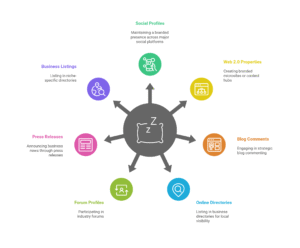
Social Profiles
Social media profiles represent the most accessible and natural pillow links available. Every legitimate business should maintain branded presence across major platforms, which makes these links low-risk. Low-risk is not no-risk, though: Google lists low-quality directory and bookmark site links as link spam, so keep to real brand profiles.
Essential platforms for immediate setup:
- Facebook Business Page: Complete with business information, photos, and regular updates
- LinkedIn Company Page: Professional networking with industry connections and thought leadership content
- Twitter/X Business Profile: Real-time engagement and industry conversation participation
- Instagram Business Account: Visual content showcasing products, services, or company culture
- YouTube Channel: Video content for tutorials, testimonials, or industry insights
Advanced social platforms: Pinterest (visual businesses), TikTok (younger demographics), and industry-specific networks like Behance (creative services).
Web 2.0 Properties
Web 2.0 platforms allow creation of branded microsites or content hubs that naturally link back to your primary domain. When developed with genuine content, these properties provide valuable pillow links with additional traffic potential.
High-value Web 2.0 platforms:
- Medium.com: Publish industry insights, case studies, or thought leadership articles with natural brand mentions
- WordPress.com: Create a branded blog featuring company updates, industry commentary, or resource collections
- LinkedIn Publishing: Professional articles demonstrating expertise within your industry network
- Tumblr: Visual content and community engagement, particularly effective for creative industries
- Blogger.com: Google’s free blogging platform
Content strategy insight: Don’t create empty properties solely for links. Develop 5-10 pieces of valuable content per platform to establish legitimate presence and potential traffic sources.
Blog Comments (White-Hat Only)
Blog commenting is a way to build relationships and bring in a little referral traffic, not a dependable link source. Google lists comments with optimized links as link spam, and most blog comment links are nofollow or ugc.
Legitimate commenting methodology:
- Target relevance: Comment exclusively on blogs within your industry or complementary niches
- Provide substantial value: Contribute meaningful insights, personal experiences, or helpful resources
- Use authentic identity: Comment with your real name or brand name—never keyword-stuffed anchor text
- Engage genuinely: Participate in follow-up discussions and build relationships with blog authors
Online Directories and Citations
Business directories remain among the most legitimate and effective pillow link sources, particularly for local businesses and professional services.
Tier 1 directories (immediate priority):
- Google Business Profile: Essential for any business with physical location or local service area
- Bing Places for Business: Microsoft’s platform serves significant search volume
- Apple Business (formerly Apple Business Connect): Controls how your business appears in Apple Maps
- Better Business Bureau: Trust and credibility signals for consumer-facing businesses
- Yelp: Consumer reviews and local discovery, particularly strong for restaurants and services
Industry-specific directories: Lawyers.com (legal), Healthgrades (medical), Houzz (home services), or G2 (B2B software) offer targeted relevance and qualified traffic potential.
Forum Profiles and Signatures
Industry forums are better treated as places to build relationships and brand recognition than as link sources. Google lists forum comments with optimized links in the post or signature as link spam, and forum links are usually nofollow or ugc anyway. Join for the community and the referral traffic.
Strategic forum engagement:
- Platform selection: Choose 2-3 high-quality forums with active, engaged communities in your industry
- Profile optimization: Complete all available fields with brand information, expertise areas, and a plain link to your website where the forum allows it
- Consistent participation: Regular contribution through question answering, resource sharing, and discussion initiation
Recommended forum types: Reddit (relevant subreddits), Quora (question answering), industry-specific forums, and local business communities.
Press Releases
Press releases are useful for coverage and awareness when you announce legitimate business news or milestones. They pass little or no SEO value: Google lists links with optimized anchor text in press releases distributed on other sites as link spam, and wire services normally nofollow their links. Treat any link as a plain branded mention.
Appropriate press release occasions:
- Product or service launches
- Significant business milestones or expansions
- Industry awards or recognition
- Community involvement or charitable initiatives
- Executive appointments or company restructuring
Distribution strategy: If you distribute one, use a reputable wire service rather than a low-quality spam network, and keep links branded and nofollow. Local news outlets and industry publications often provide higher value than mass distribution services.
Business Listings & Niche Directories
Beyond general directories, niche-specific listings provide targeted relevance and qualified traffic while contributing valuable pillow links.
Industry-specific examples:
- Restaurants: OpenTable, TripAdvisor, Zomato, local dining guides
- Hotels: Booking.com, Expedia, TripAdvisor, regional tourism boards
- Professional Services: Avvo (legal), Psychology Today (mental health), Thumbtack (local services)
- B2B Companies: G2, Capterra, Software Advice, industry association directories
- E-commerce: Shopping comparison sites, product review platforms, manufacturer dealer locators
Step-by-Step Guide to Building Pillow Links
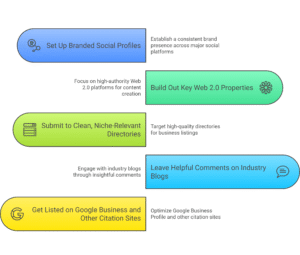
Step 1: Set Up Branded Social Profiles
Begin with comprehensive social media presence establishment across major platforms. This foundation provides 5-8 immediate pillow links and ongoing traffic potential.
Implementation timeline: Week 1
- Profile creation: Facebook, LinkedIn, Twitter, Instagram, and YouTube business accounts
- Brand consistency: Identical logos, business descriptions, contact information, and website URLs
- Content seeding: 3-5 initial posts per platform to demonstrate activity and engagement
- Network building: Follow industry leaders, competitors, and potential customers for relationship development
- Optimization: Complete all available profile fields, including business hours, services, and location information
Time investment: 4-6 hours initially, followed by 45 minutes weekly for maintenance and content updates.
Step 2: Build Out Key Web 2.0 Properties
Focus on 2-3 high-authority Web 2.0 platforms rather than spreading efforts across numerous low-quality sites.
Medium.com strategy:
- Create professionally branded profile with detailed bio and website link
- Publish 3-5 industry-relevant articles demonstrating expertise and providing genuine value
- Include natural, contextual links to relevant pages on your primary website
- Engage with other industry writers through comments and article sharing
- Join relevant publications to expand reach and credibility
WordPress.com approach:
- Establish branded subdomain (yourcompany.wordpress.com) with professional theme
- Develop 8-12 blog posts covering industry insights, company updates, and helpful resources
- Implement internal linking structure connecting posts and linking to main website
- Optimize posts for relevant long-tail keywords to attract organic traffic
Step 3: Submit to Clean, Niche-Relevant Directories
Research and target 15-25 high-quality directories rather than pursuing quantity through automated submission services.
Directory research methodology:
- Industry search: Google “[your industry] + directory” and “[your city] + business directory”
- Quality assessment: Evaluate directory authority, user engagement, and legitimate business listings
- Manual review preference: Prioritize directories requiring human review over automated submission acceptance
- Competitor analysis: Identify directories where successful competitors maintain listings
Submission optimization:
- Detailed business descriptions highlighting unique value propositions
- Accurate category selection for maximum relevance
- High-quality images showcasing products, services, or facilities
- Consistent NAP (Name, Address, Phone) information across all listings
Step 4: Leave Helpful Comments on Industry Blogs
Identify 15-20 active, authoritative blogs in your industry and become a recognized, valuable contributor through consistent, insightful commenting.
Target blog identification:
- Search methodology: Google “[your industry] + blog,” “[niche] + expert advice,” or “[topic] + tips”
- Authority verification: Use Ahrefs or SEMrush to check a blog’s Domain Rating (Ahrefs) or Domain Authority (Moz), both third-party metrics, and its organic traffic
- Engagement assessment: Look for active comment sections with author responses and community interaction
- Content relevance: Ensure blog topics align with your expertise and target audience interests
Strategic commenting approach:
- Comprehensive reading: Fully digest article content before contributing comments
- Value-added insights: Share relevant experiences, additional resources, or alternative perspectives
- Question initiation: Ask thoughtful questions that encourage further discussion and author engagement
- Relationship building: Respond to author replies and engage with other commenters professionally
Step 5: Get Listed on Google Business and Other Citation Sites
For businesses serving local markets or maintaining physical locations, citation building represents the most impactful pillow link category.
Google Business Profile optimization:
- Complete all available information fields including hours, services, and business description
- Upload high-quality photos of location, products, team members, and services
- Encourage and respond to customer reviews professionally and promptly
- Publish regular updates about promotions, events, or business developments
- Implement Google Posts for additional content and engagement opportunities
Secondary citation priorities:
- Major platforms: Bing Places, Apple Business, Facebook Business Page, and Yelp
- Local directories: Chamber of Commerce, city business directories, and regional tourism sites
- Industry directories: Professional association listings and trade organization directories
- Review platforms: Industry-specific review sites and consumer advocacy platforms
Bonus: Use a Checklist to Track Progress
Systematic tracking ensures consistent progress and prevents overlooked opportunities or duplicate efforts.
Comprehensive Pillow Link Tracking Template:
- Submission date: When you created or submitted the listing
- Platform name: Specific website or directory name
- Profile URL: Direct link to your completed listing or profile
- Login credentials: Username and password for future updates
- Current status: Pending review, live and indexed, or rejected
- Last updated: Most recent modification or verification date
- Performance notes: Traffic received, leads generated, or ranking improvements observed
This systematic approach facilitates easy updates during rebranding, contact information changes, or service expansions while maintaining comprehensive oversight of your pillow link portfolio.
Tools to Build and Monitor Pillow Links
Ahrefs / SEMrush for Backlink Audits
Professional SEO platforms provide comprehensive monitoring and analysis capabilities essential for pillow link management and overall backlink profile health assessment.
Critical monitoring features:
- New backlinks tracking: Real-time notifications when pillow links go live and get indexed
- Anchor text analysis: Ensure branded anchor distribution remains within safe parameters
- Lost backlinks monitoring: Identify when profiles get deleted or links become broken
- Competitor intelligence: Analyze competitor pillow link strategies for additional opportunities
- Link velocity tracking: Monitor acquisition pace to maintain natural growth patterns
Advanced monitoring setup: Configure email alerts for new backlinks, set up competitor tracking for pillow link opportunities, and establish monthly reporting for stakeholder updates.
Whitespark & BrightLocal for Citation Management
Specialized local SEO tools dramatically reduce time investment while improving citation quality and consistency for location-based businesses.
Whitespark advantages:
- Opportunity identification: Discovers citation possibilities specific to your location and industry
- Consistency monitoring: Tracks NAP variations across the web that could harm local rankings
- Competitor analysis: Reveals citation sources used by successful local competitors
- Progress tracking: Monitors citation building campaigns and measures impact on local visibility
BrightLocal capabilities:
- Citation building service: Professional team handles directory submissions and profile optimization
- Local rank tracking: Monitors position changes for location-based search terms
- Review management: Centralized monitoring and response system for online reviews
- Reporting automation: Client-ready reports for agencies and consultants
Google Search Console for Link Monitoring
Google’s free platform provides direct insight into how the search engine perceives and values your pillow link building efforts.
Essential Search Console reports:
- Links section: A sample of the links Google has found to your site, plus link counts (Google says the report is not a comprehensive list)
- Top linking sites: Shows which sites link to you most often (a count of links, not a measure of authority)
- Most linked pages: Reveals which content benefits most from your pillow link strategy
- Anchor text distribution: Monitors branded vs. commercial keyword ratios for penalty prevention
Optimization insights: Use Search Console data to identify underperforming pillow links, discover new linking opportunities, and validate that your links are being properly indexed and attributed.
Notion or Google Sheets for Tracking Your Strategy
Simple organizational tools often outperform complex software for day-to-day pillow link management and team collaboration.
Google Sheets template structure:
- Platform details: Name, category, and submission requirements
- Contact information: Login credentials and submission confirmation details
- Status tracking: Current state, last update, and next review date
- Performance metrics: Traffic generated, leads received, and ranking improvements
- Notes section: Special requirements, relationship contacts, and optimization opportunities
Notion workflow benefits:
- Rich media integration for screenshots and documentation
- Advanced filtering and sorting for different pillow link categories
- Team collaboration features for agencies and larger organizations
- Template databases for consistent data entry and management
Pillow Links vs Other Link Types
Pillow vs Guest Posts
Guest posting remains the gold standard for editorial link building, but pillow links offer distinct advantages in specific scenarios.
Guest posting strengths:
- Higher individual authority: Single links from DR 50+ sites carry significant ranking power
- Contextual relevance: Editorial placement within relevant content provides maximum SEO value
- Targeted keywords: Ability to optimize anchor text for specific commercial terms
- Relationship building: Develops ongoing partnerships with industry publications and influencers
- Traffic potential: Well-placed guest posts can drive substantial referral traffic
Guest posting limitations:
- Time intensity: Research, outreach, and content creation take a lot of time per successful placement
- High rejection rates: Many outreach attempts get no response or a rejection
- Significant costs: Quality placements cost real money per link through agencies or paid opportunities
- Penalty risks: Over-optimization or poor source selection can trigger algorithmic filters
Strategic integration: Build 25-40 pillow links before launching guest post campaigns to create natural acquisition patterns and maximize guest post effectiveness.
Pillow vs Niche Edits
Niche edits (inserting links into existing content) offer speed advantages but come with increased risks and costs compared to pillow links.
Niche edit advantages:
- Implementation speed: Links can go live within days rather than weeks
- Established content: Placement within aged, ranking content provides immediate authority
- Natural appearance: Links appear organic within existing editorial context
- Minimal content requirements: No need to create new articles or provide guest content
Niche edit disadvantages:
- Premium pricing: Quality niche edits usually cost more per placement than pillow links
- Higher detection risk: Sudden link additions can appear manipulative to algorithms
- Limited relationship building: Transactional nature provides no ongoing partnership benefits
- Easy removal: Site owners can delete links without notice or explanation
ROI comparison: Pillow links are cheap and low-risk for new websites, while niche edits provide faster results for established domains with urgent ranking needs.
Pillow vs PBNs
Private Blog Networks represent high-risk, high-control link building that contrasts sharply with pillow links’ safety-first approach.
PBN comparison analysis:
- Control level: PBNs offer complete control over content and linking; pillow links provide less control with lower risk
- Investment requirements: PBNs demand substantial upfront costs for domains, hosting, and content; pillow links are predominantly free
- Risk assessment: PBNs can cause catastrophic penalties; real brand profiles are low-risk, though low-quality directory links are still link spam
- Scalability factors: PBNs become increasingly dangerous as networks grow; pillow links scale safely and naturally
- Long-term viability: PBNs require constant maintenance and risk obsolescence; pillow links provide stable, long-term value
Risk Reality: Google’s spam policies treat link schemes, including networks of sites built only to pass links, as a violation. Affected sites can lose rankings or be removed from results.
Recommendation: Completely avoid PBN strategies and instead build sustainable authority through pillow links combined with white-hat editorial link acquisition.
Which Has the Best ROI for Beginners?
For new website owners and SEO beginners, pillow links deliver superior risk-adjusted returns on investment across multiple dimensions.
ROI factors favoring pillow links:
- Minimal barrier to entry: No specialized skills, industry connections, or substantial budgets required
- Immediate implementation: Many pillow links can be built within days rather than months
- Multiple business benefits: SEO improvement plus brand building, local visibility, and traffic diversification
- Long-term stability: Pillow links rarely disappear or cause future problems
- Compounding value: Early pillow links make future link building efforts more effective and safer
Recommended progression timeline:
- Months 1-3: 80% effort on pillow links, 20% on content creation and on-page optimization
- Months 4-6: 50% pillow links, 30% content development, 20% relationship building and outreach preparation
- Months 7-12: 30% pillow link maintenance, 40% content marketing, 30% editorial link building
- Year 2+: 20% pillow link expansion, 30% content, 50% high-authority link acquisition
How Google’s Core Ranking and Spam Systems Affect Pillow Linking
Helpful Content System: Why Relevance Matters More
Google’s helpful content system launched in 2022 and became part of its core ranking systems in the March 2024 core update. It rewards content made for people, which means a brand profile or directory listing only helps when it points to a real business with real content.
Algorithm alignment with pillow link philosophy:
- Brand entity recognition: Consistent mentions across legitimate platforms strengthen Google’s understanding of your business authority
- User behavior signals: Active social profiles and directory listings generate real traffic and engagement metrics
- Geographic relevance enhancement: Local citations improve location-based search accuracy and user experience
- Trust signal amplification: Multiple platform verification provides credibility indicators valued by modern algorithms
Updated best practices for HCU compliance:
- Platform relevance priority: Focus on directories and social networks where your actual customers spend time and seek information
- Complete profile development: Create comprehensive, helpful profiles rather than minimal link-only presences
- Genuine engagement emphasis: Participate authentically in social platforms and forums rather than just maintaining passive profiles
- Content value integration: Ensure pillow link content provides real value to platform users, not just SEO benefit
Spam Update: Avoiding Low-Quality Link Farms
Google’s March 2024 spam update added policies on expired domain abuse, scaled content abuse and site reputation abuse. Link schemes were already covered by Google’s link spam policies and its SpamBrain system, so pillow link quality still matters.
Updated red flags to avoid:
- Bulk submission services: Automated tools promising “1000+ directory links” typically target spam networks
- Payment-required basic listings: A fee alone is neither good nor bad. Check for editorial review and real usage before paying
- Reciprocal link requirements: Quality platforms don’t demand backlinks in exchange for basic listings
- Obvious spam indicators: Sites with broken functionality, foreign language content, or irrelevant business categories
Quality verification methodology:
- Manual review processes: Prioritize platforms requiring human verification over automated acceptance
- Legitimate business presence: Verify that recognizable, established businesses maintain active listings
- Platform authority assessment: Use a tool like Ahrefs (Domain Rating) or Moz (Domain Authority), both third-party metrics, to check a directory’s strength and organic traffic
- Editorial standards evaluation: Look for clear submission guidelines, spam policies, and content moderation
EEAT and Branded Signals: Role of Pillows
Google says E-E-A-T is not a specific ranking factor itself. Consistent branded profiles can still help Google and readers understand who you are as a business, but they are not an essential ranking factor.
EEAT enhancement through strategic pillow linking:
- Experience demonstration: Active social media presence and customer interaction showcase real business operation
- Expertise establishment: Industry directory listings and professional forum participation demonstrate subject matter knowledge
- Authority building: Consistent citations across authoritative platforms create credibility consensus
- Trust signal amplification: Verified business information across multiple sources provides reliability indicators
EEAT-optimized pillow link strategy:
- Professional platform prioritization: Emphasize LinkedIn, industry associations, and certified business directories
- Credential highlighting: Include relevant certifications, awards, and professional memberships in profiles
- Consistent brand messaging: Maintain identical expertise claims and service descriptions across all platforms
- Verification pursuit: Seek verified status on platforms offering business authentication programs
Conclusion
The SEO landscape evolves continuously, making ongoing education and community connection essential for long-term success. Pillow link building may not generate immediate excitement like viral content or breakthrough rankings, but it forms the bedrock foundation that enables sustainable organic growth and protects against algorithmic volatility. Master these fundamentals first, then layer advanced strategies on top of your solid pillow link foundation.