
Local link building means earning links from websites tied to your city or your trade: local news, city and library resource lists, associations, partners, suppliers and community groups. A handful of relevant local links can matter more than a pile of generic ones, because what you want is local relevance, not volume.
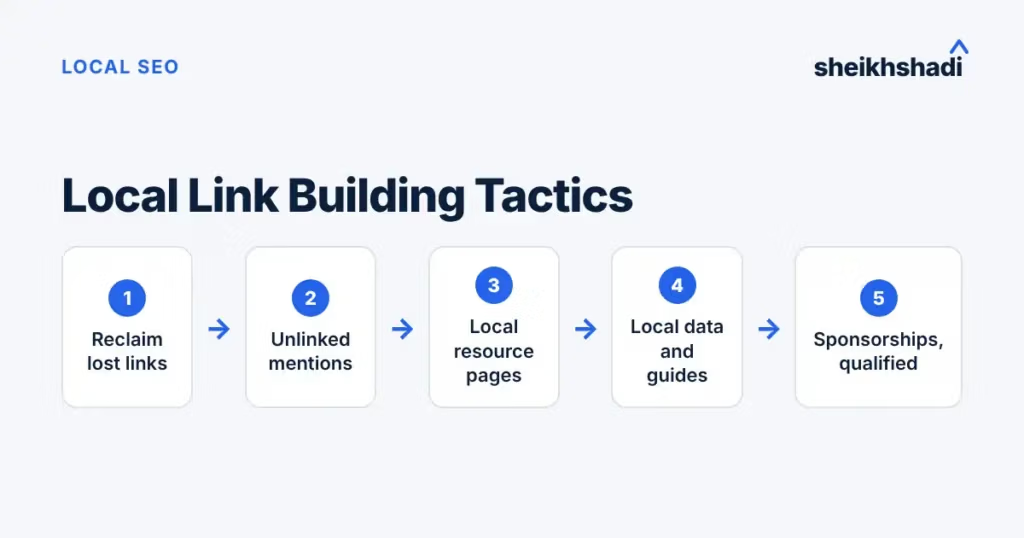
The 12 tactics here run from free checks you can finish this week to slower, paid work like sponsorships. Start at the top and move down as you have time and budget.
Why links matter for local rankings
Google’s Business Profile help page on local ranking says local results are mainly based on relevance, distance and how well known a business is. On that last factor, Google writes: “This factor’s also based on info like how many websites link to your business and how many reviews you have.”
So links feed one of three factors, next to reviews. They don’t override distance or relevance. The same page also says there is no way to request or pay for a better local ranking on Google. Links help a business that already fits the search; they won’t place a plumber two cities away in the map results.
Free tactics you can start this week
These five need time, not budget. Each starts with a check you can run in Ahrefs or a similar backlink tool.
1. Reclaim links you already lost
Local links disappear when a partner redesigns a site, a news page moves or you change your own URLs. Open your site in a backlink tool, filter for broken backlinks and list the pages on your site that return a 404 but still have links pointing at them.
For each one, redirect the dead URL to the closest live page. If the linking site moved or deleted its page, email the editor with the correct URL. It’s a quick win because the site already chose to link to you once.
2. Turn unlinked mentions into links
Local papers, event pages and community blogs mention businesses by name without linking. Search for your brand name in quotes, your owner’s name and your street address, then exclude your own domain.
When you find a mention with no link, write a short note to whoever runs the page. Thank them for the mention and ask whether they would add a link so readers can find you. Keep it to two or three sentences.
3. Find the local links your competitors have
Search your main “service + city” keyword and note the businesses that show up in the map pack and the top organic results. Put three to five of them into a link intersect or link gap tool and look for sites that link to two or more competitors but not to you.
Those overlaps point to the local chambers, trade groups, event pages and resource lists that link to businesses like yours. Ignore anything off-topic or outside your area. We prefer relevant linking pages that have been updated within the last two years. Age alone does not make a link weak, so we also weigh relevance, current usefulness and site quality.
4. Get on local resource pages
Cities, libraries, schools, nonprofits and neighbourhood associations keep pages that list useful local services: emergency contacts, small business directories, “new to the area” guides and support lists. Search phrases like your city plus “resources”, “useful links” or “local businesses”.
Only pitch a page where your business would genuinely help its readers. A food bank resource list fits a grocery wholesaler that donates; it does not fit a marketing agency.
5. Use local directories and associations, reviewed by hand
Google’s spam policies list links from low-quality directory or bookmark sites as an example of link spam. That doesn’t make every directory bad. It means each listing needs a reason to exist beyond the link.
Before you list a business anywhere, check three things by hand:
- A human reviews submissions, so not every business that pays or signs up gets listed.
- The directory is about your trade or your city, such as a chamber of commerce, a licensing body or a regional trade association.
- Real people use it: the site ranks for local searches or sends visits you can see in your analytics.
Keep your business name, address and phone number identical across every listing you keep. Skip any package that promises hundreds of directory submissions at once.
Content that earns local links
These take a few days of work up front. The payoff is a page that local journalists, bloggers and organisations can cite without you asking for a favour.
6. Publish local data nobody else has
If your business collects numbers about your area, a short stats page can earn links from local news. A moving company can show which neighbourhoods people moved into this year. An HVAC firm can share how many emergency calls came in during the last heatwave.
Explain how you collected the data, give the date range and keep customer details out of it. Then send the page to the reporters who cover your city’s business or housing news.
7. Build a local guide or free tool
A practical guide or calculator gives resource pages and local blogs a reason to link. Think of a permit checklist for home renovations in your county, a school-run parking map or a cost calculator for a service priced by local rules.
Make it something a resident would bookmark even if they never hire you. A thin page that only lists your services won’t earn links.
8. Ask customers and suppliers for a page
The businesses you already work with are the easiest links to earn. Manufacturers and wholesalers keep “where to buy” or dealer pages. B2B customers publish partner pages or case studies.
Offer a short customer story they can publish, but only with their written consent and with real details they approve. Ask suppliers whether their stockist or installer page includes you.
Relationships, press and paid placements
The last four depend on other people’s schedules or your budget. They can bring the strongest local links, so plan them as an ongoing effort rather than a one-off sprint.
9. Partner with nearby businesses that don’t compete with you
A wedding venue, a florist and a caterer share the same customers without competing. Co-host an event, write a joint guide or refer clients to each other, then link where it helps the reader.
Keep this to real working partnerships. Google’s spam policies list excessive link exchanges, where sites link to each other mainly to swap links, as link spam. A link should exist because the partnership exists.
10. Become a source for local news
Local reporters need quotes from people who know their field. Introduce yourself to the journalist who covers your topic. Pitch real news such as an opening, an expansion or a local data finding, then answer their requests fast.
Journalist request platforms such as Qwoted and Featured can also bring mentions. Expect some answers to go unpublished and some coverage to link only to your homepage or not at all.
11. Sponsor local events, teams or charities
Sponsoring a youth team, a festival or a charity run puts your name in front of local people. The sponsor page may also link to you. Here is the condition that matters: Google’s spam policies treat buying links for ranking purposes as link spam, while advertising and sponsorship links are fine when they are qualified.
That means the organiser should mark your link with rel="sponsored" or rel="nofollow". Google’s guide to qualifying outbound links names sponsored as the value for paid links. Don’t ask an organiser to remove that attribute.
Judge a sponsorship by what it brings beyond the link: referrals, local press, event visibility and goodwill. If the only reason to pay is ranking credit, spend the money elsewhere.
12. Offer a scholarship that fits your business
Colleges list external scholarships on their financial aid pages, which can bring links from local school and university sites. It only works when the scholarship is real: a funded award, clear criteria, a deadline and a winner you announce.
Tie it to your field, such as a trades scholarship from an electrical contractor. Contact only the schools in your area whose students qualify. Budget for running it every year.
How many local links do you need?
There is no fixed number. In one analysis of 10 local keywords, the average referring domains of the top 10 results ranged from 59 to 503. Ahrefs wrote in 2021 that businesses ranking on page one for local queries rarely have more than 150 referring domains.
Those ranges depend on the trade and the city, so work out your own target:
- Search your main “service + city” keyword from your area.
- Check the referring domains of the top three to five local results in a backlink tool.
- Look at which of their links are local or industry-relevant, not only how many they have.
- Close the relevance gap first: the chamber, association and local news links they have and you don’t.
What to skip
- Bulk directory submissions and listings on sites no local person visits.
- Links from general sites with no tie to your area or trade, which add little local relevance.
- “Testimonial for a link” swaps and partner link exchanges with no real relationship behind them.
- Sponsorships where the organiser promises an unqualified link as the main benefit.
- Separate city pages for areas you don’t actually serve.
Plan your local link list
Pick the first three tactics and run the checks before you spend anything on sponsorships. Want a second pair of eyes on which local links your competitors have and you’re missing? Request a free link gap analysis and we’ll send you the list of relevant sites worth going after first. For links beyond your city, see our link building service.