

If you’re running a business in 2026, you’ve probably heard that SEO is essential. But when you start looking into what it actually costs, the numbers can be all over the place. One agency quotes you $500 a month, another wants $10,000. What gives?
Here’s the truth: SEO pricing varies wildly because SEO itself varies wildly. The cost depends on your business size, goals, competition, and dozens of other factors. But don’t worry – by the end of this guide, you’ll know exactly what to expect and how much you should budget for SEO in 2026.
Let’s dive into the real numbers, what you get for your money, and how to make sure you’re not overpaying or underpaying and getting terrible results.
What Is SEO and Why It Matters
SEO stands for Search Engine Optimization. In simple terms, it’s the process of making your website more attractive to search engines like Google so that when people search for what you offer, your site shows up higher in the results.
SEO involves optimizing your website’s content, structure, and technical elements, plus building authority through links and local signals. It’s part art, part science, and definitely not something you can master overnight.
How SEO Brings Value to Your Business
Here’s why businesses are willing to spend thousands on SEO: it works. Unlike paid advertising where you stop getting traffic the moment you stop paying, SEO builds long-term, sustainable growth.
When done right, SEO delivers:
- More qualified leads: People searching for your services are already interested in buying
- Higher conversion rates: Organic visitors arrive with intent, so they tend to convert better than cold paid traffic
- Brand credibility: Ranking high on Google makes you look like the authority in your field
- Cost-effective growth: Once you rank, that traffic is essentially free
- Competitive advantage: Your competitors are doing SEO – you can’t afford not to
The businesses that invest in SEO consistently outperform those that don’t. According to BrightEdge research, 68% of online experiences begin with a search engine, making SEO crucial for business visibility.
SEO Pricing in 2026: What You Can Expect
Let’s get to the meat and potatoes – what does SEO actually cost in 2026? The answer depends on what type of SEO you need and how comprehensive you want your strategy to be.
SEO Price Ranges by Type of Service
Here are the realistic price ranges you can expect for ongoing SEO services:
Local SEO: $400–$2,500/month
Local SEO is perfect for small businesses that serve customers in a specific geographic area. Think restaurants, dentists, plumbers, or local retail stores. At the lower end ($400-$800), you’ll get basic local optimization. Mid-range ($800-$1,500) includes more comprehensive local strategy and content. High-end local SEO ($1,500-$2,500) covers multiple locations or highly competitive local markets.
National SEO: $2,500–$10,000/month
This is for businesses that want to rank nationally for competitive keywords. E-commerce sites, SaaS companies, and service businesses targeting the entire country fall into this category. The wide range reflects the massive difference in competition levels and business goals. A small online retailer might start at $2,500, while a company trying to rank for “insurance” or “loans” could easily need $8,000+ per month.
Enterprise SEO: $10,000–$30,000+/month
Large corporations with massive websites, thousands of pages, and complex technical needs require enterprise-level SEO. These campaigns involve dedicated teams, advanced tools, and sophisticated strategies. The “plus” in $30,000+ isn’t a typo – some enterprise SEO campaigns cost $50,000 or even $100,000 per month.
One-Time SEO Projects
Not every business needs ongoing SEO. Sometimes you just need specific problems fixed or want to start with a solid foundation.
Audits: $500–$7,000+
An SEO audit analyzes your website to identify problems and opportunities. A basic audit for a small site might cost $500-$1,500. Comprehensive audits for larger, more complex sites can run $3,000-$7,000 or more. Enterprise audits sometimes cost $10,000+.
Website Redesign SEO: $2,000–$15,000
When you’re redesigning your website, proper SEO planning is crucial to avoid losing your existing rankings. Small business website SEO optimization during redesign typically costs $2,000-$5,000. Larger sites with hundreds or thousands of pages can cost $8,000-$15,000 or more.
Hourly SEO Rates
Some businesses prefer to hire SEO help on an hourly basis for specific projects or ongoing consultation.
Freelancers: $50–$150/hour
SEO freelancers offer the most affordable hourly rates. New freelancers might charge $50-$75/hour, while experienced specialists typically charge $100-$150/hour. The quality varies significantly, so you need to vet carefully.
Agencies: $100–$300/hour
SEO agencies have higher overhead but typically offer more comprehensive expertise and support. Small agencies might charge $100-$150/hour, while top-tier agencies in major cities can charge $200-$300/hour or more.
Common SEO Pricing Models
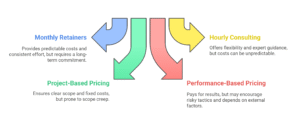
Understanding how SEO providers structure their pricing helps you choose the right fit for your business and budget.
Monthly Retainers
This is the most common SEO pricing model, and for good reason – it works. SEO is an ongoing process that requires consistent effort over months and years. Monthly retainers provide predictable costs for you and stable income for the SEO provider.
Most retainers include a specific number of hours or deliverables each month. For example, a $2,000/month retainer might include 20 hours of work, covering keyword research, content optimization, technical fixes, and reporting.
The downside? You’re committed to paying every month, even if you don’t see immediate results. But remember, SEO is a long-term strategy – expecting instant results is like planting a tree and expecting fruit tomorrow.
Hourly Consulting
Hourly consulting works well for businesses that want expert guidance but prefer to handle implementation in-house. It’s also great for one-off projects or when you need an expert opinion on specific issues.
The challenge with hourly pricing is that costs can quickly spiral out of control. A “quick” project might take longer than expected, and you could end up paying more than you budgeted. Always ask for time estimates upfront and set spending limits.
Project-Based Pricing
For specific, well-defined projects like website audits, keyword research, or content creation, project-based pricing can work well. You know exactly what you’re getting and what it costs.
The key is making sure the scope is clearly defined. Scope creep – where the project gradually expands beyond the original agreement – can turn a fixed-price project into a budget nightmare.
Performance-Based Pricing (Pay for Results)
This sounds attractive – you only pay when you get results. Some SEO providers offer to work for a lower monthly fee plus bonuses based on ranking improvements or traffic increases.
While this might seem like the perfect solution, be cautious. Performance-based SEO can lead to black-hat tactics as providers try to get quick results. Also, SEO results depend on many factors outside the provider’s control, including algorithm changes and competitor actions.
What You Get at Each Price Level
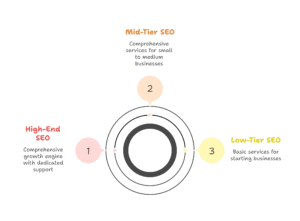
Understanding what’s included at different price points helps you set realistic expectations and choose the right level of service.
Low-Tier SEO ($400–$1,000/month)
At this price point, you’re getting the basics. Don’t expect miracles, but you can get some solid foundational work done.
Basic keyword research: The provider will identify 10-20 relevant keywords for your business. Don’t expect deep competitor analysis or long-tail keyword strategies.
On-page fixes: They’ll optimize your title tags, meta descriptions, and headers for your target keywords. Maybe some basic content recommendations.
Limited reporting: You’ll get monthly reports showing basic metrics like rankings and traffic, but don’t expect detailed analysis or strategic recommendations.
This level works for very small businesses just starting with SEO or those in low-competition niches. The work is often done by junior-level SEO practitioners or overseas providers.
Mid-Tier SEO ($1,000–$5,000/month)
This is the sweet spot for most small to medium businesses. You get comprehensive SEO services without breaking the bank.
Full-site audits: Detailed technical analysis identifying and fixing crawl errors, page speed issues, mobile problems, and other technical SEO factors.
Content strategy & writing: Strategic content planning based on keyword research, plus creation of optimized blog posts, landing pages, and other content.
Technical SEO optimizations: Implementation of schema markup, URL optimization, internal linking strategies, and other technical improvements.
Local SEO targeting: For businesses with local customers, optimization of Google My Business, local citations, and location-based content.
At this level, you typically work with experienced SEO professionals who understand strategy, not just tactics.
High-End SEO ($5,000–$30,000+/month)
This is where SEO becomes a comprehensive growth engine for your business.
Ongoing content production: Regular creation of high-quality, researched content targeting hundreds of keywords. We’re talking multiple blog posts per week, in-depth guides, and resource pages.
Link building & outreach: Proactive campaigns to earn high-quality backlinks from authoritative websites in your industry. This includes relationship building, guest posting, and digital PR.
Enterprise-level tools and analytics: Access to premium SEO tools and sophisticated tracking that provides deep insights into performance and opportunities.
Dedicated account manager: A senior SEO strategist who knows your business inside and out and develops custom strategies for your specific situation.
At this level, SEO becomes fully integrated with your overall marketing strategy. You’re not just trying to rank higher – you’re building a comprehensive online presence that drives significant business growth.
Freelancer SEO vs. Agency SEO Costs
One of the biggest decisions you’ll face is whether to hire an SEO freelancer or work with an agency. Both have pros and cons, and the costs can vary significantly.
Freelancer Pros & Pricing
SEO freelancers typically offer the most affordable option. You can find good freelancers charging $50-$150 per hour or $500-$3,000 per month for ongoing work.
The advantages of working with freelancers include:
- Lower costs: No agency overhead means more of your budget goes toward actual work
- Direct communication: You work directly with the person doing the work
- Flexibility: Often more willing to customize their approach to your specific needs
- Specialization: Some freelancers are experts in specific niches or types of SEO
However, freelancers also have limitations. They might lack the breadth of expertise that agencies offer, and if they get sick or go on vacation, your SEO work stops. They also typically don’t have access to the same premium tools and resources as agencies.
Agency Pros & Pricing
SEO agencies typically charge $1,000-$30,000+ per month, depending on their size and reputation. Yes, that’s more expensive than freelancers, but you’re paying for additional value.
Agency advantages include:
- Team expertise: Access to specialists in different areas of SEO (technical, content, link building, etc.)
- Consistent service: If one person leaves, the work continues
- Premium tools: Agencies invest in expensive SEO tools that individual freelancers can’t afford
- Proven processes: Established workflows and methodologies refined over many client engagements
- Accountability: More formal contracts and service level agreements
The downside is cost and sometimes less personal attention. At larger agencies, you might feel like a small fish in a big pond.
Which One’s Right For You?
Choose a freelancer if you have a limited budget, need specific expertise, or prefer working directly with the person doing the work. They’re often perfect for small businesses or specific projects.
Choose an agency if you need comprehensive SEO services, have a larger budget, or want the security of working with an established business. Agencies are typically better for competitive industries or complex websites.
There’s also a middle ground: boutique SEO agencies with 2-10 employees. They often provide agency-level expertise and tools with freelancer-level personal attention.
International SEO Pricing Comparison
If you’re considering working with SEO providers outside your home country, understanding international pricing differences can help you make informed decisions.
SEO Pricing in the US vs. UK, Canada, India, Australia
Here’s how SEO pricing compares across different countries:
US: $100–$300/hr
The United States has some of the highest SEO rates globally, especially in major cities like New York, San Francisco, and Los Angeles. The high cost of living and strong demand for SEO services drive these premium rates.
UK: £50–£150/hr
UK SEO rates are similar to the US when converted to dollars. London-based agencies command the highest rates, while providers in other cities charge somewhat less.
India: $20–$80/hr
India offers some of the most affordable SEO services globally. While quality varies significantly, many Indian SEO providers offer excellent value. Communication and time zone differences can be challenges.
Australia: $80–$200/hr
Australian SEO rates fall between the US and India. Sydney and Melbourne providers charge premium rates, while providers in smaller cities are more affordable.
Canada: $75–$200/hr
Canadian SEO pricing is generally lower than the US but higher than many other countries. Toronto and Vancouver command the highest rates.
When considering international providers, factor in communication challenges, time zone differences, and cultural nuances that might affect your SEO strategy.
Key Factors That Influence SEO Cost
Understanding what drives SEO pricing helps you budget appropriately and avoid unpleasant surprises.
Your Business Size & Goals
A local pizza shop has very different SEO needs than a national e-commerce retailer. Larger businesses typically need more comprehensive strategies, which cost more.
If you’re targeting aggressive growth goals – like doubling your organic traffic in 12 months – expect to pay more for the intensive work required to achieve those results.
Website’s Current SEO Health
A website that’s never been optimized requires more initial work than one that’s already well-optimized. Technical issues, poor site structure, and thin content all add to the workload and cost.
Some websites are so poorly optimized that they need complete overhauls before any meaningful SEO work can begin. This can significantly increase initial costs.
Industry Competition
Trying to rank for “personal injury lawyer” in Los Angeles is exponentially harder and more expensive than ranking for “pet grooming” in a small town. Highly competitive industries – legal, finance, insurance, real estate – require more aggressive strategies and larger budgets.
Number of Keywords & Pages
Optimizing for 10 keywords is much different than optimizing for 1,000. Similarly, a 50-page website requires less work than a 5,000-page e-commerce site.
More keywords and pages mean more research, more optimization work, and more ongoing maintenance – all of which increases costs.
Content Volume Required
Content creation is often the largest component of SEO costs. If your strategy requires multiple blog posts per week, in-depth guides, and resource pages, content costs can quickly add up.
High-quality, researched content typically costs $100-$500 per piece, depending on length and complexity. Some businesses need dozens of pieces per month.
Local vs. National Targeting
Local SEO is typically less expensive than national SEO because you’re competing in a smaller pool. However, local SEO in major cities like New York or Chicago can be just as competitive as national campaigns in some industries.
Example SEO Budget Scenarios
To make these numbers concrete, here are three illustrative scenarios showing how businesses at different sizes typically allocate SEO budgets and what results look like when campaigns go well. (Details are representative examples, not client case studies.)
Local Business Scenario: $1,200/month
A family-owned HVAC company competing in a mid-size metro area invests $1,200 per month in local SEO, focusing on keywords like “AC repair + city” and “emergency HVAC service.”
A typical strategy at this budget includes:
- Google Business Profile optimization
- Local citation building
- Service page optimization
- Regular blog content about HVAC maintenance
- Customer review management
For a business like this, doubling or tripling monthly leads within 6-12 months is a realistic outcome when the market isn’t saturated – and one or two extra jobs per month can cover the entire SEO investment.
eCommerce Scenario: $5,000/month
An online retailer losing market share to larger competitors invests $5,000 monthly in a comprehensive strategy:
- Technical SEO improvements
- Product page optimization
- Content marketing targeting its niche audience
- Link building through relevant blogs and publications
- Category page restructuring
At this investment level, a well-run campaign typically aims to double organic traffic within 12 months and generate a positive return on the SEO spend through organic revenue growth.
Enterprise Scenario: $20,000/month
A B2B software company competing for highly competitive keywords invests $20,000 monthly:
- Technical SEO for a complex site with thousands of pages
- Authority content creation targeting decision-makers
- Strategic link building and digital PR
- Conversion rate optimization
- Advanced analytics and reporting
Enterprise campaigns are measured in pipeline and revenue, not just traffic – and over an 18-24 month horizon, successful programs at this level typically target a multiple return on investment.
ROI of SEO: Is It Worth the Cost?
The big question everyone asks: is SEO actually worth what it costs? Let’s break down the numbers.
Time to Results
SEO is not a quick fix. Most businesses see initial improvements in 3-6 months, with significant results taking 6-12 months or longer. This timeline varies based on competition, starting point, and budget.
According to a study by Ahrefs analyzing 2 million pages, only 5.7% of pages rank in the top 10 within a year of publication. This emphasizes the importance of patience and consistent effort in SEO.
Don’t expect to invest in SEO and see immediate results. Anyone promising first-page rankings in 30 days is either lying or using tactics that could get you penalized.
Lead and Sales Growth Benchmarks
Well-executed SEO campaigns typically deliver:
- 20-100% increase in organic traffic within 12 months
- 15-50% increase in qualified leads
- 10-30% increase in conversion rates (organic traffic converts better than paid)
- 3:1 to 10:1 return on investment over 2-3 years
These numbers vary widely based on industry, competition, and execution quality, but they give you a realistic benchmark for expectations.
ROI vs. Paid Ads
Compared to paid advertising, SEO typically offers better long-term ROI. While paid ads stop working the moment you stop paying, SEO results can last for years.
Research by BrightEdge shows that SEO drives 1000%+ more traffic than organic social media, making it one of the most effective long-term marketing investments.
However, paid ads deliver immediate results while SEO takes time. The best approach for most businesses is using both strategies: paid ads for immediate results and SEO for long-term growth.
The Impact of AI on SEO Costs
Artificial intelligence is changing SEO in significant ways, affecting both what SEO providers can accomplish and how much they charge.
How AI Tools Are Changing SEO Services
AI tools are revolutionizing many aspects of SEO:
- Content creation: AI can help generate content outlines, first drafts, and even complete articles
- Keyword research: AI tools can identify keyword opportunities more efficiently than manual research
- Technical analysis: AI can crawl and analyze websites faster and more comprehensively than humans
- Competitive intelligence: AI can monitor competitors and identify opportunities automatically
These capabilities allow SEO providers to work more efficiently and deliver better results.
Do AI Tools Lower or Raise SEO Prices?
This is the million-dollar question. AI tools can make certain SEO tasks faster and cheaper, which could lower prices. However, they also enable more sophisticated strategies that might justify higher prices.
In practice, we’re seeing both effects. Some basic SEO services are becoming cheaper as AI automates routine tasks. But premium SEO services are becoming more sophisticated and valuable, potentially commanding higher prices.
What AI Can Do — and What Still Needs Experts
While AI is powerful, it can’t replace human expertise entirely. AI excels at:
- Data analysis and pattern recognition
- Content generation and optimization
- Technical auditing and monitoring
- Routine task automation
Humans are still essential for:
- Strategic thinking and planning
- Understanding business context and goals
- Creative problem-solving
- Relationship building and outreach
- Quality control and refinement
The best SEO providers in 2026 combine AI efficiency with human expertise and creativity.
How to Choose the Right SEO Package for Your Business
With so many options and price points, how do you choose the right SEO investment for your business?
Setting a Realistic SEO Budget
A good rule of thumb is to budget 5-10% of your desired revenue increase for SEO. If you want to grow revenue by $100,000 annually, budget $5,000-$10,000 for SEO.
Consider your industry competition and current website state. Highly competitive industries or websites that need significant work require larger budgets.
Start with what you can afford consistently for at least 6-12 months. It’s better to invest $2,000/month consistently than $5,000/month for three months and then stop.
Questions to Ask SEO Providers
Before hiring an SEO provider, ask these crucial questions:
- Can you provide case studies from similar businesses?
- What specific deliverables are included in the monthly fee?
- How do you measure and report success?
- What’s your process for keyword research and strategy development?
- How do you stay updated with Google algorithm changes?
- Can you provide references from current clients?
- What happens if we don’t see results in the expected timeframe?
Pay attention to how they answer. Good providers will be transparent about their process and realistic about timelines.
Red Flags to Avoid
Avoid SEO providers who:
- Guarantee specific rankings or results
- Offer extremely cheap services (like $99/month for comprehensive SEO)
- Can’t explain their strategies clearly
- Use high-pressure sales tactics
- Ask for long-term contracts upfront
- Can’t provide case studies or references
- Focus only on rankings rather than business results
- Promise immediate results
Remember, if it sounds too good to be true, it probably is.
Conclusion
SEO in 2026 is more sophisticated than ever, but the core principle remains the same: help people find what they’re looking for, and search engines will reward you with visibility. When you invest in quality SEO that focuses on real business results, you’re not just buying rankings – you’re buying sustainable growth for your business.


