

Picture this: You’ve just landed your dream SEO client. They’re excited, you’re excited, and everyone’s ready to boost those rankings. Fast forward three months, and suddenly they’re asking why their site isn’t ranking number one for “best pizza” when you’ve been working on local SEO for their accounting firm.
Sound familiar? This exact scenario happens more often than you’d think, and it’s why every SEO professional needs a rock-solid contract. Whether you’re a freelancer just starting out or running a full-scale agency, the right contract isn’t just a piece of paper—it’s your business lifeline.
In this guide, we’re diving deep into everything you need to know about SEO contracts. From understanding the basics to crafting bulletproof agreements that protect both you and your clients, we’ve got you covered. Plus, we’ll share some insider tips from real SEO pros and even provide actionable templates to get you started.
What Is an SEO Contract?
An SEO contract is a legally binding agreement between an SEO service provider and a client that outlines the specific services to be performed, expectations, deliverables, timelines, and compensation. Think of it as your roadmap for the entire SEO relationship.
But here’s the thing—an SEO contract isn’t just about covering your legal bases (though that’s important too). It’s about setting the foundation for a successful, long-term partnership. According to a 2025 study by Search Engine Land, 78% of SEO professionals who use detailed contracts report better client relationships and fewer disputes.

The main purposes of an SEO contract include:
- Clearly defining what SEO services will be provided
- Setting realistic expectations for results and timelines
- Establishing payment terms and schedules
- Protecting both parties from potential disputes
- Creating accountability for deliverables and milestones
“A well-structured SEO contract is like a GPS for your client relationship—it keeps everyone on the right path and prevents costly detours.” – Neil Patel, Neil Patel Digital
SEO Contract vs. SEO Service Agreement
You might hear these terms used interchangeably, and honestly, they’re pretty similar. However, there are some subtle differences worth noting.
An SEO contract tends to be more formal and legally focused. It’s typically used for larger projects or long-term retainer relationships where there’s significant money and time investment involved. These contracts often include detailed legal language about liability, intellectual property, and dispute resolution.
An SEO service agreement, on the other hand, is usually simpler and more straightforward. It focuses primarily on the services being provided and basic terms like payment and duration. These are often used for smaller projects or when working with clients who prefer less formal documentation.
The key is choosing the right document for your situation. If you’re working with enterprise clients or handling sensitive data, go with a full contract. For smaller local businesses or short-term projects, a service agreement might be perfectly adequate.
Why You Need an SEO Contract
Protects Both Client and Provider
Let’s be real for a second—SEO can be unpredictable. Google updates algorithms, competitors change strategies, and sometimes results take longer than expected. Without a proper contract, these normal fluctuations can quickly turn into major disputes.
Data from Moz’s 2025 SEO Industry Survey shows that 65% of SEO providers without formal contracts experience payment delays or disputes, compared to just 12% of those with comprehensive agreements.
For SEO providers, contracts protect against scope creep, non-payment, and unrealistic expectation battles. They give you something concrete to point to when a client asks you to “just quickly optimize 500 more pages” or wonders why they’re not ranking number one after two weeks.
For clients, contracts ensure they’re getting what they paid for. They provide clear deliverables, timelines, and recourse if things go sideways. A good contract actually makes clients more confident in their investment because they can see exactly what they’re getting.
Sets Clear Expectations and Deliverables
Here’s where most SEO relationships go wrong—unclear expectations. The client thinks “SEO” means instant number one rankings, while you know it means a comprehensive, long-term strategy that might take months to show significant results.
A detailed contract eliminates this confusion by spelling out exactly what success looks like. Instead of vague promises like “improve your rankings,” your contract should specify measurable deliverables like:
- “Optimize 20 target pages for specific keywords within 60 days”
- “Increase organic traffic by 25% within 6 months”
- “Improve site loading speed to under 3 seconds”
- “Generate 15 high-quality backlinks per month”
When everyone knows what to expect and when to expect it, projects run smoother and relationships stay positive.
“The biggest mistake I see SEO professionals make is being vague about deliverables. Specificity saves relationships.” – Brian Dean, Backlinko
Improves Client Retention and Communication
This might surprise you, but clients actually prefer working with SEO professionals who use contracts. According to HubSpot’s 2025 Service Industry Report, 82% of clients view detailed contracts as a sign of professionalism and expertise.
Contracts also improve communication by creating regular check-in points and reporting schedules. When your contract specifies monthly strategy calls and quarterly performance reviews, you’re building relationship touchpoints that keep clients engaged and informed.
Plus, when renewal time comes around, you already have a framework in place. Instead of starting from scratch, you can simply update terms and extend the agreement. This makes renewals faster and more likely to happen.
Key Elements Every SEO Contract Should Include

1. Scope of Services
This is arguably the most important section of your entire contract. The scope of services section should read like a detailed job description—specific enough to prevent confusion, but comprehensive enough to cover all your planned activities.
Instead of just saying “SEO services,” break it down into specific categories:
- Technical SEO: Site audits, page speed optimization, mobile responsiveness, XML sitemaps, robots.txt optimization
- On-Page SEO: Keyword research, title tag optimization, meta descriptions, header tag structure, internal linking
- Content Strategy: Content audits, keyword-optimized blog posts, page copy improvements, content calendar development
- Off-Page SEO: Link building, local citations, online reputation management, social signals
Be specific about what’s included and, equally important, what’s not included. If website development isn’t part of your service, say so clearly. If paid advertising is separate, mention that too.
2. Deliverables and Milestones
Deliverables are the tangible outputs your client can expect, while milestones are the timeline markers that show progress. Both are crucial for keeping projects on track and clients satisfied.
Good deliverables are specific and measurable. Instead of “SEO report,” specify “Monthly 20-page SEO performance report including organic traffic growth, keyword ranking improvements, technical issues addressed, and next month’s strategy.”
Milestones should align with your SEO strategy phases:
- Month 1: Complete technical audit and initial keyword research
- Month 2: Implement technical fixes and optimize priority pages
- Month 3: Launch content strategy and begin link building
- Month 6: Comprehensive performance review and strategy adjustment
3. Timelines and Deadlines
SEO timelines can be tricky because results aren’t always predictable. However, you can definitely set timelines for your activities and deliverables, even if you can’t guarantee specific ranking improvements by certain dates.
Research from Ahrefs indicates that 73% of successful SEO campaigns show measurable improvements within 3-6 months, but this varies significantly based on competition and starting point.
Structure your timelines in two parts:
- Activity timelines: When you’ll complete specific tasks like audits, optimizations, and content creation
- Review periods: When you’ll assess results and adjust strategies based on performance
Always include buffer time for revisions and unexpected issues. If you think something will take two weeks, build in three weeks to account for client feedback cycles and potential complications.
4. Payment Terms and Pricing
Money conversations can be awkward, but your contract should make payment terms crystal clear. This section should cover:
- Total project cost or monthly retainer amount
- Payment schedule (upfront, monthly, milestone-based)
- Accepted payment methods
- Late payment fees and policies
- Refund policies
- Expense reimbursement procedures
For retainer agreements, specify what happens if the client wants to pause or reduce services mid-contract. For project-based work, outline what additional costs might arise if the scope changes.
Pro tip: Consider requiring a percentage upfront (typically 25-50%) for new clients. This protects you from non-payment and demonstrates the client’s commitment to the project.
5. Legal Terms and Compliance (e.g., GDPR, CCPA)
In today’s privacy-focused world, data compliance isn’t optional—it’s essential. Your contract needs to address how you’ll handle client data and ensure compliance with relevant regulations.
Key compliance areas to address:
- GDPR compliance for European clients or EU data
- CCPA compliance for California-based businesses
- Data storage and security practices
- Third-party tool data sharing (analytics, SEO tools, etc.)
- Client website privacy policy requirements
If you’re not sure about specific legal requirements, it’s worth consulting with a lawyer who understands digital marketing regulations. The small upfront cost can save you from major legal headaches later.
6. Confidentiality and IP Ownership
SEO work often involves access to sensitive business information—traffic data, revenue figures, competitive strategies, and proprietary processes. Your contract should clearly address confidentiality expectations for both parties.
The intellectual property section should specify:
- Who owns content created during the engagement
- Whether you can use client work as case studies (with permission)
- What happens to deliverables if the contract terminates early
- Rights to use proprietary SEO tools and methodologies
Generally, clients should own content created specifically for their business (like website copy), while you retain rights to your processes, templates, and methodologies.
7. Termination and Renewal Clauses
Nobody wants to think about ending a relationship before it starts, but clear termination clauses protect everyone involved. This section should cover:
- Notice requirements for termination (typically 30 days)
- Circumstances that allow immediate termination
- How final payments and deliverables are handled
- Data return and deletion procedures
- Non-compete or non-solicitation terms (if applicable)
For renewal clauses, specify whether contracts auto-renew, require active renewal, or need renegotiation. Auto-renewal can be convenient, but make sure both parties have easy exit options if circumstances change.
SEO Contracts by Service Type
Local SEO Contracts
Local SEO has its own unique requirements and challenges, so your contracts should reflect that specificity. Local SEO clients often have different expectations and success metrics compared to broader SEO campaigns.
Key elements for local SEO contracts:
- Geographic targeting specifications: Which cities, regions, or radius areas you’ll target
- Local citation building: How many directories, which platforms, and quality standards
- Google Business Profile optimization: Specific services like photo optimization, post creation, and review management
- Review management scope: Whether you’re monitoring, responding, or just reporting on reviews
- Local content creation: Location-specific landing pages, local event coverage, community involvement content
BrightLocal’s 2025 Local SEO Industry Survey found that 68% of local businesses see improved rankings within 90 days when working with experienced local SEO providers, so your timelines can often be more aggressive than national campaigns.
Technical SEO Agreements
Technical SEO projects require a different contract approach because they’re often more project-based than ongoing, and they require specific technical expertise and access.
Technical SEO contracts should specify:
- Required access levels: Website admin access, hosting account access, developer collaboration requirements
- Technical deliverables: Specific fixes like site speed improvements, mobile optimization, schema markup implementation
- Testing and validation procedures: How you’ll test changes and measure improvements
- Backup and rollback procedures: What happens if technical changes cause issues
- Developer coordination: How you’ll work with the client’s existing technical team
Since technical SEO often involves website changes that could potentially cause issues, your contract should include clear liability limitations and testing procedures.
Content SEO Contracts
Content-focused SEO engagements need contracts that address both the SEO strategy and content creation processes. These agreements often involve more creative elements and subjective quality assessments.
Content SEO contract essentials:
- Content quantity and types: How many blog posts, landing pages, or other content pieces per month
- Research and keyword integration: How keyword research informs content creation
- Content approval processes: Review cycles, revision limits, and approval timelines
- Content ownership and usage rights: Who owns the content and how it can be used
- Editorial guidelines and brand voice: Quality standards and style requirements
Consider including sample content or detailed style guides as contract appendices to ensure everyone understands quality expectations from the start.
Link Building and Outreach Contracts
Link building contracts need special attention because this area of SEO carries higher risks and often involves representing the client’s brand in outreach communications.
Link building agreements should address:
- Link quality standards: Domain authority minimums, relevance requirements, no-spam policies
- Outreach procedures: Communication templates, approval processes, brand representation guidelines
- Reporting and transparency: What link metrics you’ll track and report
- Risk management: How you’ll avoid toxic links and handle potential Google penalties
- Third-party relationships: Whether you’ll work with other websites, influencers, or paid placement (and disclosure requirements)
“Link building is high-risk, high-reward. Your contract should reflect both the potential and the precautions.” – Tim Soulo, Ahrefs
How to Customize SEO Contracts for Different Clients
Freelancers vs. Agencies
The size and structure of your SEO business should influence how you approach contracts. Freelancers and agencies have different capabilities, resources, and risk profiles.
Freelancer contract considerations:
- Emphasize personal expertise and specialized skills
- Include provisions for vacation time and sick days
- Limit scope to manageable workloads
- Consider simpler payment terms and shorter contracts
- Include clear boundaries about availability and response times
Agency contract considerations:
- Highlight team capabilities and backup resources
- Include account management and communication structures
- Offer more comprehensive service packages
- Implement more formal reporting and review processes
- Include team transition procedures if account managers change
Small Businesses vs. Enterprise Clients
Different client sizes require different contract approaches. Small businesses often need simpler terms and more education, while enterprise clients may require extensive legal review and complex approval processes.
Small business contract tips:
- Use plain language and avoid excessive legal jargon
- Include educational elements about SEO timelines and processes
- Offer flexible payment terms and smaller upfront commitments
- Focus on practical, measurable outcomes
- Keep contracts concise but comprehensive
Enterprise client considerations:
- Prepare for legal review and potential contract negotiations
- Include detailed compliance and security provisions
- Address complex approval hierarchies and stakeholder management
- Plan for longer sales cycles and contract approval processes
- Include provisions for working with multiple departments and teams
One-Time Projects vs. Monthly Retainers
Project-based and retainer contracts serve different purposes and require different structures.
Project-based contracts should focus on:
- Specific deliverables and completion criteria
- Clear project phases and milestones
- Change order procedures for scope modifications
- Final deliverable transfer and project closure
- Warranty periods for completed work
Retainer contracts should emphasize:
- Ongoing service levels and monthly deliverables
- Performance tracking and regular reviews
- Flexibility for strategy adjustments
- Long-term relationship building
- Renewal terms and pricing escalations
Contract Lifecycle: What to Know
Creating and Sending Contracts
The contract creation process sets the tone for your entire client relationship. Start by gathering detailed information about the client’s needs, goals, and constraints during your initial consultations.
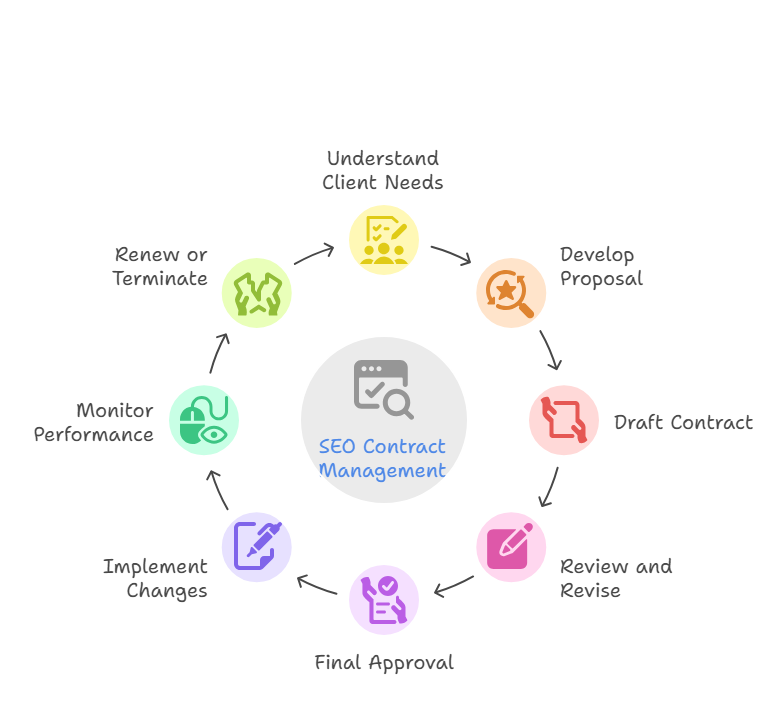
Here’s a streamlined contract creation process:
- Discovery phase: Understand the client’s business, current SEO situation, and specific goals
- Proposal development: Create a detailed proposal outlining your recommended approach
- Contract drafting: Translate the proposal into contract terms and deliverables
- Review and revision: Allow time for client questions and reasonable modifications
- Final approval: Get signatures from all necessary parties
When sending contracts, include a cover email that summarizes key points and explains next steps. Make it easy for clients to ask questions or request clarifications before signing.
Amendments and Scope Changes
Even the best contracts sometimes need adjustments. The key is having clear procedures for handling changes without derailing the entire project.
Effective change management includes:
- Change request procedures: How clients can request modifications
- Impact assessment: How you’ll evaluate timeline and budget implications
- Approval processes: Who needs to approve changes and how
- Documentation requirements: How changes will be recorded and tracked
Small changes can often be handled with simple email confirmations, but significant scope changes should require formal contract amendments with new signatures.
Renewals and End-of-Term Options
Successful contract renewals start long before the current contract expires. Begin renewal conversations at least 60-90 days before the end date to allow time for planning and negotiation.
Renewal best practices:
- Review performance against original goals and deliverables
- Present data showing results and ROI from your work
- Propose improvements or new strategies for the next term
- Address any concerns or challenges from the current contract
- Offer incentives for multi-year commitments when appropriate
How to Legally Terminate a Contract
Sometimes contracts need to end early, either due to performance issues, changing business needs, or other circumstances. Following proper termination procedures protects both parties legally.
Legal termination typically involves:
- Providing required notice (usually 30 days unless contract specifies otherwise)
- Documenting the reasons for termination
- Completing final deliverables and payments
- Returning or securely deleting confidential information
- Providing transition assistance if specified in the contract
Best Practices for SEO Contracts
Use Simple Language
Legal documents don’t have to sound like they were written by ancient lawyers using outdated language. Your contracts should be clear, straightforward, and easy to understand.
Instead of “The party of the first part shall endeavor to optimize the digital presence,” try “We will improve your website’s search engine rankings.” Your clients will appreciate contracts they can actually read and understand.
Simple language benefits everyone:
- Reduces misunderstandings and disputes
- Makes clients more comfortable signing contracts
- Speeds up the review and approval process
- Demonstrates your communication skills
- Makes future reference easier for both parties
Include Exit Clauses
Even confident SEO professionals should include reasonable exit clauses in their contracts. These provisions protect both parties if circumstances change or if the relationship isn’t working out.
Good exit clauses specify:
- Notice requirements for contract termination
- How final payments and deliverables are handled
- Data return and confidentiality obligations post-termination
- Any non-compete or non-solicitation restrictions
- Procedures for transferring ongoing work to new providers
Always Use E-Signatures
Digital signatures aren’t just convenient—they’re often more legally secure than traditional paper signatures. E-signature platforms provide audit trails, timestamps, and verification that can be crucial if disputes arise.
Benefits of e-signature platforms:
- Faster contract execution and project start times
- Better record keeping and document management
- Reduced printing, scanning, and mailing costs
- Environmental benefits from paperless processes
- Integration with CRM and project management systems
Popular e-signature platforms include DocuSign, Adobe Sign, and PandaDoc, all of which offer legally binding signatures accepted in most jurisdictions.
Keep a Version History
Contracts often go through multiple revisions during negotiation, and you need to track these changes carefully. Version control prevents confusion and ensures everyone is working from the same document.
Effective version control includes:
- Clear file naming conventions (e.g., “ClientName_SEO_Contract_v2.1”)
- Change logs documenting what was modified in each version
- Secure storage of all contract versions
- Clear identification of the final, executed version
- Backup procedures to prevent document loss
Top SEO Contract Templates (With Comparison)
Comparison Table: Template Features & Use Cases
Not all SEO contract templates are created equal. Here’s a breakdown of different template types and when to use them:
Basic SEO Service Agreement
- Best for: Small projects, new freelancers, simple retainer relationships
- Length: 2-4 pages
- Key features: Basic service description, payment terms, simple termination clause
- Pros: Quick to customize, easy client approval
- Cons: Limited legal protection, may not cover complex scenarios
Comprehensive SEO Contract
- Best for: Large projects, enterprise clients, long-term retainers
- Length: 8-15 pages
- Key features: Detailed service descriptions, comprehensive legal terms, IP clauses, compliance provisions
- Pros: Strong legal protection, covers most scenarios
- Cons: Can be intimidating for small clients, longer approval process
Retainer-Specific Agreement
- Best for: Ongoing monthly SEO services
- Length: 4-8 pages
- Key features: Monthly deliverables, performance tracking, renewal terms
- Pros: Optimized for ongoing relationships
- Cons: Not suitable for project-based work
Editable and Downloadable Options (Free + Paid)
When seeking SEO contract templates, look for resources that offer both free and premium options:
Free Resources:
- Legal template websites with basic SEO service agreements
- SEO industry blogs offering simplified contract templates
- Professional association resources for marketing consultants
- Government small business resources with general service contracts
Paid Premium Options:
- Legal software platforms with industry-specific templates
- SEO tool companies offering contract libraries to subscribers
- Business consultants specializing in agency operations
- Legal professionals who understand digital marketing contracts
Retainer Agreements vs. Project-Based Contracts
Understanding when to use retainer agreements versus project-based contracts can significantly impact your business success and client satisfaction.
Retainer agreements work best when:
- Clients need ongoing SEO maintenance and optimization
- You’re providing comprehensive, multi-faceted SEO services
- The client values consistent, predictable service delivery
- You want steady, recurring revenue
- The SEO strategy requires continuous adjustment and optimization
Project-based contracts are ideal for:
- Specific, defined SEO needs like technical audits
- Clients with limited budgets who need targeted improvements
- Short-term campaign work or seasonal optimization
- Clients who prefer to evaluate results before committing long-term
- Specialized services like local SEO setup or penalty recovery
Using AI and Automation to Generate Contracts
AI Contract Tools for SEO Professionals
Artificial intelligence is revolutionizing contract creation, making it faster and easier to generate customized agreements. According to Legal Tech News, 47% of service businesses now use AI-powered contract tools to streamline their legal documentation process.
AI contract tools typically offer:
- Industry-specific templates and clause libraries
- Automated customization based on client information
- Risk assessment and recommendations
- Integration with CRM and project management systems
- Real-time collaboration and revision tracking
Pros and Cons of Automated Legal Docs
Advantages of AI-generated contracts:
- Speed: Generate comprehensive contracts in minutes instead of hours
- Consistency: Standardized language and formatting across all contracts
- Cost-effectiveness: Reduce legal review costs for standard agreements
- Accessibility: Advanced legal language made available to small businesses
- Updates: Automatic incorporation of new legal requirements and best practices
Potential drawbacks:
- Generic language: May not address unique business situations
- Legal limitations: AI can’t replace professional legal advice for complex situations
- Over-reliance risk: May reduce understanding of actual contract terms
- Jurisdiction issues: May not account for specific local laws and regulations
Popular Tools (e.g., PandaDoc, Docracy, Legalese.ai)
Several platforms are leading the way in AI-powered contract generation for service businesses:
PandaDoc offers comprehensive document automation with SEO-friendly templates, e-signature integration, and CRM connectivity. It’s particularly strong for service-based businesses and offers good customization options.
LawGeex provides AI-powered contract review and generation with strong focus on legal accuracy and risk assessment. It’s more expensive but offers enterprise-level legal compliance.
ContractPodAi combines contract generation with lifecycle management, making it good for agencies handling multiple client contracts simultaneously.
SEO Contracts and Legal Compliance
Jurisdiction Matters: Local, National, and International Law
Legal requirements for contracts vary significantly depending on where you and your clients are located. Understanding jurisdiction issues is crucial for creating enforceable contracts and avoiding legal complications.
Key jurisdiction considerations:
- Governing law: Which country’s or state’s laws will govern contract interpretation
- Dispute resolution: Where legal disputes will be handled
- Service delivery location: Where the actual SEO work will be performed
- Business registration: Where your business is legally established
- Tax implications: How different jurisdictions affect tax obligations
GDPR, CCPA, and Data Processing Clauses
Data privacy regulations significantly impact SEO contracts because SEO work often involves handling personal data through analytics, user behavior tracking, and customer information.
GDPR compliance requirements include:
- Clear data processing purposes and legal bases
- Data subject rights and procedures
- Data breach notification procedures
- Cross-border data transfer safeguards
- Data retention and deletion policies
CCPA considerations involve:
- Consumer rights to data access and deletion
- Opt-out mechanisms for data sales
- Third-party data sharing disclosures
- Business vs. service provider relationships
Working with Clients in Different Countries
International SEO contracts require additional considerations beyond standard domestic agreements. Currency, time zones, communication preferences, and cultural differences all impact contract terms.
International contract considerations:
- Currency and payment methods: Which currency for payments and who handles conversion fees
- Communication schedules: How time zone differences affect meetings and deliverables
- Cultural business practices: How different cultures approach contracts and business relationships
- Local SEO requirements: Country-specific search engines and optimization practices
- Tax and reporting obligations: International tax implications and reporting requirements
Step-by-Step: How to Create an SEO Contract
Step 1: Outline Your Services
Start by clearly defining exactly what SEO services you provide. This isn’t just a list of activities—it’s a comprehensive description of how you approach SEO strategy and execution.
Begin with a client consultation to understand:
- Their current SEO situation and challenges
- Specific goals and success metrics
- Budget constraints and timeline expectations
- Internal resources and team capabilities
- Previous SEO experiences and lessons learned
Then organize your services into logical categories that align with their needs. Use tools like Ahrefs or SEMrush to conduct thorough audits that inform your service recommendations.
Step 2: Set Terms and Payment Schedules
Payment terms can make or break client relationships, so invest time in creating fair, clear payment structures that work for both parties.
Consider these payment options:
- Monthly retainer: Fixed monthly fee for ongoing services
- Project-based: Total project cost paid in installments tied to milestones
- Hybrid model: Base retainer plus project fees for additional work
- Performance-based: Base fee plus bonuses tied to specific results (use carefully)
Step 3: Add Legal Protections
Legal protections aren’t about being difficult—they’re about creating clear boundaries that protect both parties and prevent misunderstandings.
Essential legal protections include:
- Liability limitations: Reasonable limits on your responsibility for client losses
- Force majeure clauses: Protection against unforeseeable circumstances
- Confidentiality agreements: Protection for sensitive business information
- Intellectual property terms: Clear ownership of created materials
- Dispute resolution procedures: How conflicts will be handled
Step 4: Customize Based on Client Type
No two clients are exactly alike, so your contracts should reflect the specific needs and circumstances of each engagement.
Customization factors include:
- Industry-specific requirements: Healthcare, finance, and other regulated industries have special needs
- Company size and structure: Enterprise clients need different terms than small businesses
- Technical capabilities: Clients with strong technical teams need different support than those without
- Risk tolerance: Some clients prefer conservative approaches while others embrace aggressive strategies
Step 5: Review and Sign
The final review and signature process sets the tone for your entire working relationship. Make this process as smooth and professional as possible.
Effective review processes include:
- Sending contracts with clear explanation emails
- Scheduling review calls to answer questions
- Using professional e-signature platforms
- Providing signed copies to all parties immediately
- Setting clear next steps for project kickoff
Pro Tips From SEO Experts
Quotes From Real Agencies and Freelancers
We’ve gathered insights from experienced SEO professionals who’ve learned contract lessons the hard way:
“I used to think contracts were just formalities until a client demanded refunds because they didn’t rank number one after one month. Now my contracts clearly explain SEO timelines and what realistic results look like. It’s saved me countless headaches.” – Sarah M., Freelance SEO Consultant
“The best contract advice I can give is to include specific examples of deliverables. Instead of saying ‘monthly reports,’ I specify ’20-page comprehensive reports including traffic analysis, keyword rankings, technical issues, and next month’s strategy.’ Clients know exactly what they’re getting.” – Mike R., SEO Agency Owner
“Payment terms were killing my cash flow until I started requiring 50% upfront for new clients. It sounds scary, but professional clients understand the reasoning, and it filters out tire-kickers who aren’t serious about investing in SEO.” – Jennifer L., Local SEO Specialist
Common Mistakes to Avoid
Learn from others’ mistakes with these common contract pitfalls:
- Vague service descriptions: “SEO services” means different things to different people. Be specific about what you’ll actually do.
- Unrealistic timelines: Promising “first page rankings in 30 days” sets you up for failure and disappointed clients.
- No scope change procedures: Clients will ask for additional work. Have clear procedures for handling these requests.
- Weak payment terms: “Net 30” payment terms can create cash flow problems. Consider requiring faster payment or upfront deposits.
- Missing liability protections: SEO involves risk. Make sure your contracts include reasonable liability limitations.
Negotiation Tips That Don’t Scare Clients Away
Contract negotiation doesn’t have to be adversarial. Here’s how to handle client concerns while protecting your interests:
- Lead with education: Explain why certain terms exist rather than just saying “that’s our policy”
- Offer alternatives: If clients resist certain terms, propose alternative solutions that meet both parties’ needs
- Use analogies: Compare SEO contracts to other professional services like legal or medical contracts
- Stay flexible on non-essentials: Compromise on minor terms while holding firm on important protections
- Focus on partnership: Frame contracts as partnership agreements rather than vendor relationships
“The goal isn’t to win the contract negotiation—it’s to start a successful partnership. Reasonable clients appreciate fair terms that protect everyone.” – Rand Fishkin, SparkToro
Final Thoughts
Why SEO Contracts Are Non-Negotiable in 2025
The SEO industry has matured significantly over the past decade. What used to be a “Wild West” environment of handshake deals and informal agreements has evolved into a professional service industry with sophisticated clients and complex requirements.
In 2025, SEO contracts aren’t just recommended—they’re essential for business survival. Here’s why:
- Legal complexity: Data privacy laws, compliance requirements, and international regulations make legal protection crucial
- Client sophistication: Modern clients expect professional service delivery with clear accountability
- Competitive landscape: Professional contracts differentiate you from less serious competitors
- Financial protection: Proper contracts protect your cash flow and business sustainability
- Relationship management: Clear agreements create better client relationships and higher satisfaction
Next Steps: Build Your Contract and Grow Your SEO Biz
Now that you understand the importance and components of effective SEO contracts, it’s time to take action. Here’s your roadmap for implementing professional contracts in your SEO business:
Immediate actions (this week):
- Audit your current contract situation—do you have adequate protection?
- Research contract templates or tools that fit your business size and needs
- List your specific services and deliverables to include in future contracts
- Identify any legal compliance requirements for your target markets
Short-term goals (next month):
- Create or customize your standard SEO contract template
- Have a legal professional review your contract for adequacy
- Set up e-signature and contract management systems
- Practice explaining contract terms to potential clients
Long-term strategy (next quarter):
- Implement contracts for all new client relationships
- Review and update existing client agreements when possible
- Track how contracts improve client relationships and business outcomes
- Continuously refine your contract terms based on experience
The SEO industry continues to evolve, but one thing remains constant: successful SEO professionals protect their businesses and serve their clients better with clear, comprehensive contracts. Don’t let another day pass without this essential business protection in place.


