

There are now over 4.5 million podcasts competing for listeners’ attention across Apple Podcasts, Spotify, YouTube, and dozens of smaller directories. Most of them are invisible beyond the audience the host already has. The reason is not content quality — there are exceptional shows that consistently publish to an audience of dozens because no systematic effort has been made to help new listeners find them. Podcast SEO is the infrastructure that changes that equation: the disciplined, technical practice of making podcast content findable by people who do not yet know the show exists.
The mechanics of podcast SEO are different from traditional web SEO in one critical way: search engines cannot hear audio. A 60-minute conversation between two experts on customer acquisition strategy contains thousands of keyword-rich sentences, precise answers to search queries that thousands of people type every month, and specific terminology that prospective listeners are actively searching for — but none of it is accessible to a search engine crawler unless it has been converted to text and published on a page that can be indexed. The transcript is the SEO foundation; every other optimization builds on it. Show notes, episode pages, structured data markup, podcast directory listings, competitive keyword research, inbound links, and audience analytics all operate on top of that text layer.
The tools that define a modern podcast SEO program span several distinct functions that work together: keyword research tools that identify what prospective listeners are searching for before content is recorded, transcription tools that convert audio into the crawlable text that makes episodes indexable, show notes generators that turn those transcripts into structured, keyword-optimized web content, podcast website builders that create SEO-ready episode pages with proper metadata and schema markup, podcast directories where accurate and optimized listings improve internal discovery, analytics platforms that reveal who is listening and how they are finding the show, and general SEO tools that apply traditional search optimization to the podcast’s web presence. No single tool covers the full spectrum — the most effective podcast SEO programs use three to five complementary tools with clearly defined roles.
This guide evaluates the best tools for podcast SEO across the full spectrum of functions, with verified pricing and specific guidance on which tool serves which function best.
Quick Comparison: Top 10 Podcast SEO Tools for 2026
| # | Tool | SEO Function | Starting Price | Free Tier | Best Feature | Our Rating |
|---|---|---|---|---|---|---|
| 1 | Ahrefs | Keyword research for episode topics and show strategy | Starter $29/mo; Lite $129/mo | Yes (7-day trial) | Episode keyword research with search volume, difficulty, and question-based query surfacing | 9.4/10 |
| 2 | Descript | Transcription and text-based editing for SEO content | Free; Hobbyist $16/mo (annual) | Yes | Edit audio by editing text — fastest transcription-to-publishable-content workflow available | 9.3/10 |
| 3 | Podpage | Podcast website builder with automatic SEO-optimized episode pages | Basic $19/mo ($12/mo annual) | Yes (14-day trial) | Auto-generates individual episode pages with schema markup, transcripts, and show notes | 9.2/10 |
| 4 | Capsho | AI show notes, blog posts, and episode metadata generation | $99/mo | Yes (7-day trial) | Converts raw episode audio into a complete set of SEO-optimized content assets in minutes | 9.0/10 |
| 5 | Listen Notes | Podcast search engine for directory visibility and competitive research | Free (search); API from free | Yes | The largest independent podcast search database — critical for listing optimization and category benchmarking | 9.1/10 |
| 6 | Rephonic | Podcast database for competitive intelligence and guest cross-promotion | Light $99/mo; Standard $149/mo; Business $299/mo | Yes (7-day trial) | Audience size estimates, contact data, and network mapping for podcast growth strategy | 8.9/10 |
| 7 | CoHost | Advanced podcast analytics with B2B audience demographics | Lite Plan $34/mo (demo) | Yes (7-day trial) | B2B listener intelligence — identifies which companies and job titles are in your audience | 9.1/10 |
| 8 | Buzzsprout | SEO-friendly hosting with IAB-certified analytics and transcription | Free (90 days); $19/mo | Yes | Podcast-specific website, IAB-certified download analytics, and directory submission in one platform | 9.0/10 |
| 9 | Semrush | Web SEO and keyword research for podcast episode pages | Pro $139.95/mo | No (7-day trial) | Episode page keyword targeting and unlinked mention discovery for link-building from podcast web content | 9.2/10 |
| 10 | Google Search Console | Free search performance monitoring for podcast web content | Free | Yes (completely) | Zero-cost indexing verification and search performance data for every podcast episode page | 9.0/10 |
How We Evaluated These Podcast SEO Tools
Every tool in this guide was assessed across six dimensions that reflect the real demands of a podcast SEO program — not feature checkboxes or generic discovery metrics.
Keyword research quality for podcast-specific content: Effective podcast SEO starts before recording begins. The tools that generate the most durable organic traffic are those whose episode topics are aligned with the specific search queries their target audience actually uses — not what the host assumes they search for. We evaluated how well each tool surfaces podcast-relevant keywords, question-based queries, and topical clusters that translate into episode titles, show notes, and web page content that ranks.
Transcription accuracy and SEO readiness: The transcript is the primary SEO asset for any audio-first podcast. A transcript that is 70 percent accurate and requires two hours of manual correction per episode creates production overhead that most podcasters abandon within months. We evaluated transcription accuracy on representative audio samples including multiple speakers, technical terminology, proper nouns, and conversational speech patterns — and the speed with which raw transcripts can be converted into publishable, structured content without manual editing.
Episode page optimization quality: The episode page is the searchable unit of podcast SEO. A well-optimized episode page includes a keyword-targeted title and meta description, structured show notes functioning as a blog post, a complete transcript published as indexed text, schema markup for podcast content, appropriate internal linking, and a canonical URL structure that separates each episode’s SEO equity. We evaluated how well each tool supports or automates these page-level optimizations.
Directory and platform discoverability: Podcast SEO is not only about Google. Apple Podcasts, Spotify, and specialized podcast directories like Listen Notes all have their own search and recommendation algorithms, and optimizing podcast metadata for these platform-internal algorithms can generate significant audience growth independent of Google search traffic. We evaluated each tool’s contribution to directory optimization, category selection, metadata quality, and platform algorithm performance.
Content repurposing for SEO scale: The most efficient podcast SEO programs generate multiple pieces of indexable content from each episode — not just a transcript, but a structured blog post, a YouTube description, social media posts, and email newsletter content that each create additional discovery surfaces. We evaluated the tools that accelerate this repurposing workflow and their effect on the total volume of SEO-optimized content generated per episode.
Analytics and performance intelligence: Podcast SEO programs that do not measure what is working cannot be systematically improved. We evaluated the depth of analytics each tool provides — download trends, listener demographics, episode retention, traffic sources, search query data, and the audience intelligence that informs both content strategy and SEO targeting decisions.
Why Podcast SEO Has Changed in 2026
Three developments define the podcast SEO landscape in 2026 that distinguish it meaningfully from three years earlier.
The first is YouTube’s displacement of traditional podcast apps as the primary discovery channel. According to Cumulus/Signal Hill 2025 research, YouTube has surpassed Apple Podcasts and Spotify as the primary way U.S. listeners discover new podcasts. This development changes the SEO architecture for podcast growth: YouTube is fundamentally a search engine, and the optimization disciplines that drive discoverability on YouTube — keyword-targeted titles, searchable descriptions, chapter markers, closed captions, thumbnail optimization — are now central to podcast audience acquisition in a way they were not when discovery happened primarily through Apple Podcasts’ category browse and Spotify’s editorial curation. Podcasts that publish video to YouTube with proper optimization are accessing the largest search-driven discovery channel available; podcasts that publish audio only are choosing to be absent from that channel.
The second is the expansion of podcast SEO scope into AI-generated content surfaces. Listeners increasingly use AI assistants to identify podcast recommendations, get summaries of specific episodes, or find shows relevant to a topic. The podcasts that appear in AI-generated recommendations are those that are consistently and accurately represented in the indexed text across their web presence — episode pages, transcripts, show notes, and directory listings. Keyword-optimized, structured text content that has been published, indexed, and accumulated citations over time is the foundation of both traditional Google SEO and AI retrieval visibility. The investment in podcast SEO made today for Google indexing is simultaneously an investment in the AI discovery surfaces that will matter more as search behavior continues evolving.
The third is the normalization of podcast transcription as a standard production workflow element rather than an optional accessibility feature. Buzzsprout data tracking over 120,000 podcasts shows that web browser listening rose to 7.3 percent of total listens by January 2025, up from 5.4 percent in June 2024 — reflecting a growing share of listeners discovering and consuming podcast content through direct search rather than dedicated podcast apps. This listener behavior shift is driven by the indexability of episode page text: when an episode page with a full transcript and structured show notes ranks for a specific search query, the listener who finds it via Google reads or skims the content on the page before or instead of opening a podcast app. The text content that serves search indexing simultaneously serves this growing browser-based listener population.
Detailed Reviews: Best Tools for Podcast SEO in 2026
1. Ahrefs — Best for Podcast Keyword Research and Episode Topic Strategy

| Key Information | Overview |
|---|---|
| Best For | Podcasters and content marketers who want to identify exactly what search queries their target audience uses before deciding on episode topics — building the show’s content strategy around proven search demand |
| Pricing | Starter $29/mo (limited). Lite $129/mo. Standard $249/mo. Advanced $449/mo. Annual billing saves ~20% |
| Free Tier | Yes — 7-day trial available for Lite and above |
| Key Strengths | Keyword Explorer for search volume, keyword difficulty, and click-through potential; Questions filter for “what/how/why” queries matching conversational episode formats; Content Gap analysis to identify topics competitors rank for that the show has not covered; Backlink profile analysis for episode page link-building; Site Audit for technical SEO of podcast website |
| Key Weaknesses | Starter plan restricts many features needed for comprehensive research; no podcast-specific keyword categories; Lite plan ($129/mo) is the practical minimum for full research capability |
| Best For Podcasters | B2B podcasters, content marketing teams, and any show positioned as a category authority where organic search discovery is a primary growth channel |
| SEO Function | Keyword research, competitive analysis, content gap identification, backlink tracking |
| Best Pairing | Descript for transcribing episodes planned around Ahrefs-researched keywords; Podpage or a podcast website for publishing the optimized episode pages that target identified keywords |
Ahrefs earns the first position in this guide because podcast SEO starts before recording — in the strategic decision about what each episode covers. The podcaster who records an episode about “how to negotiate a salary raise” because it is a topic they find interesting is making a content investment with unknown organic search return. The podcaster who uses Ahrefs to verify that “how to negotiate salary” generates 45,000 monthly searches at medium keyword difficulty, with the top-ranking content being generic blog articles that a podcast-anchored episode page with a detailed transcript and show notes could outperform, is making the same investment with a measurable probability of organic traffic. The keyword research happens before recording; the SEO return compounds for years after publishing.
The Questions filter in Ahrefs’ Keywords Explorer is the single most practically useful feature for podcast episode planning. Entering a broad topic term and filtering for “what,” “how,” and “why” prefixes surfaces the specific questions that real people are searching for answers to — which map directly to podcast episode formats. A B2B marketing podcast researching “account-based marketing” through this filter will surface dozens of specific question-based queries (“how does account-based marketing work,” “what is the difference between ABM and demand generation,” “how to measure ABM ROI”) that each represent a potential episode topic with documented search demand, appropriate keyword difficulty for a growing podcast website, and a specific audience intent the episode can address.
The Content Gap analysis compares a podcast’s web presence against competing shows or authority sites in the same category, identifying topics that competitors rank for that the podcast has not covered. For podcasts that compete in categories with established shows, this analysis reveals the specific content gaps that represent the least-contested ranking opportunities — episodes that could capture search traffic in areas where the competition has not yet produced adequate content.
The backlink analysis tools track which episode pages are accumulating inbound links from other websites, which topics are generating the most editorial citation, and which guests are driving link acquisition through mentions on their own platforms. For podcast SEO programs that include link-building outreach — reaching out to guests and mentioned resources to request links back to the episode page — Ahrefs provides the monitoring infrastructure that quantifies that effort’s return.
Where Ahrefs Falls Short
Ahrefs’ Starter plan ($29/mo) restricts access to many features that podcast keyword research requires — the full Keywords Explorer and Content Gap analysis capabilities require the Lite plan ($129/mo), making the effective entry price for comprehensive podcast SEO research higher than the headline suggests. Ahrefs also has no podcast-specific keyword data or directory optimization features; it is a general SEO research platform whose value for podcast SEO depends on the podcaster’s ability to translate keyword research into episode planning and page optimization.
The Verdict on Ahrefs
Ahrefs is the right starting point for any podcast with organic search traffic as a serious growth objective. The episode planning value alone — identifying high-volume, achievable search queries before recording rather than hoping existing episodes happen to capture organic traffic — justifies the investment. The Lite plan at $129/mo is the practical minimum for full access; the Standard plan at $249/mo adds the historical data and additional research tools that established shows running systematic keyword programs require.
2. Descript — Best for Transcription and SEO-Ready Content Production
| Key Information | Overview |
|---|---|
| Best For | Podcasters who want to edit their episodes and produce SEO-ready transcripts, show notes, and social clips in a single workflow — without separately managing an audio editor and a transcription service |
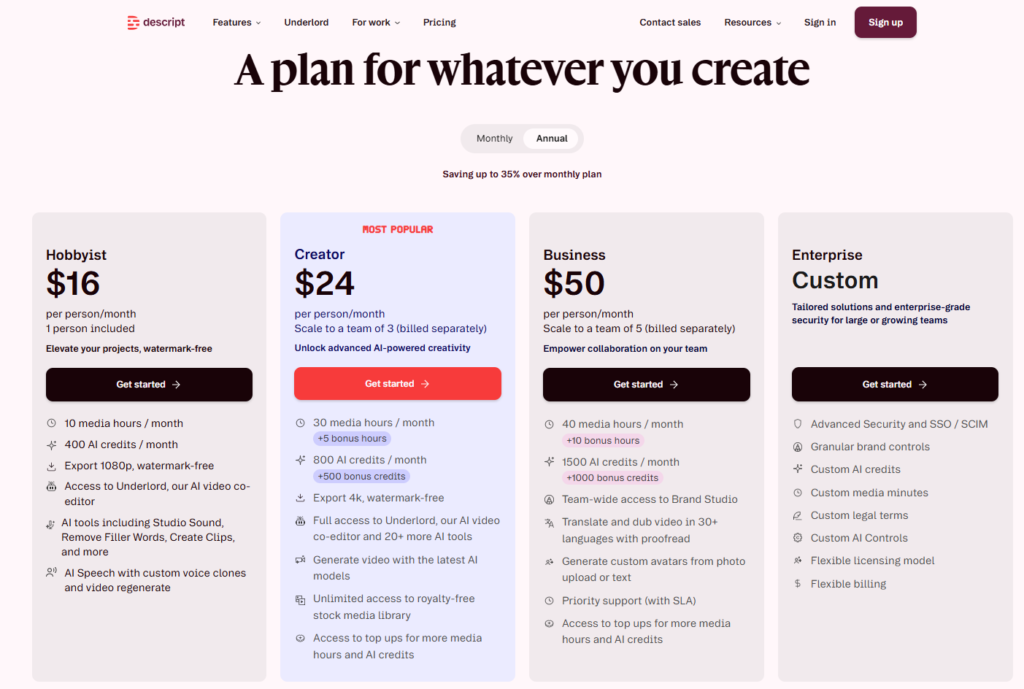
| Pricing | Free (1 hr/mo media, watermarked). Hobbyist $16/mo (annual) / $24/mo (monthly). Creator $24/mo (annual) / $35/mo (monthly). Business $50/mo (annual) / $65/mo (monthly) |
| Free Tier | Yes — 1 hour of media per month with watermarked exports |
| Key Strengths | Text-based video and audio editing (edit the transcript, the audio updates automatically), AI transcription with 95%+ accuracy on clear audio, speaker identification and labeling, automatic filler word removal, Studio Sound noise reduction, AI clip generation for social distribution, auto-generated chapter markers, export to show notes, chapters, and structured content formats |
| Key Weaknesses | Media hours and AI credits system can be confusing — September 2025 restructuring replaced transcription-hours model; multi-camera recordings consume media hours faster than expected; free plan’s 1-hour monthly limit is insufficient for regular publishing |
| Best For Podcasters | Solo creators, B2B podcasters, and content marketing teams that record weekly or more frequently and need transcription integrated into their editing workflow |
| SEO Function | Transcription, show notes drafting, content repurposing, chapter generation |
| Best Pairing | Podpage or podcast website for publishing Descript-generated transcripts and show notes; Capsho for converting Descript transcripts into full blog posts and social content |
Descript solves the transcription bottleneck that defines most podcast SEO failures. Teams that try to publish a full transcript and structured show notes for every episode without automation tools confront a production reality that is unsustainable: manual transcription of a 45-minute episode takes two to three hours, and editing that transcript into a structured, keyword-optimized show notes page adds another hour. Multiply that by 52 episodes per year and the SEO content production becomes a 156-hour annual task that competes with the actual content creation work for available production time. Most teams choose to skip it and accept the reduced organic traffic as an unavoidable cost.
Descript’s text-based editing model eliminates this overhead because the transcript is produced as a byproduct of the editing workflow rather than as a separate post-production task. When a podcaster uploads their recorded episode to Descript and begins editing by reading the auto-generated transcript — deleting fillers, trimming digressions, restructuring segments — the audio is simultaneously being edited based on every transcript change. By the time the episode is production-ready, the clean, edited transcript already exists as a structured document. The marginal cost of adding podcast SEO content to the workflow is near zero.
The chapter generation feature automatically identifies topic transitions in the episode and proposes chapter titles and timestamps that become the structural backbone of show notes. For podcast episode pages, chapters serve triple duty: they improve user experience by allowing readers to jump to specific sections, they provide a heading structure that search engine crawlers use to understand the episode’s content scope, and they signal to YouTube’s algorithm how the episode is organized when video versions are published.
Studio Sound — Descript’s AI audio enhancement — reduces the quality gap between professionally recorded content and episodes recorded in home environments. While not an SEO feature directly, production quality influences listen-through rates and engagement signals that affect platform algorithm distribution. Episodes where listeners drop off early generate worse algorithmic performance than episodes with strong retention, and audio quality is a consistent predictor of early listener drop-off.
Where Descript Falls Short
The September 2025 restructuring of Descript’s pricing model — from straightforward transcription hours to a combined media hours and AI credits system — has created planning complexity that requires understanding before committing to a tier. A multi-camera podcast that uploads both camera angles as separate files consumes media hours at double the rate of the nominal recording length. Teams running regular multi-participant, multi-camera recordings should carefully model their actual monthly media hour consumption against each plan’s limits before subscribing.
The Verdict on Descript
Descript is the right transcription and editing tool for any podcast that wants to systematically produce SEO-ready content without doubling production time. The Creator plan at $24/mo annually — which provides 30 media hours per month, 4K export capability, and the full AI suite including eye contact correction and Studio Sound — is the right tier for most independent podcasters and small content teams. The workflow integration between editing and transcription is the category’s most significant production efficiency advantage, and the free plan provides enough monthly capacity to validate the workflow before committing to a paid subscription.
3. Podpage — Best SEO-Optimized Podcast Website Builder
| Key Information | Overview |
|---|---|
| Best For | Podcasters who need a dedicated, SEO-optimized website that automatically creates individual episode pages from their RSS feed — without web development skills or WordPress maintenance overhead |
| Pricing | Basic $19/mo ($12/mo annual). Pro $29/mo ($19/mo annual, ~$228/yr). Elite $59/mo ($38/mo annual). Annual billing saves ~35% |
| Free Tier | Yes — 14-day free trial, no credit card required; 30-day money-back guarantee |
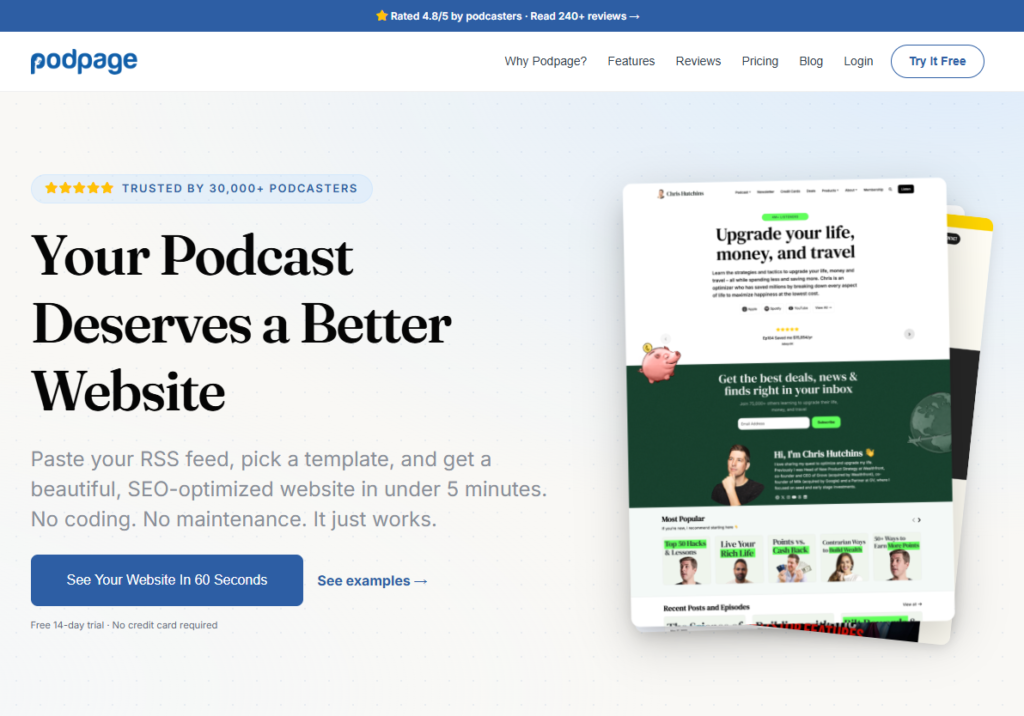
| Key Strengths | Automatic episode page creation from RSS feed (updates within minutes of publishing), podcast-specific schema markup on every page, custom domain support, episode transcript display, automatic directory embed players, guest profile pages with SEO value, review import from Apple Podcasts (175+ countries on Elite), advanced SEO analysis tool (Elite), mobile-optimized design, email capture integration |
| Key Weaknesses | Not a podcast host — requires a separate podcast hosting platform; Pro features like custom pages and blog require upgrading from Basic; some advanced customization limited without HTML/CSS access |
| Best For Podcasters | Any podcaster without a dedicated website, or those wanting to move from a podcast hosting platform’s basic website to a purpose-built SEO-optimized podcast site |
| SEO Function | Episode page SEO, schema markup, Google discoverability, website authority building |
| Best Pairing | Buzzsprout or any podcast host for audio hosting; Descript for transcripts that can be published to Podpage episode pages; Ahrefs for keyword research informing the episode pages Podpage publishes |
Podpage addresses the most common structural gap in podcast SEO programs: the absence of a proper web presence. The typical podcast has its audio hosted on Buzzsprout, Libsyn, or Anchor, which provides a basic podcast page on the hosting platform’s subdomain — a page that is not optimized for search, carries no domain authority, and provides no mechanism for building a crawlable archive of episode-specific content that search engines can rank. Podpage replaces this with a branded, domain-owned podcast website that automatically creates and publishes a dedicated SEO page for every episode within minutes of the RSS feed updating.
The automatic episode page architecture is the feature that defines Podpage’s SEO value. Each episode page is built with the structural elements that search indexing requires: a clean, keyword-appropriate URL based on the episode title, the embedded audio player, episode description and show notes, a transcript display field, schema markup identifying the content as a podcast episode (including the PodcastEpisode structured data type that enables Google’s rich results for podcast content), chapter markers if provided, and guest profile links that create internal site architecture. This structured page is what search engines index; it is what ranks for the episode’s topic keywords; and it is what receives inbound links from guests and cited sources.
The guest profile feature creates SEO value that many podcasters overlook. When a guest appears on the show, their name, professional profile, and episode contribution are published to a dedicated page linked from the episode. Search engines processing queries for the guest’s name — a common search pattern for people who have seen the guest elsewhere and want to find specific content they have produced — may surface the Podpage episode page alongside the guest’s own website. This named-person SEO creates organic traffic pathways entirely distinct from topic keyword searches, generating discovery by the guest’s existing audience.
The Pro plan’s blog capability transforms Podpage from a pure podcast website into a content marketing hub. Publishing written content that expands on episode topics — summary posts, key takeaway articles, related research guides — extends the show’s keyword footprint beyond the specific queries that episode titles and transcripts capture, creating a content architecture where the podcast drives topically adjacent blog content that ranks for the secondary keywords the audio alone cannot target.
Where Podpage Falls Short
Podpage is a podcast website builder, not a hosting platform — the audio files still need to live on a separate podcast host. This creates a two-tool requirement that Buzzsprout or Castos users who already have hosting-platform websites may see as redundant cost. The value equation depends on whether the hosting platform’s built-in website provides adequate SEO infrastructure (most do not) or whether a dedicated podcast website on the show’s own domain is worth the incremental monthly cost. For any podcast serious about organic search growth, the domain authority and page-level control that a dedicated Podpage site provides over a hosting-platform subdomain is commercially significant.
The Verdict on Podpage
Podpage is the right podcast website tool for any show that currently has its web presence on a podcast hosting platform’s subdomain and has not invested in a dedicated, domain-owned website. The Basic plan at $12/mo annually provides automatic episode pages, schema markup, and domain support — the minimum viable SEO infrastructure for a podcast with organic search ambitions. Upgrade to Pro ($19/mo annually) for the blog, email capture, and engagement features that transform the website from an episode archive into a listener conversion engine.
4. Capsho — Best for AI-Powered Show Notes and SEO Content Generation
| Key Information | Overview |
|---|---|
| Best For | Podcasters and content marketing teams who want to convert each episode’s audio file into a complete set of SEO-optimized content assets — show notes, blog post, social captions, YouTube description, email copy, and transcripts — without writing any of it manually |
| Pricing | $99/mo flat (7-day free trial; 300 upload minutes/mo, 50 image credits/mo, 15 clipping studio runs/mo) |
| Free Tier | Yes — 7-day free trial with 120 upload minutes, 20 image credits, and 7 clipping runs |
| Key Strengths | Full content suite from a single audio upload — generates episode title, SEO description, show notes, blog post, LinkedIn article, YouTube title and description, social media captions in multiple formats, email copy, transcript, and lead magnet copy; self-learning tone adaptation based on edits; intelligent clip identification; AI thumbnail and social graphic generation; guest appearance content generation |
| Key Weaknesses | Single $99/mo plan with no lower-cost tier for lower-volume publishers; 300 monthly upload minutes is approximately 300 minutes of audio content per month — a weekly 60-minute show uses 240 minutes, leaving 60 minutes of buffer; content requires editing for voice accuracy and SEO keyword insertion |
| Best For Podcasters | Coaches, consultants, and B2B content teams publishing weekly or biweekly with a diverse content distribution strategy across multiple platforms |
| SEO Function | Show notes generation, blog post creation, episode metadata, content repurposing at scale |
| Best Pairing | Podpage for publishing Capsho-generated show notes to SEO-optimized episode pages; Ahrefs for keyword research that informs the topic framing Capsho uses to generate content |
Capsho addresses the most time-consuming post-production task in podcast SEO: transforming the recorded audio into the multiple pieces of text content that create searchable surfaces across different platforms. The manual equivalent of Capsho’s output per episode — writing show notes from scratch, adapting the content into a blog post, creating platform-specific social captions for LinkedIn, Twitter, Instagram, and Facebook, drafting an email to the show’s list, writing a YouTube description, and generating a transcript — typically consumes three to five hours of production time. At a monthly publishing cadence of four episodes, this is a 12 to 20 hour monthly commitment to content writing alone, separate from recording, editing, and all other show production tasks.
Capsho’s workflow collapses this overhead: upload the audio file, and within minutes the platform generates the complete content set — trained on the show’s existing content to match the host’s writing style, tone, and structural preferences. The generated content is not a raw draft requiring complete rewriting; it is a structured first pass that typically requires 20 to 40 minutes of light editing, keyword integration, and voice refinement before publishing. The edit-review cycle rather than the blank-page creation cycle is what makes Capsho viable as a production tool rather than a novelty.
The self-learning capability is what distinguishes Capsho from generic AI writing tools. As the host edits the generated content — adjusting a sentence structure, changing a word choice, adding a specific framing for how they introduce topics — Capsho incorporates those patterns into subsequent generation. Over weeks of use, the generated content progressively requires less editing as the AI model learns the specific writing idiosyncrasies, preferred terminology, and structural preferences of the individual show. This compounding efficiency is the practical commercial benefit that distinguishes a tool trained on a specific show’s voice from a general-purpose content generator.
The clip identification feature analyzes the uploaded episode for the most shareable moments based on criteria the user specifies — the most counterintuitive statement, the sharpest piece of advice, the moment of strongest engagement — and surfaces them as ready-to-share clips. For podcast SEO programs that include YouTube Shorts, TikTok clips, and Instagram Reels as discovery channels, this automated clip selection eliminates the manual scrubbing of full-length episodes to identify shareable moments.
Where Capsho Falls Short
Capsho’s flat $99/mo pricing with a single tier creates a cost-efficiency gap for low-frequency publishers. A podcaster publishing biweekly with 30-minute episodes uses approximately 60 of the plan’s 300 monthly upload minutes — paying $99/mo for 20 percent of the plan’s capacity. For shows publishing less than weekly at moderate episode lengths, the per-episode cost of Capsho is high relative to the content volume generated. Capsho is most cost-efficient for weekly publishers producing 45 to 90 minute episodes who are committed to full content distribution across multiple platforms.
The Verdict on Capsho
Capsho is the right show notes and SEO content generation tool for podcasters with a consistent weekly publication schedule, a diverse content distribution strategy that requires show notes, blog posts, social content, and email marketing for each episode, and a willingness to spend 20 to 40 minutes editing AI-generated content rather than two to four hours writing it from scratch. The 7-day free trial with meaningful usage capacity provides a genuine test of the workflow before committing to $99/mo.
5. Listen Notes — The Podcast Search Engine Essential for Directory Optimization
| Key Information | Overview |
|---|---|
| Best For | Podcasters who want to understand how their show and individual episodes appear in the world’s largest independent podcast search database, and to benchmark their category positioning against competitors |
| Pricing | Free for basic search and directory use. Premium Membership for advanced search features. API plans from free (Starter) to Pro/Enterprise (contact for pricing). Dataset products separately priced |
| Free Tier | Yes — full podcast search, episode discovery, curated list access, and basic directory browsing at zero cost |
| Key Strengths | Database of 3.75 million+ podcasts and 187 million+ episodes indexed since 2017, episode-level search finding specific episodes by keyword, podcast genre and category browsing, Listen Later playlist functionality, show submission and listing verification, curated best podcast lists with editorial selection signals, API access for developers building on podcast data |
| Key Weaknesses | Direct listener growth impact is indirect — Listen Notes is a research tool and directory presence, not an audience acquisition channel by itself; Premium Membership features (contact database, monitoring) focused on PR/outreach rather than SEO |
| Best For Podcasters | All podcasters should verify their listing; most valuable for shows actively monitoring competitive positioning and keyword presence in podcast search results |
| SEO Function | Directory listing optimization, competitive benchmarking, keyword presence in podcast search, episode discoverability research |
| Best Pairing | Rephonic for deeper competitive intelligence beyond what Listen Notes’ free tier surfaces; Podpage for ensuring the show’s web presence matches the quality of its Listen Notes listing |
Listen Notes is the reference database for the podcast industry — the standard against which podcast metadata quality, discoverability, and competitive positioning are benchmarked. With over 3.75 million podcasts and 187 million individual episodes indexed in its database since 2017, it functions as the de facto podcast search engine for listeners, researchers, PR professionals, advertisers, and journalists who want to find podcast content on specific topics. For a podcast SEO program, the first operational step is verifying that the show’s Listen Notes listing is accurate, complete, and optimized — because this listing is one of the first things that appears when anyone researches the show outside of Apple Podcasts or Spotify.
The episode-level search capability makes Listen Notes uniquely valuable for competitive keyword research. Entering a topic keyword into Listen Notes surfaces not just shows that cover the topic generally, but specific individual episodes from any podcast that have addressed that topic — revealing how other shows are framing the same content, what episode titles are working in the category, and which guests and angles are generating the most listener engagement. This competitive episode research, done before recording, informs both the episode title optimization and the specific angle that will differentiate the new episode from existing content on the same topic.
The show submission process — submitting a new podcast or verifying an existing listing — directly affects how the show appears in Listen Notes’ search results. A listing with an accurate, complete description, correct genre and category assignments, verified episode count, and appropriate keyword tags performs better in Listen Notes’ internal search algorithm than a listing with incomplete metadata. For shows in competitive categories where dozens of podcasts target the same audience, the metadata quality difference between a well-optimized listing and a default, minimally populated listing is a meaningful discoverability gap.
Listen Notes’ curated lists — editorially selected collections of the best podcasts in specific categories and topics — are one of the platform’s most valuable organic distribution mechanisms. Appearing on a Listen Notes curated list drives discovery from the platform’s audience of podcast enthusiasts who browse by category and topic rather than searching for specific terms. While editorial selection cannot be directly influenced, maintaining a high-quality listing with accurate genre assignment and a compelling description creates the preconditions for editorial consideration.
Where Listen Notes Falls Short
Listen Notes is primarily a research and reference tool, not an active audience acquisition channel. The platform’s direct contribution to listener growth is difficult to measure independently of other organic discovery mechanisms. For podcasters expecting Listen Notes to function as a distribution platform that actively pushes their show to new audiences, the expectation needs recalibration — it is a passive discovery resource where accurate, high-quality listings create the opportunity for research-driven discovery by listeners actively seeking content in the show’s category.
The Verdict on Listen Notes
Listen Notes is the right tool for the baseline podcast directory optimization that every show should maintain — verifying the listing, ensuring accurate metadata, correcting any indexing errors, and monitoring how the show and its episodes appear in category searches. The free tier provides all the functionality most podcasters need for these purposes. The Premium Membership and API products serve specific use cases — PR outreach, podcast monitoring, developer applications — that are distinct from the core SEO value of maintaining a strong directory presence.
6. Rephonic — Best for Competitive Intelligence and Cross-Promotion Opportunity Research
| Key Information | Overview |
|---|---|
| Best For | Podcasters, brands, and agencies who want data-driven competitive intelligence on audience sizes, demographics, and contact information for shows in their category — for cross-promotion partnerships, guest strategy, and SEO benchmarking |
| Pricing | Light $99/mo (100 searches, 1 user). Standard $149/mo (500 searches, 5 users). Business $299/mo (unlimited searches, 10 users, priority support). Annual billing gives 2 months free |
| Free Tier | Yes — 7-day free trial |
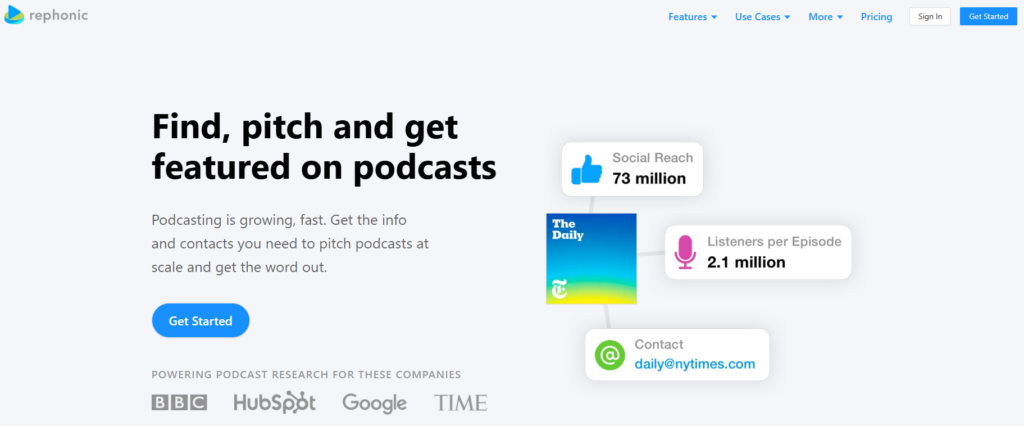
| Key Strengths | Database of 2M+ podcasts with estimated listener counts, audience demographics, guest history, sponsor history, contact information for hosts, network visualization showing podcast relationships, advanced search filters by topic/category/size/demographics, list building and CRM-style management for outreach campaigns |
| Key Weaknesses | Listener count estimates are approximations not precise measurements; contact information completeness varies by show size; primarily valuable for outreach and research workflows rather than direct on-page SEO |
| Best For Podcasters | Shows actively pursuing cross-promotion partnerships, guest swap programs, or category leadership research as part of a structured audience growth strategy |
| SEO Function | Competitive intelligence, cross-promotion research, audience size benchmarking, guest strategy |
| Best Pairing | Listen Notes for directory visibility alongside Rephonic’s deeper audience data; Ahrefs for keyword research that complements Rephonic’s competitive show intelligence |
Rephonic sits at the intersection of podcast SEO and podcast growth strategy by addressing the dimension of discoverability that traditional SEO tools cannot: understanding where the target audience is already listening, and identifying the shows they trust that could introduce them to the new podcast. The most reliable audience growth mechanism for any podcast is introduction by another podcast that already has the target audience’s attention — a guest appearance, a cross-promotion mention, or a collaborative episode. The precondition for pursuing these growth channels strategically is knowing which shows have the right audience, what size that audience is, who the host is, and how to reach them.
Rephonic’s database of 2 million podcasts with estimated audience sizes, demographic breakdowns, and contact information for hosts addresses this research need. For a podcaster planning a systematic cross-promotion outreach program, Rephonic reduces what would otherwise be hours of manual research — finding relevant shows, estimating their audience size from limited public data, identifying the host’s contact information across multiple platforms — to a filterable database query and exportable contact list. The research that might take 10 hours per batch of 20 target shows is done in under an hour.
The network visualization feature maps the relationships between podcasts — which shows share guests with which other shows, which hosts appear as guests across multiple programs in the same category, and which guest networks are driving the highest cross-pollination of audiences. For podcasters building a guest strategy, this network map reveals which central nodes in the podcast category’s guest network would provide the broadest audience exposure through a single appearance.
The SEO dimension of Rephonic’s value is specifically the backlink strategy it enables. When a podcaster appears as a guest on another show, the host typically publishes an episode page mentioning the guest and often linking to their podcast. For podcast websites with SEO authority, these guest-driven inbound links from other podcast episode pages are among the most natural and editorially appropriate link-building mechanisms available. Rephonic’s identification of shows whose episode pages carry meaningful domain authority — discoverable through Ahrefs or Semrush after identifying target shows through Rephonic — enables a strategic guest booking approach that simultaneously serves audience growth and link-building objectives.
Where Rephonic Falls Short
Rephonic’s audience size estimates are approximations based on directory signals and modeling rather than precise first-party data — the actual listener counts for most shows are not publicly disclosed by Apple, Spotify, or other platforms. The estimates are directionally accurate for relative size comparisons across similar shows, but should not be treated as precise download figures for media buying decisions. The $99/mo Light plan’s 100-search limit is restrictive for agencies managing outreach across many shows simultaneously, making the Standard ($149/mo) or Business ($299/mo) tier the practical minimum for team-scale use.
The Verdict on Rephonic
Rephonic is the right competitive intelligence tool for podcasters who have established their core SEO infrastructure — keyword-researched episode topics, a proper podcast website with episode pages, transcripts, and show notes — and are ready to build the strategic cross-promotion and guest network that compounds organic growth. The 7-day free trial provides enough research capacity to validate the database quality for a specific podcast category before subscribing. The Light plan at $99/mo is appropriate for individual podcasters; the Standard plan at $149/mo is necessary for small teams or agencies managing outreach for multiple shows.
7. CoHost — Best for Advanced Podcast Analytics and Audience Intelligence
| Key Information | Overview |
|---|---|
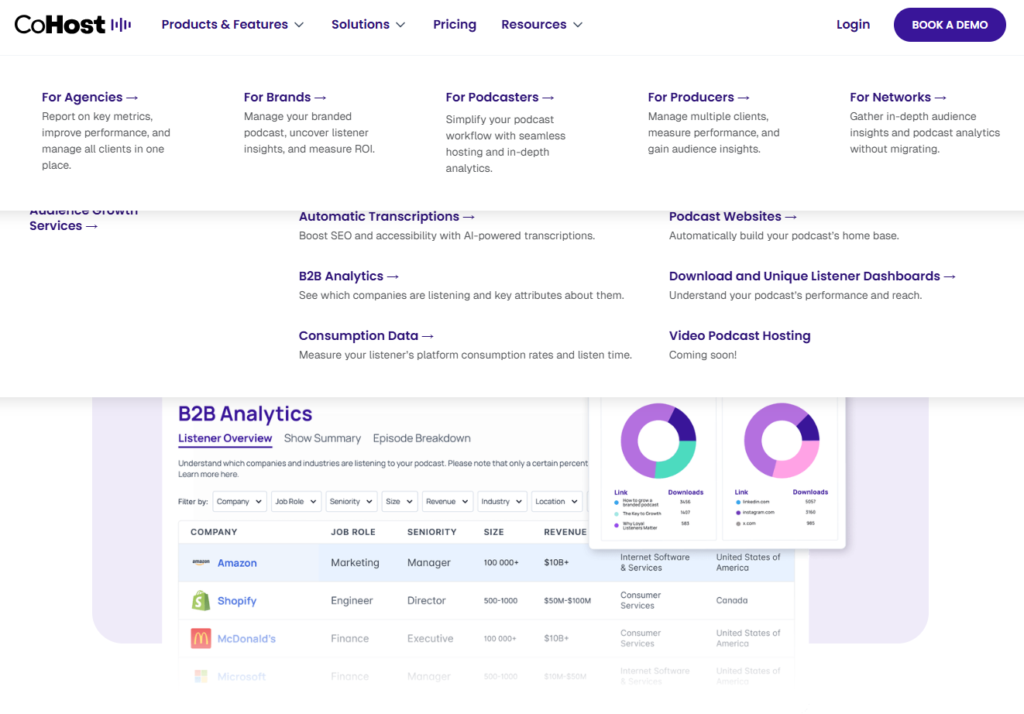
| Best For | B2B brands, podcast agencies, and professional podcast operations that need to understand not just how many people are listening, but who those people are — their companies, job titles, industries, and demographics — to measure ROI and refine content strategy |
| Pricing | Lite $31/mo , Plus $49/mo, Professional, Analytics, and Insights tiers — contact sales or book a demo. Prefix analytics available without migrating hosting |
| Free Tier | Yes — demo-based onboarding |
| Key Strengths | B2B Analytics identifying which companies listen to the podcast (company name, industry, size, location, job role, seniority), Advanced Audience Demographics (age, income, lifestyle, hobbies, social media habits), Prefix tool that overlays CoHost analytics on any hosting platform without migration, IAB-certified download analytics, consumption rate tracking, tracking links for attribution, exportable company listener list for CRM/lead generation integration |
| Key Weaknesses | Custom pricing without publicly disclosed rates requires sales engagement before evaluation; demographic data represents estimates and sample-based modeling rather than individually verified data points; Prefix requires technical setup |
| Best For Podcasters | B2B podcasts, corporate branded podcasts, and podcast agencies where ROI attribution, audience composition verification, and lead generation are primary program objectives |
| SEO Function | Audience intelligence informing content strategy, consumption analytics, attribution tracking, ROI measurement |
| Best Pairing | Buzzsprout or any existing host for audio distribution alongside CoHost’s Prefix analytics; HubSpot or Salesforce for CRM integration of CoHost’s exportable company listener data |
CoHost solves the measurement problem that prevents most B2B podcast programs from demonstrating business value to leadership and securing ongoing investment. The metrics that standard podcast hosting platforms provide — download counts, episode performance trends, listener geography — are adequate for consumer podcast programs where audience size is the primary business objective. They are inadequate for B2B branded podcasts where the commercial question is not “how many people downloaded this episode?” but “are the right people — decision-makers at companies in our target market — actually listening?”
CoHost’s B2B Analytics answers that specific question. By analyzing the IP address and device fingerprint patterns of podcast downloads against a professional network database, CoHost identifies the companies whose employees are listening — returning a filterable, exportable list of companies by industry, size, revenue, and location, with the job roles and seniority levels of the listeners within those companies. For a B2B company running a podcast to build brand awareness among enterprise technology buyers, the ability to show leadership that the show is being listened to by CTOs and procurement managers at target-account companies is the difference between continued investment and program cancellation.
The Prefix product — which adds CoHost’s analytics layer to any existing podcast hosting setup without requiring migration — is the feature that makes CoHost accessible to established podcasts that are not willing to undergo the operational disruption of changing hosting platforms. By adding a simple CoHost-provided redirect in the RSS feed settings of the existing host, the show’s downloads begin routing through CoHost’s measurement infrastructure, activating the B2B Analytics and demographic data without any other changes to the existing workflow. For agencies managing clients whose shows are already hosted on Buzzsprout, Libsyn, or Megaphone, Prefix provides CoHost’s analytics value without the client migration risk.
The audience demographics data — providing estimates of listeners’ age, household income, lifestyle interests, social media habits, and family composition — gives content marketers the listener profile information needed to align episode topics and guest selection with the actual audience composition rather than the assumed audience. When demographics data reveals that the show’s audience skews younger and more senior than expected, with strong overrepresentation in specific geographies and industries, it informs not just content strategy but the SEO keyword targeting decisions that Ahrefs research supports — because the show is optimizing for the audience it actually has, not the audience it imagined.
Where CoHost Falls Short
CoHost’s custom pricing model and demo-required onboarding process create evaluation overhead that smaller podcasts without a B2B measurement mandate may not be willing to invest. The demographic and company data are modeling-based estimates rather than individually verified data points — CoHost is transparent about this, but the accuracy limitation matters for teams planning to use the data for individual-level sales prospecting rather than aggregate audience intelligence. The platform is also most valuable for podcast programs that already have a meaningful listener base; the analytics are limited for shows with very low download volumes where the statistical sample is insufficient for reliable demographic modeling.
The Verdict on CoHost
CoHost is the right analytics platform for B2B podcasts, corporate branded shows, and podcast agencies where demonstrating ROI and audience composition quality to business stakeholders is a program requirement. The B2B Analytics capability — identifying the companies listening to the show — is uniquely valuable and not replicated at this quality by any other platform. The Prefix product specifically is worth evaluating for any established B2B podcast currently using a hosting platform without advanced audience intelligence, as it adds this capability without requiring migration.
8. Buzzsprout — Best SEO-Friendly Podcast Hosting for Growing Shows
| Key Information | Overview |
|---|---|
| Best For | Podcasters who want IAB-certified analytics, guided distribution to all major platforms, a built-in podcast website, and access to transcription — in a single hosting platform designed specifically for beginner-to-intermediate podcasters |
| Pricing | Free (2 hrs/mo upload, episodes deleted after 90 days). $19/mo (6 hrs). $39/mo (15 hrs). $79/mo (35 hrs). Annual billing saves 15–19% |
| Free Tier | Yes — functional free plan with 2-hour monthly upload limit and 90-day episode retention |
| Key Strengths | IAB-certified download analytics (verifiable for sponsors), podcast website on Buzzsprout subdomain with embeddable players, guided distribution to Apple Podcasts, Spotify, Amazon Music, and 10+ directories, Magic Mastering audio enhancement, Cohost AI add-on for automated transcription and show notes, dynamic ad insertion, visual clip creation tool for social media, Buzzsprout Ads marketplace for monetization |
| Key Weaknesses | Episode storage per tier is based on upload hours per month rather than total storage — once per-month upload hours are exhausted there is no additional upload; podcast website lives on Buzzsprout’s subdomain, not a custom domain without additional setup; transcription through Cohost AI is an add-on cost ($0.25/minute) |
| Best For Podcasters | New and growing podcasters who want an all-in-one platform covering hosting, distribution, analytics, and basic SEO without managing multiple specialized tools |
| SEO Function | Distribution, IAB-certified analytics, podcast website with episode pages, transcription access |
| Best Pairing | Podpage for a custom-domain podcast website with deeper SEO features alongside Buzzsprout’s hosting; Ahrefs for keyword research that informs the show notes and episode titles published on Buzzsprout’s episode pages |
Buzzsprout earns its place in a podcast SEO tools guide not as a pure SEO tool but as the hosting infrastructure that makes all other podcast SEO work possible. The RSS feed, directory distribution, podcast website, and episode metadata that Buzzsprout provides are the foundation on which every SEO optimization is built — and Buzzsprout’s execution of these foundational functions is consistently reliable, accessible to non-technical podcasters, and integrated with enough adjacent features that most growing shows can run a complete basic podcast SEO program without additional tools.
The IAB-certified download analytics are a meaningful operational advantage. IAB certification means Buzzsprout’s download counts adhere to industry-standard guidelines for filtering bots, duplicate requests, and non-human traffic — producing download numbers that accurately reflect genuine listener interest and are credible for sponsor negotiations. For podcasts working toward monetization, IAB-certified analytics are a precondition for sponsor trust; for podcasts at earlier stages, they provide the accurate baseline data that makes performance trend analysis meaningful rather than inflated.
The guided directory distribution — which automates submission to Apple Podcasts, Spotify, Amazon Music, iHeart, and multiple additional directories from a single Buzzsprout configuration — ensures that the show’s podcast SEO surface area is complete across all major discovery platforms immediately upon launch. Many podcasters underestimate the cumulative discovery impact of being present in a large number of directories; the marginal listener who discovers a show through Pocket Casts’ curated lists or Amazon Music’s podcast recommendations represents audience growth that would not occur without broad directory presence.
The Cohost AI transcription add-on, available at $0.25 per minute of audio, provides automated transcription and show notes generation within the Buzzsprout interface. For podcasters who want integrated transcription without managing a separate Descript subscription, this add-on provides adequate transcription quality for most podcast audio and produces structured show notes that can be published directly to the episode’s Buzzsprout page, improving the page’s SEO content density without a separate tool investment.
Where Buzzsprout Falls Short
Buzzsprout’s per-episode-upload-hour pricing model creates planning constraints that monthly-upload-heavy shows encounter. The $19/mo plan’s 4 upload hours per month covers a weekly 60-minute show with no buffer; exceeding the limit either requires waiting until the next billing cycle or upgrading to the $39/mo tier. The podcast website on Buzzsprout’s subdomain rather than a custom domain limits the SEO equity that episode pages can accumulate — links to a Buzzsprout-hosted episode page build authority for Buzzsprout’s domain rather than the show’s own. Podcasters serious about long-term SEO authority should pair Buzzsprout with Podpage or a WordPress-based podcast website for their public-facing episode content.
The Verdict on Buzzsprout
Buzzsprout is the right podcast hosting platform for beginner and intermediate podcasters who want reliable, accessible distribution with enough built-in SEO features — podcast website, transcription access, multi-directory distribution, and IAB-certified analytics — to operate a functional podcast SEO program without managing multiple specialized tools. The $19/mo plan is appropriate for weekly shows up to 60 minutes; the $39/mo plan serves more frequent publishers or longer-format shows. Pair with Podpage when organic search growth from episode pages becomes a priority.
9. Semrush — Best for Web SEO and Episode Page Optimization
| Key Information | Overview |
|---|---|
| Best For | Podcasters who have an established podcast website and want to optimize individual episode pages for Google search, track keyword rankings, discover unlinked mentions for link-building, and monitor competitive web positioning |
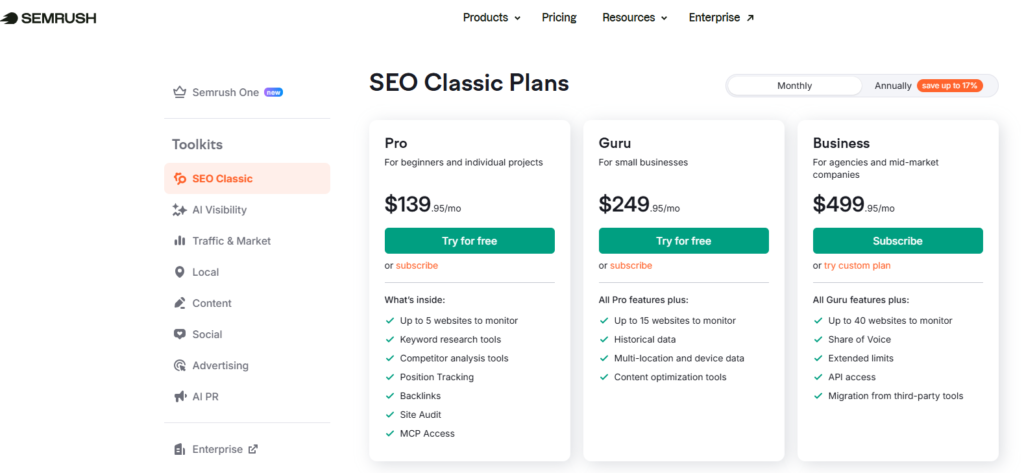
| Pricing | Pro $139.95/mo. Guru $249.95/mo. Business $499.95/mo. Annual billing saves ~17%. 7-day free trial on Pro and Guru |
| Free Tier | Yes — 7-day trial |
| Key Strengths | Keyword research with 25.5 billion keyword database, Position Tracking for monitoring episode page rankings over time, Site Audit for technical SEO issues on podcast website, Backlink Analytics tracking who links to episode pages, Brand Monitoring for unlinked podcast mentions, On-Page SEO Checker providing specific optimization recommendations for episode pages, Topic Research for content cluster planning around podcast themes |
| Key Weaknesses | Higher price point than Ahrefs for comparable keyword research capability; Site Audit most valuable for podcast websites with meaningful existing page volume; no podcast-specific features |
| Best For Podcasters | Established shows with a podcast website and 50+ published episodes, particularly B2B podcasts where specific episode pages target transactional keywords and need ongoing rank tracking |
| SEO Function | Episode page keyword optimization, rank tracking, technical SEO, backlink monitoring, unlinked mention discovery |
| Best Pairing | Podpage for the episode website that Semrush’s optimizations apply to; Rephonic for competitive podcast intelligence alongside Semrush’s web competitive data |
Semrush’s role in a podcast SEO program is fundamentally about the web content layer — the episode pages, show notes, blog posts, and transcripts that convert audio content into indexed, rankable web content. Where Ahrefs is the planning tool (identifying keywords before recording), Semrush is the execution and monitoring tool (verifying that published episode pages are ranking, tracking position changes over time, and identifying the specific on-page improvements that would move a page from position 8 to position 3 for its target keyword).
The Position Tracking feature is the core value for established podcast websites. By configuring the show’s domain and its target keywords — the specific queries that each episode’s page is optimized for — Semrush monitors daily ranking changes and delivers a dashboard showing exactly which episode pages are ranking, at what positions, and how those positions are trending. For a podcast that publishes weekly and optimizes each episode page for a specific keyword, this tracking provides the feedback loop that validates the keyword research and optimization work, identifies which episode page formats and optimization approaches produce the best ranking outcomes, and surfaces pages that have dropped in position and may benefit from content refreshes.
The On-Page SEO Checker applies Semrush’s analysis to specific episode pages and returns prioritized recommendations for improving their search performance. For a podcast episode page targeting “content marketing for SaaS companies,” the checker might surface that the page’s transcript contains the keyword but the episode title does not use it in its optimal form, the meta description is missing the secondary keyword that appears in the top-ranking competitor pages, the internal link structure does not connect the episode to related episodes on adjacent topics, or the page’s load speed is slower than the benchmark that correlates with better ranking in the episode’s target SERP. These specific, actionable recommendations are more operationally useful than generic best practices.
The Brand Monitoring tool’s unlinked mention discovery — finding pages on external websites that mention the podcast or its host without linking to the podcast website — creates a link-building pipeline specific to the show’s brand mentions. When a journalist writes an article about content marketing trends and mentions a podcast episode without linking to it, that unlinked mention represents a backlink opportunity with a very high conversion rate, because the editorial relationship is already established. Semrush surfaces these opportunities with source domain authority scores and contact information access through the platform’s outreach tools.
Where Semrush Falls Short
Semrush’s Pro plan at $139.95/mo is a meaningful monthly investment for solo podcasters. The full keyword research, rank tracking, and site audit capability that makes Semrush most valuable for podcast SEO programs is justified when the podcast website has significant content volume — typically 50+ episode pages — and when organic search traffic is already contributing measurably to audience growth. For podcasts just starting their SEO program, Ahrefs at $129/mo for the Lite tier provides comparable keyword research capability at similar cost; Semrush’s additional value emerges for more established programs with ongoing rank tracking requirements.
The Verdict on Semrush
Semrush is the right SEO platform for established podcasts with active episode page publishing programs, where tracking keyword rankings, monitoring competitive positioning, and systematically improving on-page optimization across a growing episode archive are operational priorities. For podcasters who already use Semrush for other marketing purposes, the Brand Monitoring and On-Page SEO Checker are immediate value additions to an existing subscription at no incremental cost. For podcasters choosing between Semrush and Ahrefs as their first SEO platform, the choice is close — Semrush edges ahead for rank tracking and on-page analysis; Ahrefs edges ahead for keyword research depth and competitive content gap analysis.
10. Google Search Console — The Free Search Performance Monitor Every Podcast Website Must Use
| Key Information | Overview |
|---|---|
| Best For | Every podcaster with a website — verifying that episode pages are indexed by Google, understanding what search queries are surfacing the show, identifying which episodes are generating organic search impressions, and monitoring technical issues that affect indexing |
| Pricing | Free — completely free for any Google account holder with a verified website |
| Free Tier | Yes — fully functional with no restrictions for verified website owners |
| Key Strengths | Search performance data showing exact queries bringing search traffic to episode pages, indexing status for all published episode pages, Core Web Vitals monitoring, mobile usability reports, schema markup validation for podcast structured data, URL inspection for diagnosing specific indexing issues, backlink data from Google’s own crawl, click-through rate and average position data per page and per query |
| Key Weaknesses | Only shows data for Google search (not Bing, DuckDuckGo, or other search engines); search query data limited to the last 16 months; no keyword research or competitive analysis features |
| Best For Podcasters | Every podcaster with any website — non-negotiable regardless of what other tools are in the stack |
| SEO Function | Indexing verification, search performance measurement, technical SEO monitoring, query intelligence |
| Best Pairing | Any podcast website (Podpage, WordPress, etc.) for the web presence GSC monitors; Ahrefs or Semrush for keyword research and competitive analysis that complement GSC’s search performance data |
Google Search Console is the non-negotiable foundation of any podcast web SEO program — not because it is the most capable tool on this list, but because it is the only source of truth for what Google actually sees, indexes, and ranks from the podcast’s web presence. Without Search Console verified and configured, a podcast SEO program is operating blind: keyword research identifies opportunities, episode pages are published and optimized, but there is no mechanism for confirming that Google has indexed those pages, understanding what queries are actually triggering impressions, or diagnosing why specific pages that should rank are not appearing in search results.
The Search Performance report is the most operationally useful feature for podcast SEO programs. For each episode page on the podcast website, it shows the exact search queries generating impressions and clicks, the average position in search results, and the click-through rate. This data frequently reveals surprises that inform the SEO strategy: an episode published about “B2B email marketing” is getting the majority of its search impressions from queries about “email list segmentation” — the specific topic that dominated the episode discussion — indicating that the episode title should be revised to match the actual search demand the content is satisfying. An episode that has accumulated 5,000 impressions at an average position of 11 represents a page that ranks on the first page’s boundary and may move into position 5–7 with targeted on-page optimization — a specific, identified opportunity that no amount of keyword research alone would surface.
The Coverage report shows which episode pages have been indexed by Google, which are excluded (and why), and which have indexing errors. For podcast websites with RSS-fed automatic episode page creation — like Podpage — confirming that new episode pages are indexed within days of publication is a monitoring task that Search Console automates. Discovering that 30 episode pages have been excluded from indexing due to a Noindex tag accidentally applied during a website theme update is a problem that would otherwise be invisible until an organic traffic drop triggered investigation months later.
The structured data report validates that the podcast schema markup on episode pages is correctly implemented. Google’s podcast-specific rich results — the enriched SERP appearance for podcast episodes that includes a listen button, episode details, and show name — require correctly implemented PodcastEpisode structured data. Search Console’s schema validation confirms whether the markup is valid, identifies specific markup errors preventing rich results eligibility, and shows which pages are currently receiving the enhanced SERP display.
Where Google Search Console Falls Short
Search Console provides data only for the show’s own web presence — it has no competitor visibility, no keyword research capability, and no data for search engines other than Google. The 16-month data retention limit prevents long-term trend analysis for established shows. Search Console is exclusively a monitoring and diagnostic tool; it cannot improve the podcast’s SEO position by itself — it tells you what is happening so that Ahrefs, Semrush, Podpage, Descript, and Capsho can be used to improve it.
The Verdict on Google Search Console
Google Search Console is the right tool for every podcaster who has a website, with zero conditions and no threshold — it is free, provides first-party data that no other tool replicates, and takes 10 minutes to verify. There is no competitive alternative and no budget threshold that makes it appropriate to skip. Configure it on day one of any podcast website launch, verify that new episode pages are getting indexed, and review the Search Performance report monthly to identify which queries are driving traffic and which pages have ranking improvement opportunities.
Which Podcast SEO Tools Should You Choose? A Decision Framework
The right podcast SEO toolkit depends on where the show is in its growth trajectory and which SEO functions are currently most underserved.
If you are starting from zero and need the highest-impact first investment: Descript Creator ($24/mo annual) for integrated transcription and editing, Podpage Basic ($12/mo annual) for a proper podcast website with episode pages, and Google Search Console (free) for indexing monitoring. This three-tool stack at under $40/mo creates the foundational SEO infrastructure — indexed episode pages with transcripts — that everything else builds on.
If you have a website and some episode pages but minimal organic traffic: Ahrefs Lite ($129/mo) for keyword research to plan future episodes around proven search demand, and Buzzsprout at $19/mo if not already on a hosting platform with directory distribution and IAB analytics. Verify the Listen Notes listing is accurate and optimized at no cost.
If you are producing content but struggling to maintain show notes at the required volume: Capsho ($99/mo) to automate show notes, blog posts, and social content generation from each episode upload. The production time saved quickly justifies the cost for weekly publishers.
If you are running a B2B podcast and need to demonstrate ROI to leadership: CoHost (custom pricing) for B2B audience analytics that identifies company-level listener data. This is the difference between reporting download numbers and reporting which companies in the target market are listening.
If you have established episode pages and want to improve their search rankings: Semrush Pro ($139.95/mo) for position tracking, on-page optimization recommendations, and unlinked mention discovery. This is the systematic improvement layer for podcasts where the foundation is already in place.
Recommended Podcast SEO Stacks by Podcaster Profile
| Podcaster Type | Primary Tools | Supporting Tools | Monthly Cost | SEO Coverage |
|---|---|---|---|---|
| New Solo Podcaster | Buzzsprout $19/mo + Google Search Console (free) | Descript free (limited) | $19/mo | Hosting + distribution + basic analytics + indexing |
| Growing Indie Podcast | Descript Creator ($24/mo) + Podpage Basic ($12/mo) | Google Search Console, Listen Notes | $36/mo | Transcription + episode pages + SEO indexing |
| Weekly Content Publisher | Above stack + Capsho ($99/mo) | Ahrefs Starter ($29/mo) | ~$165/mo | Full content production + keyword strategy |
| B2B Branded Podcast | CoHost (custom) + Ahrefs Lite ($129/mo) | Descript, Podpage, Google Search Console | Custom + $165+/mo | Audience intelligence + keyword research + web SEO |
| Established SEO-Driven Show | Semrush Pro ($139.95/mo) + Descript + Podpage | Rephonic ($99/mo), Capsho, Google Search Console | $280–$360/mo | Full-stack: keyword research, on-page, tracking, content, competitive |
| Podcast Agency / Network | Rephonic Business ($299/mo) + CoHost (custom) | All of the above per client | Custom | Client growth strategy + competitive intelligence + analytics |
Head-to-Head: Which Tool Wins Each Category?
| Category | Winner | Runner-Up | Notes |
|---|---|---|---|
| Keyword Research for Podcast Topics | Ahrefs | Semrush | Ahrefs on keyword research depth and content gap; Semrush on rank tracking |
| Transcription and Content Production | Descript | Capsho | Descript on editing integration; Capsho on full content asset generation |
| Show Notes and Content Automation | Capsho | Descript | Capsho on breadth of content types; Descript on editing depth |
| Podcast Website and Episode Pages | Podpage | Buzzsprout (built-in) | Podpage on dedicated SEO-optimized design; Buzzsprout for integrated hosting |
| Directory Optimization | Listen Notes | Buzzsprout (distribution) | Listen Notes for listing quality; Buzzsprout for multi-directory submission |
| Competitive Intelligence | Rephonic | Listen Notes | Rephonic on audience data and contact info; Listen Notes on free research access |
| Podcast Analytics | CoHost | Buzzsprout | CoHost on B2B audience intelligence; Buzzsprout on IAB-certified downloads |
| Episode Page SEO and Ranking | Semrush | Ahrefs | Semrush on on-page analysis; Ahrefs on keyword discovery |
| Free Search Performance Monitoring | Google Search Console | N/A | No competition at zero cost |
| Best Overall Value per Dollar | Google Search Console (free) + Descript ($24/mo annual) | Podpage ($12/mo annual) + Buzzsprout ($19/mo) | Core infrastructure under $40/mo |
Frequently Asked Questions
What exactly is podcast SEO and how is it different from regular SEO?
Regular SEO optimizes text-based web pages so search engines can find and rank them. Podcast SEO applies the same principles to audio content by creating the text layer — transcripts, show notes, episode pages — that makes the audio indexable. Because search engines cannot hear audio files, every podcast SEO action involves converting spoken content into text and publishing it in a structured, crawlable format. The goal is two-fold: optimizing the podcast’s web content for Google search rankings, and optimizing the podcast’s metadata (title, description, category, episode titles) for internal discovery algorithms on Apple Podcasts, Spotify, and other podcast platforms. Both are required for comprehensive discoverability.
What is the most important single action for podcast SEO?
Publishing a full, clean transcript on every episode page. This single action converts audio content into the indexed text that search engines use to rank pages, dramatically increases the keyword footprint of each episode page from a few hundred words of show notes to thousands of words of specific, topically relevant content, provides the long-tail keyword coverage that captures the specific questions and phrasing patterns that individual listeners search for, and improves accessibility — itself an indirect SEO signal. If the podcast has a website and is not publishing transcripts, fixing this is the highest-return SEO action available regardless of any other optimization already in place.
Can podcasts rank on Google, and how does that actually work?
Yes, and increasingly well. Google has invested significantly in podcast content since its 2019 announcement that it would begin indexing podcast audio, and it now regularly surfaces podcast episode pages in search results for informational and conversational queries. The mechanism is text-based: Google does not index the audio itself but indexes the text content on the episode page — the title, meta description, show notes, and transcript. An episode page that provides a keyword-targeted title, a complete 4,000-word transcript, and structured show notes organized with H2 and H3 headings creates the same indexable content density as a well-optimized blog post, and competes for the same search query rankings. Podcast episode pages with strong transcripts consistently rank for long-tail queries where the episode discussion provides a specific, detailed answer that published text articles do not.
How does YouTube fit into podcast SEO strategy?
YouTube is now the primary discovery channel for new podcast listeners in the U.S. according to recent Edison Research, which means video versions of podcast episodes — published with optimized titles, keyword-rich descriptions, chapter markers, and closed captions — should be treated as a central pillar of podcast SEO rather than a supplementary channel. YouTube is the second-largest search engine globally and since Alphabet owns both YouTube and Google, YouTube content receives favorable indexing treatment in Google search results. A podcast that publishes video versions of episodes to YouTube with appropriate SEO optimization is simultaneously building presence on the platform where most new audience discovery now occurs and generating content that Google indexes and ranks in web search.
What are the most important metadata fields for podcast directory SEO?
The podcast title and episode titles carry the most SEO weight in directory algorithms — they are the highest-visibility, most-crawled metadata fields and should include primary keywords naturally rather than being purely brand-driven. The podcast description (up to 500 characters in most directories) should concisely identify the show’s topic, target audience, and key themes using the language prospective listeners search for. Episode descriptions should expand on the episode title with supporting keywords, guest names, and specific topics covered. Genre and category selection determines which category browse pages the show appears on — choosing the most accurate primary category rather than the most competitive one often produces better discovery results. Tags and keywords (where supported) should reflect the specific subtopics and terminology the target audience uses.
Final Takeways: The Podcast SEO Stack That Grows With the Show
Podcast SEO is not a one-time setup task — it is a production discipline that compounds over time as episodes accumulate, episode pages build authority, and keyword-targeted content creates an increasingly comprehensive topical footprint that search engines reward with sustained organic traffic. The shows that grow consistently through organic search are not those that did a flurry of SEO work at launch and then returned to pure content production; they are the shows that have built podcast SEO into the standard production workflow so that every new episode automatically generates the indexed content that extends the show’s discoverability.
Two principles should guide podcast SEO tool selection. First, build the infrastructure before scaling the content. The most common podcast SEO failure is publishing 100 episodes without a proper podcast website, without transcripts, and without keyword-planned episode topics — and then trying to retrofit those elements to the existing archive. Each episode page published without a transcript is a missed indexing opportunity. Each episode whose title was written for listenability rather than searchability is content that will not capture organic traffic regardless of its quality. Start the infrastructure early — Podpage for the website, Descript for transcriptions, and Google Search Console for monitoring — and every subsequent episode publication becomes an automatic SEO event.
Second, sequence the tool investment to match the show’s stage. A podcast publishing its first 20 episodes should not be investing $500/mo in Semrush, Rephonic, and CoHost — the data volume necessary to make those tools valuable does not yet exist. The minimum viable podcast SEO stack — Descript for transcription ($24/mo), Podpage for episode pages ($12/mo annual), and Google Search Console (free) — costs under $40/mo and creates the foundation that all subsequent tool investments build on. Add keyword research with Ahrefs Lite when episode planning needs to be more data-driven. Add Capsho when content production volume becomes the constraint. Add Semrush or Rephonic when episode pages have established rankings that need monitoring and competitive context.
The Podcast SEO Stack That Works for Most Shows
For a B2B or content-led podcast at the growth stage: Ahrefs Lite ($129/mo) for episode keyword strategy, Descript Creator ($24/mo annual) for transcription within the editing workflow, Podpage Pro ($19/mo annual) for the podcast website with episode pages and blog, Capsho ($99/mo) for show notes and content generation automation, and Google Search Console (free) for performance monitoring. Total investment: approximately $275/mo. Total coverage: keyword-planned episodes, transcribed and published to optimized episode pages, with full content distribution automation and search performance measurement. This stack, operated consistently with one weekly episode publication, produces the compounding organic discoverability that distinguishes the podcasts that audiences find from the ones they do not.


