

Your brand is being discussed right now — on Reddit threads you have not seen, in Twitter replies your notifications missed, across review sites you did not know existed, and increasingly in AI-generated summaries that shape how prospective customers perceive you before they ever visit your website. Most of those conversations happen without any tag, mention, or notification that would surface them organically. The brands that know about them in real time respond, learn, and adapt. The brands that do not find out in retrospect — through a customer complaint that references a three-week-old viral thread, a PR crisis that was visible for 48 hours before anyone on the team noticed, or a competitor campaign that ate into their share of voice while they were focused elsewhere.
Brand monitoring is the systematic practice of tracking every online mention of your brand, products, executives, competitors, and relevant industry terms across every platform where those conversations occur. In 2026, that surface area has expanded significantly: it now includes social networks, news sites, blogs, forums, review platforms, podcasts, newsletters, YouTube comments, LinkedIn posts, and the AI-generated search results and chatbot responses that influence discovery for a growing share of buyers who never run a traditional web search. The monitoring program that covered Twitter, Facebook, and Google News three years ago is now materially incomplete.
The brand monitoring tools market spans a wide range of capabilities and price points — from Google Alerts at zero cost to enterprise intelligence platforms at $20,000 or more per year. The distinction between them is not simply data volume. It is the quality of sentiment analysis, the depth of historical data access, the sophistication of alerting logic, the breadth of platform coverage, and the degree to which the platform helps teams act on what they find rather than simply accumulating data. This guide evaluates the best brand monitoring tools against the real operational demands of marketing, PR, and customer experience teams in 2026.
Quick Comparison: Top 10 Brand Monitoring Tools for 2026
| # | Platform | Primary Use | Starting Price | Free Tier | Best Feature | Our Rating |
|---|---|---|---|---|---|---|
| 1 | Brandwatch | Enterprise consumer intelligence and social listening | Custom pricing | No (demo) | Deepest social data archive with AI-powered pattern detection | 9.4/10 |
| 2 | Brand24 | Real-time brand monitoring for SMBs and mid-market | Individual $249/mo ($199/mo annual) | Yes (14-day trial) | AI-powered mention analysis with podcast and newsletter tracking | 9.2/10 |
| 3 | Mention by Agorapulse | Real-time media monitoring across 1B+ sources daily | Standard $99/mo ($79/mo annual) | Yes (30-day trial) | Pulse anomaly detection for early crisis warning | 9.0/10 |
| 4 | Sprout Social | Social management plus integrated brand monitoring | Standard $199/seat/mo | Yes (30-day trial) | Smart Inbox that routes monitoring alerts into team workflows | 9.1/10 |
| 5 | Meltwater | Earned media and social monitoring for PR teams | Custom (Essentials, Suite, Enterprise) | No (demo) | Broadest traditional media and podcast coverage available | 9.0/10 |
| 6 | Talkwalker | Enterprise visual and AI analytics | Custom pricing | No (demo) | AI-powered image and logo recognition in visual content | 9.1/10 |
| 7 | Awario | Budget-friendly social listening and lead generation | Starter $29/mo; Pro $89/mo | Yes (7-day trial) | Best mentions-per-dollar value in the category | 8.8/10 |
| 8 | Semrush Brand Monitoring | SEO-integrated brand mention and backlink tracking | From $139.95/mo (Pro plan) | Yes (7-day trial) | Unlinked mention discovery for SEO link-building opportunities | 8.9/10 |
| 9 | BuzzSumo | Content performance and brand mention tracking | Content Creation $199/mo | Yes (7-day trial) | Ties brand mentions to content performance and backlink data | 8.7/10 |
| 10 | Google Alerts | Free keyword alerts for web-indexed content | Free | Yes (completely) | Zero-cost baseline monitoring for web content | 8.2/10 |
How We Evaluated These Brand Monitoring Platforms
Every platform in this guide was assessed across six dimensions that reflect the real operational demands of a brand monitoring program — not data volume benchmarks or vendor-provided coverage statistics.
Mention coverage and source breadth: The value of a monitoring platform is bounded by what it can hear. We evaluated the comprehensiveness of each platform’s source coverage — social networks, news sites, blogs, forums, review platforms, podcasts, newsletters, YouTube, and the emerging AI-driven content surfaces that increasingly shape brand perception — and the freshness of that coverage relative to the platforms where conversations happen.
Sentiment analysis accuracy and nuance: Most monitoring platforms classify mentions as positive, negative, or neutral. The platforms that deliver operational value go further — detecting sarcasm, context-dependent sentiment, nuanced criticism, and the difference between a complaint and a crisis. We evaluated sentiment accuracy against real-world mention samples where context and tone variation challenge basic classification models.
Alert quality and signal-to-noise ratio: The primary operational failure of brand monitoring programs is not insufficient data — it is alert fatigue. A platform that generates 2,000 daily notifications conditions teams to ignore them, which defeats the monitoring purpose entirely. We evaluated the precision of each platform’s alerting system, the quality of its filtering and Boolean search capabilities, and whether the default behavior trends toward noise or signal.
Competitive intelligence depth: Brand monitoring that only watches the brand’s own mentions provides half the picture. Understanding how competitors are discussed, how share of voice shifts across the category, and what narratives are forming around competing products requires competitive monitoring that most platforms support with varying degrees of analytical depth. We evaluated the practical utility of competitive analysis features rather than their nominal presence on feature lists.
Crisis detection and response speed: The window between when a reputational threat begins and when it becomes unmanageable is often measured in hours. We evaluated each platform’s ability to identify anomalous mention volume, sentiment shifts, and emerging negative narratives before they reach peak velocity — and the alerting infrastructure that brings those signals to the attention of the people who can act on them.
Total cost of ownership and team scalability: Brand monitoring pricing ranges from free to enterprise six-figure contracts, and the cost structures — per-keyword, per-mention, per-seat, custom — vary enough that a platform attractive at small scale can become prohibitive as the monitoring program matures. We evaluated realistic costs for marketing teams monitoring 3 to 20 keywords across teams of 1 to 20 users.
Why Brand Monitoring Has Changed in 2026
Three developments define the brand monitoring landscape in 2026 that distinguish it from three years earlier.
The first is the extension of monitoring scope into AI-generated content. When a prospective customer asks ChatGPT, Gemini, or Perplexity about the best product in a category and the AI response recommends a competitor, that is a brand perception event that occurred outside any monitored channel. The brands that appear in AI-generated summaries, recommendations, and comparisons are those that have been consistently discussed across credible sources in ways that large language models have indexed. Brand monitoring in 2026 increasingly means understanding not just what is being said about your brand on social media and in the press, but how your brand is represented in the training data and real-time retrieval systems that shape AI-generated responses. Several platforms have begun adding AI visibility tracking to their monitoring suites as a result, and the categories of brand presence data that matter strategically have expanded accordingly.
The second is the normalization of visual monitoring alongside text monitoring. A significant and growing fraction of brand-relevant content on Instagram, TikTok, YouTube, and Pinterest never includes a text mention of the brand name — a product appears in an unboxing video, a logo is visible in a lifestyle post, a brand color palette is used in user-generated content without any accompanying text identifier. The platforms that can identify these visual brand presences — using image recognition to detect logos, products, and brand visual elements without text anchor — are providing fundamentally more complete monitoring coverage than those limited to text matching.
The third is the consolidation of brand monitoring with social media management. Marketing teams in 2026 rarely want a pure-monitoring tool that operates separately from their publishing and engagement infrastructure. The demand is increasingly for unified platforms where monitoring alerts arrive in the same workspace where the team schedules content, responds to comments, and measures engagement — eliminating the context switch between monitoring data and the communication tools used to act on it. This consolidation trend has driven Sprout Social, Hootsuite, and similar platforms to invest in monitoring capability, and has created the hybrid category where brand monitoring and social media management share a single operational surface.
Detailed Reviews: Best Brand Monitoring Tools for 2026
1. Brandwatch — Best Enterprise Consumer Intelligence and Social Listening Platform
| Key Information | Overview |
|---|---|
| Best For | Large enterprises and agencies that need the deepest available consumer intelligence, AI-powered trend detection, and historical social data archives for strategic decision-making |
| Pricing | Custom pricing across three product suites: Consumer Intelligence, Social Media Management (includes monitoring), and Influencer Marketing. Contact required for all pricing |
| Free Tier | No — personalized demo available |
| Key Strengths | 100+ million source coverage, social data archive dating to 2010, Iris AI for automated pattern detection and insight surfacing, image and video recognition for visual brand mentions, customizable dashboards, consumer segmentation, Boolean search with advanced operators, global language support |
| Key Weaknesses | Enterprise pricing inaccessible to most SMBs; significant learning curve; full capability requires dedicated analyst investment to operationalize; no transparent public pricing |
| Best For Teams | Enterprise marketing, PR, and consumer insights teams; agencies serving global consumer brands; organizations treating brand intelligence as a strategic research function |
| Source Coverage | 100+ million sources including all major social networks, news, blogs, forums, review sites, YouTube, Reddit |
| Sentiment Analysis | AI-powered with nuanced classification including image and video sentiment |
| Best Pairing | Salesforce or HubSpot for CRM-connected alert routing; Tableau or Power BI for custom analytics visualization on top of Brandwatch data exports |
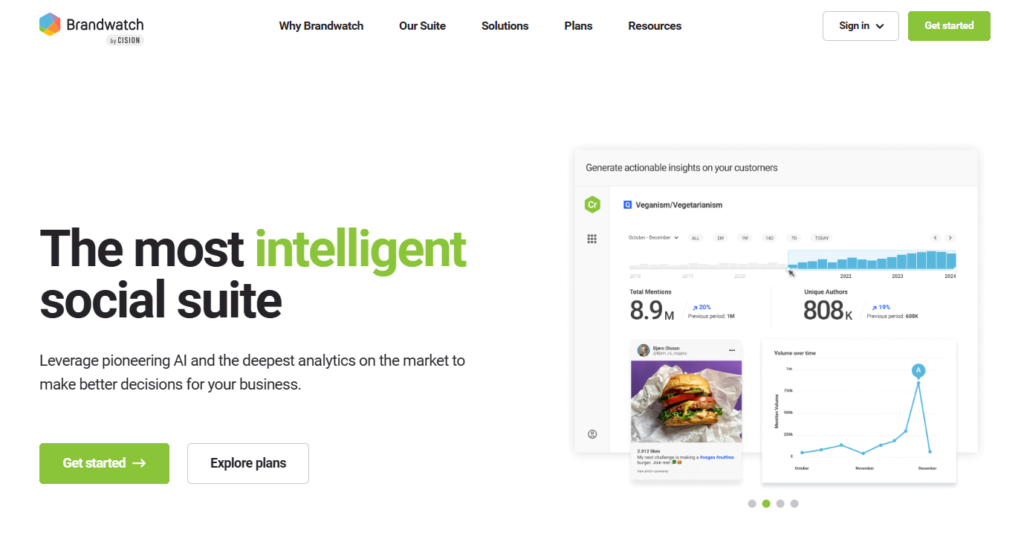
Brandwatch’s position as the enterprise standard for consumer intelligence rests on a combination of data scale, historical depth, and AI capability that no mid-market competitor has matched. The archive of social data dating to 2010 — covering over 100 million online sources — is not just a large database: it is the foundation for longitudinal brand analysis, trend research, and historical crisis auditing that organizations with serious consumer intelligence mandates require. When a marketing team needs to understand how consumer perception of their brand has evolved over a decade, or how a competitor category has shifted in sentiment across five years of product releases, that analysis is only possible with an archive of this depth.
Iris, Brandwatch’s proprietary AI analytics engine, operates on a different architectural principle than the rule-based alerting systems of mid-market tools. Rather than requiring users to define what they want to be alerted about, Iris continuously scans the data streams connected to a brand’s monitoring setup and surfaces patterns, anomalies, and emerging themes that the user’s predefined alerts would not catch — the early signal of a developing narrative, the unexpected demographic driving a sudden mention spike, the influencer whose post is generating disproportionate engagement before any alert threshold is triggered. For organizations with the analyst capacity to act on these proactively surfaced insights, this detection depth changes the operational model of monitoring from reactive to anticipatory.
The visual monitoring capability — using image recognition to detect brand logos, product packaging, visual brand elements, and associated objects in photos and videos without any text mention — addresses the coverage gap that text-only monitoring cannot close. For consumer brands where visual user-generated content is a primary expression of brand affinity, the ability to monitor untagged visual mentions is the difference between seeing 40 percent of brand-relevant content and seeing 80 percent of it. Fashion, consumer electronics, food and beverage, and retail brands with visually distinctive products receive the most immediate value from this capability.
Where Brandwatch Falls Short
Brandwatch’s enterprise positioning creates a structural accessibility barrier. The pricing requires a sales conversation, the onboarding requires dedicated implementation support, and the full analytical capability requires trained analysts who can use the platform’s query builder and segmentation tools effectively. Organizations that purchase Brandwatch expecting to deploy it like a self-serve SaaS tool typically underutilize it significantly. The investment in platform training and dedicated analyst bandwidth is a prerequisite for the ROI that enterprise pricing implies.
The Verdict on Brandwatch
Brandwatch is the right brand monitoring platform for enterprises with dedicated consumer intelligence functions and the analyst capacity to operationalize its depth of capability. For organizations treating brand monitoring as a strategic intelligence investment — not just an alert system — the archive depth, AI detection, and visual monitoring capabilities are genuinely differentiated from every alternative at any price point. For organizations that need a functional monitoring tool rather than a consumer intelligence platform, Brand24, Mention, or Sprout Social provide better cost-adjusted value.
2. Brand24 — Best Real-Time Brand Monitoring for SMBs and Mid-Market
| Key Information | Overview |
|---|---|
| Best For | Small and mid-market businesses that want comprehensive real-time brand monitoring with AI-powered analysis, sentiment tracking, and influencer identification — without enterprise complexity or pricing |
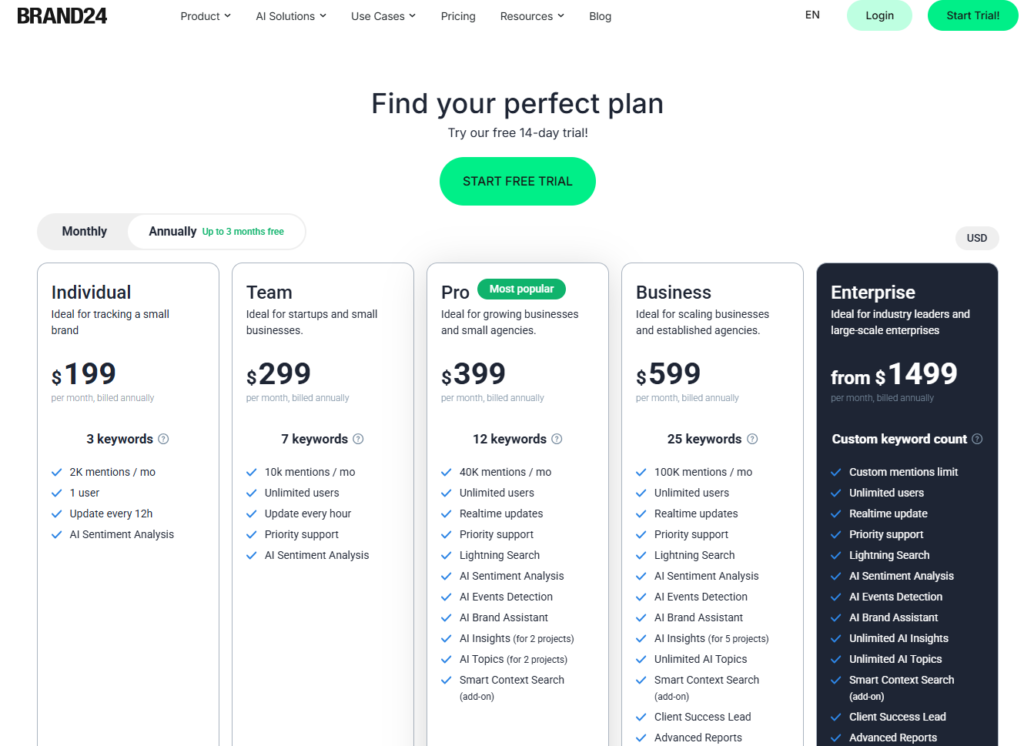
| Pricing | Individual $249/mo ($199/mo annual, 1 user, 3 keywords, 2K mentions). Team $349/mo ($299/mo annual, unlimited users, 7 keywords, 5K mentions). Pro $499/mo ($399/mo annual, 12 keywords, 25K mentions). Enterprise started from and custom keyword count |
| Free Tier | Yes — 14-day free trial, no credit card required |
| Key Strengths | Real-time mention tracking across social media, news, blogs, forums, podcasts, newsletters, and review sites; AI sentiment analysis with Discussion Leaders and Topic Analysis (higher tiers); AI Insights report with weekly pattern analysis; Brand Assistant AI chatbot for data queries; mobile app; Slack integration; influencer scoring |
| Key Weaknesses | Individual plan’s 12-hour data refresh is too slow for real crisis response; podcast monitoring limited to Enterprise tier; historical data access restricted on lower plans; mention limits create capacity constraints for high-volume brands |
| Best For Teams | Marketing teams, PR professionals, agencies, and solo brand managers at SMBs and mid-market companies |
| Source Coverage | Facebook, Instagram, X, Reddit, LinkedIn, YouTube, TikTok, blogs, news, forums, Quora, Medium, review sites, podcasts (Enterprise), newsletters |
| Sentiment Analysis | AI-powered with sentiment classification and anomaly detection |
| Best Pairing | Slack for real-time mention routing to team channels; HubSpot for CRM-connected monitoring; Zapier for custom alert workflows |
Brand24 has built the strongest value proposition in the mid-market brand monitoring category by combining genuine monitoring breadth — covering social networks, blogs, news, forums, podcasts, and newsletters in real time — with an AI analysis layer that processes that data into actionable insight rather than simply surfacing raw mention volumes. The platform sits at the intersection of accessibility and capability: sophisticated enough to serve established marketing teams that need reliable daily monitoring, simple enough to onboard and configure in under an hour without training or professional services.
The AI Insights report — generated weekly or monthly depending on the tier — is the feature that moves Brand24 from a mention aggregator into an analytical tool. Rather than presenting raw mention data for the team to interpret, the AI analyzes the pattern of mentions, correlates spikes with specific events or posts, identifies the highest-influence sources driving mention volume, surfaces the platforms where the brand is gaining the most traction, and generates a structured interpretation of what the data means for brand health. For marketing teams without dedicated social listening analysts, this automated interpretation significantly reduces the expertise required to extract value from monitoring data.
The source coverage breadth — particularly the inclusion of podcast and newsletter monitoring on the Enterprise plan — reflects Brand24’s ongoing expansion of its coverage surface in response to the fragmentation of brand-relevant conversations across emerging media formats. A brand mentioned in a newsletter with 50,000 subscribers or discussed in a popular industry podcast may generate more qualified audience attention than dozens of social media posts, and Brand24’s ability to surface these mentions provides monitoring completeness that social-only tools miss.
The Brand Assistant — a ChatGPT-style AI interface that operates on the brand’s own monitoring data — allows team members to query the platform in natural language. Questions like “which competitor is generating the most positive sentiment this month?” or “what content is driving our mention spikes?” produce structured answers derived from the monitoring database without requiring the user to navigate dashboards or configure reports. For marketing teams where the monitoring data is generated by one person and consumed by many, this conversational access layer significantly broadens practical utility.
Where Brand24 Falls Short
The Individual plan’s 12-hour data refresh rate is genuinely problematic for any brand monitoring use case that requires timely crisis response — a negative story that gains traction over a 12-hour window can reach significant distribution before the plan’s data update cycle surfaces it. The Pro plan ($399/mo annual) with real-time updates is the practical minimum for brands where monitoring is operationally critical rather than informational. Mention limits on each tier also create planning constraints for high-volume brands where monthly mention counts can be exhausted mid-month during peak campaign or crisis periods.
The Verdict on Brand24
Brand24 is the right brand monitoring platform for SMBs and mid-market businesses that need genuine monitoring capability — real-time coverage across a broad source set, AI-powered analysis, and the practical workflow integrations that make monitoring data actionable — at a price point the segment can justify. The Team plan ($299/mo annual) is the right starting tier for most growing businesses; the Pro plan ($399/mo annual) is appropriate for established brands where real-time monitoring and advanced AI analysis are operationally necessary. The Individual plan is suitable only for basic awareness monitoring where response speed is not critical.
3. Mention by Agorapulse — Best for Real-Time Monitoring with Anomaly Detection
| Key Information | Overview |
|---|---|
| Best For | Marketing teams and agencies that need precise, real-time media monitoring across 1 billion sources with anomaly detection that flags unusual mention patterns before they become crises |
| Pricing | Standard $79/mo (10 user, 2 alerts, 5K mentions). Pro $119/mo (10 users, 5 alerts, 10K mentions). ProPlus $149/mo (10 users, 7 alerts, 20K mentions). Company custom- Tailored Pricing |
| Free Tier | Yes — 30-day free trial with access to most Company plan features, no credit card required |
| Key Strengths | Coverage across 1B+ sources updated daily, Pulse anomaly detection for sudden mention volume changes, Boolean search for precise query targeting, 2 years of historical data, competitor tracking, shareable live reports, social media scheduling on paid plans, 82% sentiment analysis accuracy |
| Key Weaknesses | Alert and mention caps on lower tiers are restrictive for high-volume brands; no podcast or newsletter monitoring; the jump from ProPlus to Company plan for 10+ alerts is a significant cost increase |
| Best For Teams | PR professionals, agencies managing multiple client brands, marketing teams needing fast anomaly detection for crisis preparedness |
| Source Coverage | Social media, news, blogs, forums, review sites, 30+ source types including Reddit, Pinterest, and Twitch |
| Sentiment Analysis | AI-powered, 82% accuracy across monitored sources |
| Best Pairing | Slack for real-time alert routing; HubSpot for CRM integration; AgencyAnalytics for white-label client reporting incorporating Mention data |
Mention’s defining feature is the Pulse anomaly detection system — the capability that earns it a place in monitoring stacks specifically for brand protection and crisis preparedness rather than just routine awareness. Pulse monitors mention volume patterns in real time and alerts the team when conversation about the brand deviates significantly from its historical baseline — a sudden spike in negative mentions, an unusual geographic concentration of conversations, or an abrupt increase in overall mention volume that may indicate an emerging issue before the content itself has been reviewed. This statistical anomaly detection catches developing situations in their early stages, before the team would identify them through normal dashboard review.
The 1 billion daily source coverage — updated in real time on paid plans — provides monitoring breadth that covers the distribution of brand conversations across the long tail of media sources. Brands that generate most of their monitoring data from a handful of major social platforms can operate adequately with narrower coverage; brands whose discussions occur across thousands of niche forums, regional news sites, and specialized blogs require the breadth that Mention’s source network provides. The 2 years of historical data included in all paid plans enables trend analysis and seasonal comparison that platforms with shorter history windows cannot support.
The Boolean search capability — allowing precise query construction with AND, OR, NOT, and proximity operators — enables monitoring programs to achieve the signal quality that reduces alert fatigue. A brand with a common name or product category that generates large volumes of irrelevant mentions benefits significantly from Boolean precision: specifying the exact context in which the brand name should appear alongside required adjacent terms filters the monitoring feed to the commercially relevant conversations rather than the noise that drowns them.
For agencies managing monitoring programs across multiple client brands, Mention’s shareable live report links — which update automatically with current data without requiring the client to have platform access — provide a practical client communication mechanism that avoids the overhead of scheduled report generation.
Where Mention Falls Short
Mention’s alert and mention limits create operational constraints for established brands with high conversation volume. The ProPlus plan’s 7 alerts and 20,000 mentions per month is adequate for focused monitoring programs but insufficient for comprehensive multi-brand or multi-keyword monitoring without moving to the custom Company plan pricing. Podcast and newsletter coverage — available in Brand24’s Enterprise tier — is absent from Mention’s current platform, which matters for brands with meaningful presence in audio content. The Solo plan’s 2-alert limit is restrictive enough that it functions primarily as an individual awareness tool rather than a business monitoring program.
The Verdict on Mention
Mention is the right brand monitoring platform for PR teams, agencies, and marketing teams where crisis early warning and real-time anomaly detection are the primary monitoring objectives. The Pulse detection capability and Boolean precision make it the strongest tool in the mid-market category for organizations where the cost of missing a developing issue is higher than the monitoring subscription investment. The Pro plan at $119/mo is the appropriate starting tier for most small teams; the ProPlus plan at $149/mo unlocks the multi-user and increased mention capacity that agency and corporate monitoring programs require.
4. Sprout Social — Best for Combined Social Management and Brand Monitoring
| Key Information | Overview |
|---|---|
| Best For | Marketing and social media teams that want brand monitoring integrated into the same platform they use for publishing, engagement, and social media management — rather than operating a separate monitoring tool |
| Pricing | Standard $199/seat/mo (brand monitoring included). Professional $299/seat/mo (unlimited competitor insights, sentiment analysis). Advanced $399/seat/mo (AI sentiment, message spike alerts, helpdesk integrations) |
| Free Tier | Yes — 30-day free trial |
| Key Strengths | Smart Inbox aggregating all mentions, messages, and comments across platforms into a single actionable feed, real-time keyword and brand monitoring on Standard and above, AI-powered sentiment analysis (Advanced), competitor analytics dashboard, message spike alerts (Advanced), team task assignment for mentions requiring response, 30-day trial |
| Key Weaknesses | Per-seat pricing makes team-wide deployment expensive; $199/seat entry point is high for the monitoring capability relative to Brand24 or Mention; monitoring depth less comprehensive than dedicated listening tools at comparable price points |
| Best For Teams | Social media managers, customer experience teams, marketing teams where publishing and monitoring operate in the same workflow |
| Source Coverage | All major social networks plus review sites; web monitoring through Social Listening add-on |
| Sentiment Analysis | AI-powered on Advanced tier; standard sentiment on Standard and Professional |
| Best Pairing | HubSpot or Salesforce for CRM-connected case management on inbound mentions; Brandwatch for deep listening alongside Sprout’s management and engagement layer |
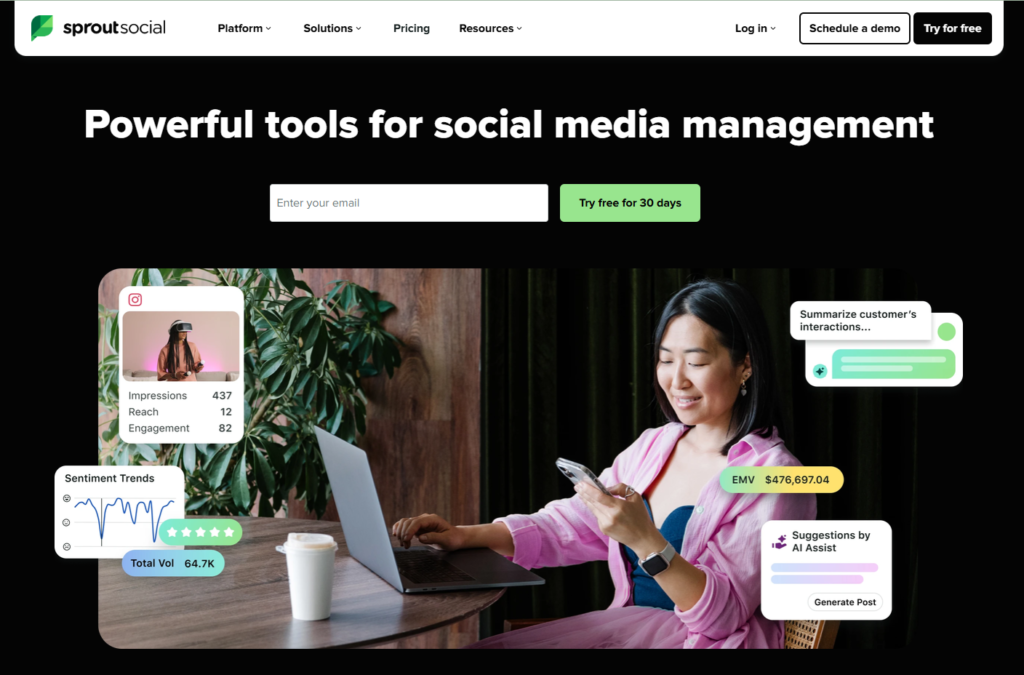
Sprout Social’s brand monitoring capability is not its primary selling point — Brandwatch, Brand24, and Mention all provide more comprehensive pure-monitoring functionality. Sprout’s value is the integration of monitoring into the platform where social media teams actually work. When a brand mention arrives in Sprout’s Smart Inbox, the team member who reviews it can respond directly, assign it to a colleague, tag it for reporting, add it to a case management workflow, or escalate it — all within the same interface, without any context switch to a separate monitoring tool or export to a separate response system.
The Smart Inbox aggregation — pulling mentions, comments, messages, and keyword alerts from all connected social profiles into a single prioritized feed — solves the operational fragmentation that monitoring programs typically create. Without this integration, monitoring alerts arrive in one tool, engagement happens in another, reporting is compiled in a third, and the team’s attention is divided between interfaces that do not share context. Sprout’s unified surface means that a mention flagged as requiring a response becomes an assigned task in the same system where the response is drafted and published, creating an audit trail and accountability structure that distributed tools cannot match.
The Advanced tier’s message spike alerts — which notify the team when mention volume exceeds a defined threshold — provide the crisis detection functionality that dedicated monitoring tools offer as a core feature. For teams that primarily use Sprout for social management and want basic crisis alerting without investing in a separate monitoring tool, this Advanced tier capability provides adequate early warning for most standard brand monitoring scenarios.
Where Sprout Social Falls Short
Sprout Social’s per-seat pricing is the primary operational constraint. At $199 to $399 per seat per month, equipping a five-person marketing team with full monitoring access costs between $1,000 and $2,000 per month at the entry tiers. Dedicated monitoring tools like Brand24 Pro at $399/mo or Mention ProPlus at $149/mo provide unlimited user seats at a fraction of the cost. The monitoring depth — source coverage, Boolean search precision, historical data access, and analytical sophistication — also trails dedicated listening platforms. Teams whose primary operational need is comprehensive monitoring rather than integrated social management are typically better served by a dedicated monitoring tool, which can be integrated with Sprout through API connections or Zapier.
The Verdict on Sprout Social
Sprout Social is the right monitoring-inclusive platform for social media teams that need publishing, engagement, and monitoring to operate from a single surface — and for whom the workflow integration value justifies the per-seat pricing premium over dedicated monitoring tools. For teams where monitoring is the primary workflow rather than a component of a broader social management function, Brand24 or Mention provide more monitoring value per dollar. The 30-day trial is generous enough to evaluate whether the integration value justifies the cost before committing.
5. Meltwater — Best for Earned Media and Traditional Media Intelligence
| Key Information | Overview |
|---|---|
| Best For | PR teams and corporate communications functions that need comprehensive monitoring across traditional media, news, podcasts, and broadcast alongside social media — with media intelligence framing rather than pure social listening |
| Pricing | Custom pricing across three tiers: Essentials (core monitoring for small teams), Suite (cross-department with integrated tools), Enterprise (custom, global organizations). Annual contracts standard |
| Free Tier | No — personalized demo available |
| Key Strengths | 270,000+ global news sources, 20,000+ podcast monitoring, TV and radio monitoring, social media listening, AI-powered sentiment and trend analysis, competitor benchmarking, influencer identification (via Klear acquisition), PR analytics and reporting, strong Asia-Pacific coverage |
| Key Weaknesses | Custom-only pricing with no publicly disclosed rates requires sales process before evaluation; annual contract requirement; learning curve for teams not experienced with enterprise media intelligence platforms; implementation investment required |
| Best For Teams | Corporate communications, PR agencies, investor relations, and any function where earned media coverage is a primary monitoring objective |
| Source Coverage | 270K+ news sources, 20K+ podcasts, TV and radio, social media, blogs, forums — broadest traditional media coverage in the category |
| Sentiment Analysis | AI-powered with industry and regional context |
| Best Pairing | Cision for media distribution alongside Meltwater’s monitoring; Salesforce for PR-to-sales connection; Slack for alert routing |
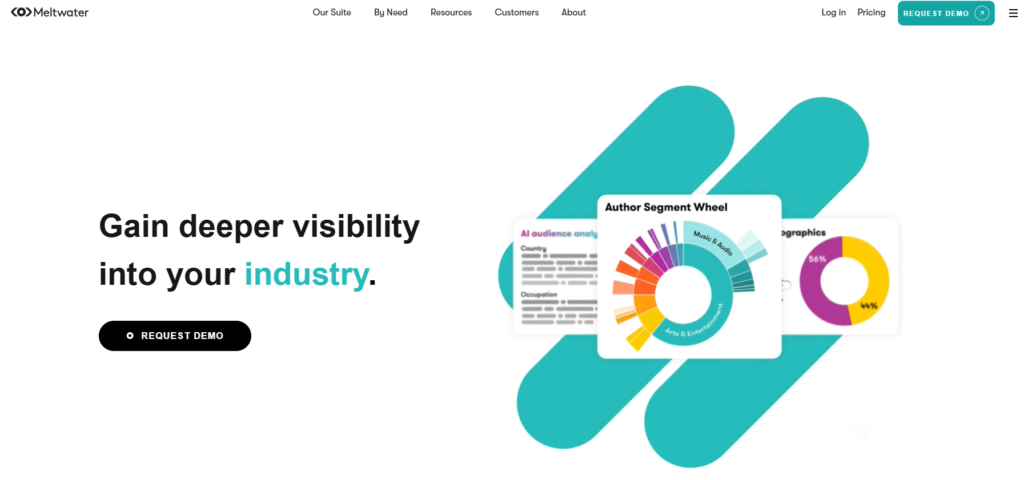
Meltwater’s differentiated position in the brand monitoring landscape is the breadth and depth of its traditional media coverage — the 270,000 global news sources, 20,000+ podcasts, television broadcast monitoring, and radio coverage that make it the platform of choice for PR and corporate communications teams whose primary monitoring objective is earned media presence rather than social conversation. For a social media-first brand, Brand24 or Mention provide adequate monitoring at significantly lower cost. For a consumer goods company tracking how it appears in regional news coverage across 40 markets, a pharmaceutical company monitoring regulatory discussion in medical trade press, or a financial institution tracking investor sentiment across financial media, Meltwater’s coverage depth is not a premium feature — it is the baseline requirement.
The Klear influencer intelligence integration, acquired by Meltwater in 2022 and developed substantially since, adds influencer discovery, relationship management, and campaign analytics to the media monitoring foundation. For PR and marketing teams running influencer programs alongside their earned media monitoring, having both functions accessible from a single platform reduces the tool overhead and data reconciliation that managing them separately requires. Influencer mentions and earned media coverage can be analyzed within the same reporting framework, producing a unified picture of brand presence that neither function could provide independently.
The AI trend analysis identifies emerging topics, shifting narratives, and competitive positioning movements across Meltwater’s broad media source set before they reach peak conversation volume — providing the early intelligence that enables proactive communications strategy rather than reactive response. For corporate communications functions supporting C-suite strategy, this forward-looking capability is operationally more valuable than the retrospective reporting that simpler tools provide.
Where Meltwater Falls Short
Meltwater’s custom pricing and annual contract requirement create evaluation friction that brands with shorter decision timelines or smaller budgets find prohibitive. Without publicly disclosed pricing, teams cannot evaluate whether the cost fits their budget without entering a sales process — and without budget context, the sales process cannot confirm fit before significant evaluation time is invested on both sides. The implementation and onboarding investment required to operationalize Meltwater effectively is also substantially greater than plug-and-play tools like Brand24, making it a poor choice for organizations without dedicated resources to deploy and manage the platform.
The Verdict on Meltwater
Meltwater is the right brand monitoring platform for PR teams and corporate communications functions with significant earned media presence across traditional and emerging audio media. The depth of news and podcast coverage, combined with broadcast monitoring capability, provides a completeness of earned media intelligence that no other platform on this list matches. For organizations whose monitoring scope extends meaningfully into traditional media rather than being primarily social-driven, Meltwater’s comprehensive coverage justifies the enterprise investment and implementation overhead.
6. Talkwalker — Best for Enterprise Visual Analytics and Multilingual Monitoring
| Key Information | Overview |
|---|---|
| Best For | Global enterprises that need AI-powered visual brand recognition, multilingual sentiment analysis across 187 languages, and predictive trend analytics at scale |
| Pricing | Custom enterprise pricing — contact required. Generally comparable to or above Brandwatch’s pricing tier |
| Free Tier | No — demo available |
| Key Strengths | AI-powered logo and object recognition in images and videos across 150M+ sources, 187-language sentiment analysis, predictive trend forecasting, Blue Silk GPT for conversational data queries, custom dashboard builder, consumer intelligence depth for brand strategy |
| Key Weaknesses | Enterprise-only pricing accessible only to large organizations; implementation complexity; requires dedicated analyst investment; no transparent public pricing |
| Best For Teams | Global enterprise marketing, consumer insights, and brand strategy teams with multilingual monitoring requirements |
| Source Coverage | 150M+ websites and social sources, 30+ social networks in 187 languages, visual content across Instagram, TikTok, YouTube |
| Sentiment Analysis | AI-powered across 187 languages with visual sentiment capability |
| Best Pairing | Salesforce for enterprise CRM integration; Tableau for custom analytics visualization |
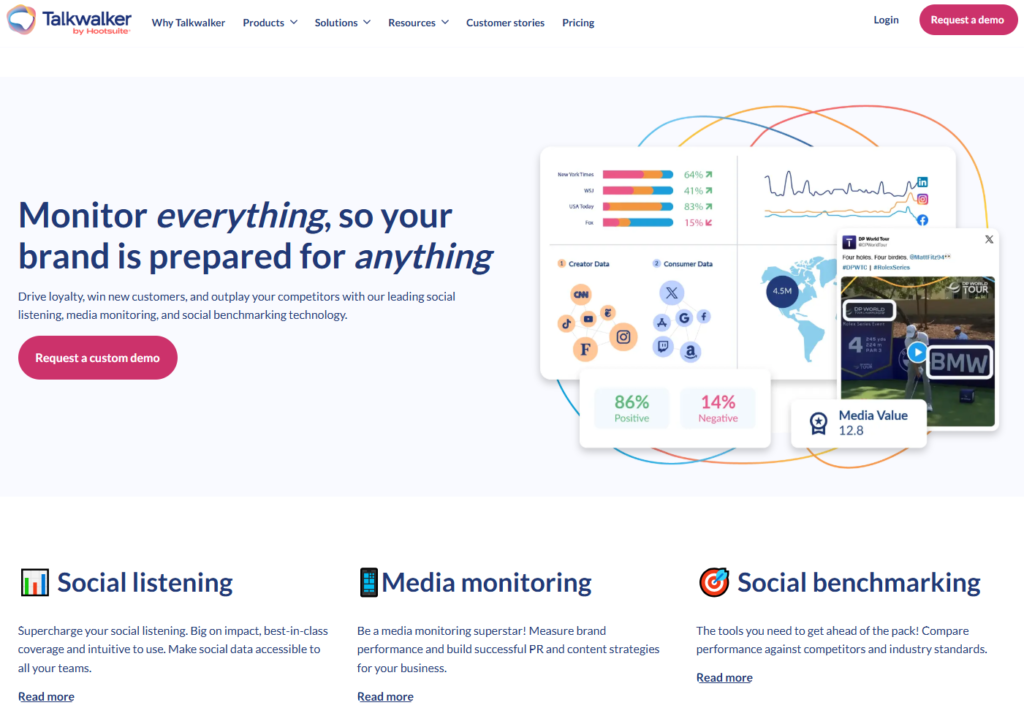
Talkwalker competes directly with Brandwatch at the top of the enterprise consumer intelligence market, with two specific capabilities that represent its most significant differentiators. The first is visual analytics — using computer vision AI to detect brand logos, product packaging, brand color schemes, and associated objects in images and videos across 150 million sources. This visual recognition capability means that a brand with highly recognizable visual assets can monitor a substantially larger share of brand-relevant content than text monitoring alone would surface, particularly on visually native platforms like Instagram, TikTok, and Pinterest where brand representation often occurs without text identification.
The second differentiator is the scale and depth of multilingual monitoring. With sentiment analysis covering 187 languages and source monitoring across 30+ social networks globally, Talkwalker provides genuine global brand monitoring coverage for enterprises operating across multiple linguistic and cultural markets. The sentiment models are not simple translations of English-language classifiers — they are trained on language-specific data that captures the cultural context, idiomatic expression, and tonal variation that make sentiment interpretation accurate rather than superficially multilingual.
Blue Silk GPT, Talkwalker’s AI interface for conversational data queries, allows brand intelligence analysts to ask natural language questions of the platform’s data and receive structured analytical responses. This conversational access reduces the query-building overhead that makes enterprise analytics platforms time-consuming to operate — enabling more analysts at various skill levels to extract insights from the monitoring data without requiring deep platform expertise.
Where Talkwalker Falls Short
Like Brandwatch, Talkwalker requires enterprise budget and analyst investment to operationalize effectively. The platform’s depth and configurability create a learning curve that self-service deployment cannot clear — teams that deploy Talkwalker without dedicated analyst bandwidth typically underutilize it significantly. Custom pricing and required sales engagement also mean that most organizations discover the cost is beyond their budget after investing substantial evaluation time.
The Verdict on Talkwalker
Talkwalker is the right enterprise brand monitoring platform for global organizations with significant multilingual monitoring requirements and visual brand presence that text monitoring cannot adequately cover. For enterprises choosing between Talkwalker and Brandwatch, the selection typically comes down to specific capability fit: Talkwalker’s visual analytics and multilingual depth versus Brandwatch’s data archive and Iris AI. Both require the same analyst investment, implementation complexity, and enterprise budget commitment to deliver their potential value.
7. Awario — Best Budget-Friendly Social Listening and Lead Generation Tool
| Key Information | Overview |
|---|---|
| Best For | Startups, small businesses, and budget-conscious marketers who need reliable brand and competitor monitoring at the lowest price point in the professional category |
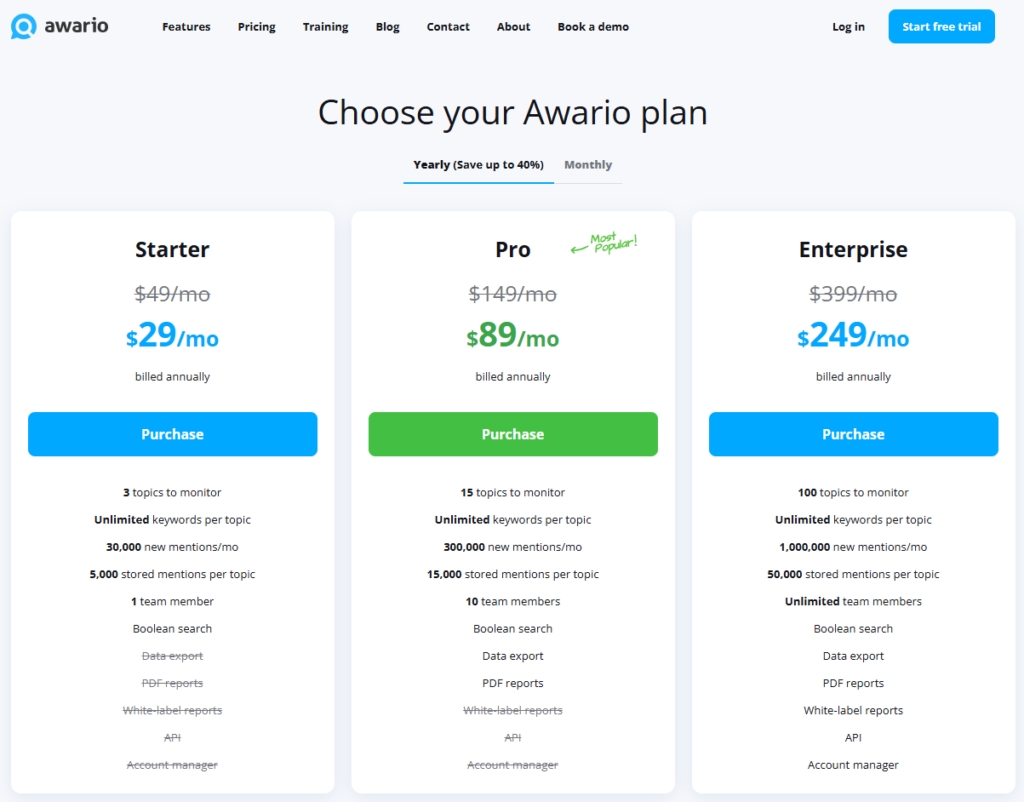
| Pricing | Starter $29/mo (3 topics, 30K mentions/mo, 1 user). Pro $89/mo (15 topics, 300K mentions/mo, 10 users). Enterprise $249/mo (100 topics, 1M mentions/mo, unlimited users). Annual billing saves approximately 40% |
| Free Tier | Yes — 7-day free trial |
| Key Strengths | Best mentions-per-dollar ratio in the category, Boolean search included on all plans, real-time and historical data access, competitor comparison dashboard, Awario Leads for social selling opportunity identification, white-label PDF and HTML reports (Enterprise), team collaboration features on Pro and above |
| Key Weaknesses | No podcast, newsletter, or LinkedIn monitoring; sentiment analysis uses simpler models than Brand24 or Mention; Starter plan limited to 1 user and 3 topics; no mobile app |
| Best For Teams | Solo marketers, startup founders, small agencies, and any team prioritizing cost efficiency over monitoring depth |
| Source Coverage | Social networks (excluding LinkedIn), news, blogs, forums, Reddit, web pages — approximately 13 billion pages crawled daily |
| Sentiment Analysis | Basic sentiment classification; less nuanced than premium platforms |
| Best Pairing | Semrush or Ahrefs for backlink opportunities found via Awario’s unlinked mentions; Slack for alert routing |
Awario’s primary competitive claim is efficiency: it delivers more monitored mentions per dollar spent than any other platform in the category. Independent comparisons consistently show Awario providing approximately 1,900 mentions per dollar at its Pro plan pricing, compared to Brand24’s approximately 650 mentions per dollar — a difference that matters significantly for cost-sensitive organizations whose monitoring programs are constrained by budget rather than by a requirement for the deepest available analytical capability.
The Awario Leads feature is the capability that distinguishes it most clearly from pure-monitoring tools at comparable price points. By monitoring for conversations where users express a need or complaint that the brand could address — questions about product alternatives, complaints about competitors, requests for service provider recommendations — Awario identifies social selling opportunities that turn monitoring data into direct pipeline input. For small businesses and startups where marketing and sales functions overlap and every monitored channel is expected to contribute to revenue, this lead generation dimension extends the ROI of the monitoring subscription beyond brand awareness.
The Boolean search — available on all Awario plans including the $29/mo Starter tier — provides the query precision that allows effective monitoring even on plans with limited mention capacity. A well-constructed Boolean query that includes only commercially relevant brand context can make a 30,000-monthly-mention limit effectively unlimited for focused monitoring programs, by ensuring that the allotted mentions are populated with signal rather than noise.
White-label PDF and HTML report generation on the Enterprise plan ($249/mo) makes Awario viable for agencies that need to deliver branded monitoring reports to clients without the reporting overhead of building custom reports in external tools. For small agencies managing monitoring programs for multiple clients under a combined budget, Awario’s Enterprise plan provides agency-scale reporting at a price point that individual client monitoring budgets can absorb.
Where Awario Falls Short
Awario’s source coverage has meaningful gaps relative to Brand24 and Mention. LinkedIn is not monitored — a significant omission for B2B brands where LinkedIn is a primary professional conversation platform. Podcast and newsletter monitoring are absent entirely. The sentiment analysis model, while functional, produces less nuanced classifications than the AI-powered systems of Brand24 or Mention, which matters for brands where sentiment accuracy drives response decisions. The lack of a mobile app also constrains real-time monitoring capability for teams where monitoring responsibility belongs to individuals who are not always at a desk.
The Verdict on Awario
Awario is the right brand monitoring tool for startups, small businesses, and budget-conscious marketers who need reliable monitoring coverage at the lowest professional price point available. The Starter plan at $29/mo is genuinely functional for solo brand monitoring; the Pro plan at $89/mo provides agency-capable features at a total cost that most small agencies can allocate without client-specific budget justification. For organizations where monitoring depth, LinkedIn coverage, or podcast monitoring is a requirement, Brand24 or Mention provide the necessary capabilities at a moderate cost increase.
8. Semrush Brand Monitoring — Best for SEO-Integrated Unlinked Mention Discovery
| Key Information | Overview |
|---|---|
| Best For | SEO teams and content marketers who want brand monitoring integrated with their existing SEO workflow — particularly for identifying unlinked mentions that represent link-building opportunities |
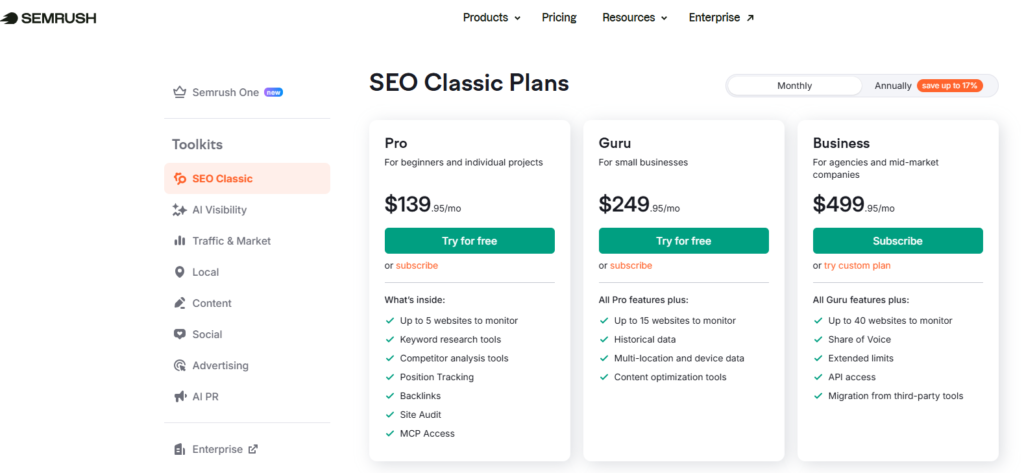
| Pricing | Included in Semrush Pro ($139.95/mo), Guru ($249.95/mo), and Business ($499.95/mo) plans. Brand Monitoring is one of many tools within the Semrush suite |
| Free Tier | Yes — 7-day free trial on Pro and Guru plans |
| Key Strengths | Unlinked brand mention detection with direct link-building outreach prompts, integration with Semrush backlink and keyword data, sentiment analysis on mentions, mentions volume chart, traffic estimation for mention sources, site authority scores for prioritizing outreach targets |
| Key Weaknesses | Not a dedicated brand monitoring platform — monitoring depth and coverage are secondary to Semrush’s primary SEO functions; social media mention coverage less comprehensive than Brand24 or Mention; best used as a supplementary tool alongside a primary monitoring platform |
| Best For Teams | SEO teams using Semrush as their primary SEO platform, content marketers tracking content mentions for link-building, digital PR teams combining monitoring with SEO strategy |
| Source Coverage | Web content including news, blogs, and public web pages — social media coverage more limited |
| Sentiment Analysis | Basic positive/negative/neutral classification |
| Best Pairing | Brand24 or Mention as the primary social and media monitoring layer alongside Semrush’s web-content monitoring |
Semrush Brand Monitoring earns its place in a brand monitoring tools list not by competing with dedicated monitoring platforms on coverage depth or social listening sophistication, but by delivering a specific and valuable monitoring capability — unlinked mention detection — within the Semrush ecosystem that most SEO teams are already paying for and operating daily.
Unlinked mentions are the brand’s most immediately actionable monitoring insight for SEO purposes: articles and blog posts that reference the brand by name without linking to the brand’s website. These are link-building opportunities hiding in plain sight — the publisher is already aware of and familiar with the brand, has already made an editorial decision to mention it, and in many cases will add a link when contacted with a simple, low-friction outreach request. The conversion rate on unlinked mention outreach consistently outperforms cold link-building prospecting because the relationship foundation — the publisher’s existing familiarity and positive disposition toward the brand — is already established.
Semrush Brand Monitoring surfaces these unlinked mentions with source authority scores, traffic estimates for the mentioning page, and direct access to the publisher’s contact information through Semrush’s outreach tools — creating a complete workflow from mention discovery to link acquisition within a single platform. For SEO teams that manage brand monitoring as a link-building tactic rather than a reputation management function, this integrated workflow is more operationally efficient than detecting unlinked mentions in a separate monitoring tool and then switching to Semrush for the link-building follow-up.
The sentiment classification overlaid on detected mentions — basic positive, negative, and neutral scoring — provides a relevance filter that prioritizes the mentions worth responding to for either reputation management or outreach purposes, without requiring manual review of every mention in the feed.
Where Semrush Brand Monitoring Falls Short
Semrush Brand Monitoring is not a social listening platform. The coverage is concentrated on indexed web content — news sites, blogs, and public web pages — with limited social media monitoring that does not approach the breadth or depth of dedicated monitoring tools. For the reputation management, crisis detection, and social conversation monitoring that are the primary use cases for most brand monitoring programs, Semrush’s coverage is insufficient as a standalone solution. It is correctly used as a supplementary SEO-focused monitoring layer alongside Brand24, Mention, or a comparable primary monitoring tool.
The Verdict on Semrush Brand Monitoring
Semrush Brand Monitoring is the right brand monitoring tool for SEO teams already using Semrush who want to operationalize unlinked mention outreach as part of their link-building strategy. For any Semrush user who has not yet activated the Brand Monitoring tool, doing so is a zero-incremental-cost addition to an existing subscription that can generate link acquisition opportunities with minimal ongoing effort. It is not a primary monitoring platform and should not be evaluated as one — its value is as an SEO-integrated monitoring layer within a broader brand monitoring stack.
9. BuzzSumo — Best for Content-Performance Brand Monitoring
| Key Information | Overview |
|---|---|
| Best For | Content marketers and digital PR teams who want to understand how brand mentions connect to content performance, backlink acquisition, and social sharing — rather than just where the brand is mentioned |
| Pricing | Content Creation $199/mo. PR & Comms $299/mo. Suite $499/mo. Enterprise $999/mo. Annual billing saves approximately 20% |
| Free Tier | No — 30-day free trial |
| Key Strengths | Brand mention tracking tied to content performance metrics (backlinks, shares, engagement), competitor content analysis, journalist and publisher identification behind brand-relevant content, author alert system, trending content identification, historical content data back to 2009, question analysis for content opportunity research |
| Key Weaknesses | Expensive relative to dedicated monitoring tools for the monitoring-specific functionality; social media monitoring less comprehensive than Brand24 or Mention; primarily a content research tool with monitoring as a secondary capability |
| Best For Teams | Content marketing teams, digital PR professionals, SEO practitioners focused on earned media and link acquisition |
| Source Coverage | Web content, news, blogs — strong on content performance; social media monitoring secondary |
| Sentiment Analysis | Basic; not a primary BuzzSumo capability |
| Best Pairing | Brand24 or Mention for social monitoring alongside BuzzSumo’s content-performance monitoring layer; Semrush or Ahrefs for backlink data alongside BuzzSumo’s content discovery |
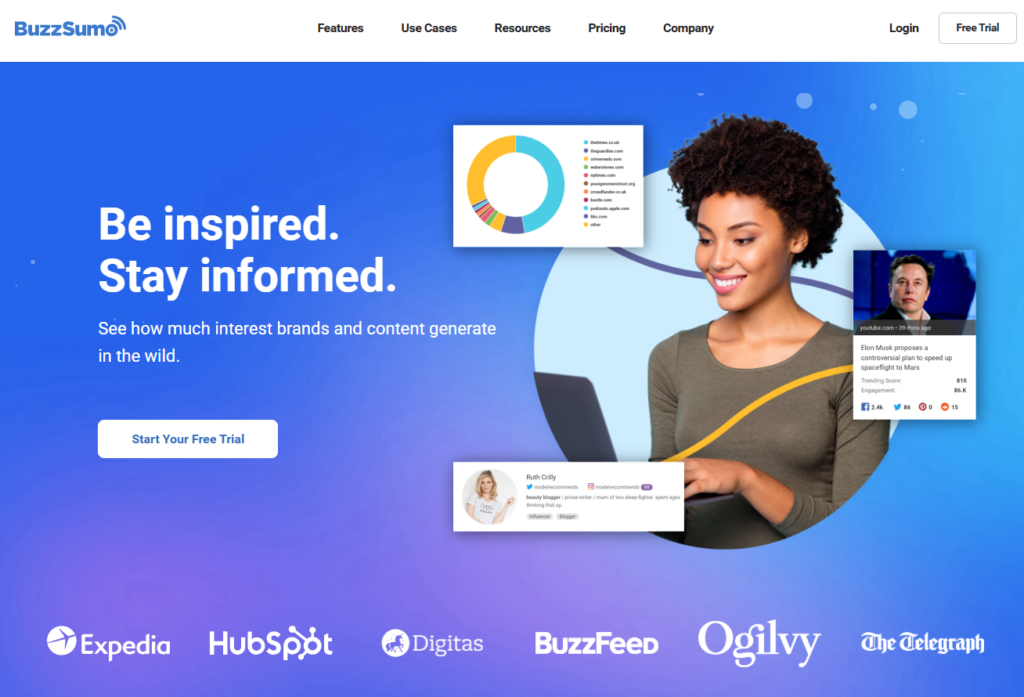
BuzzSumo’s approach to brand monitoring is fundamentally different from every other platform on this list: it connects brand mentions to content performance. Rather than simply alerting when the brand is mentioned, BuzzSumo surfaces which pieces of content mentioning the brand are generating the most backlinks, social shares, and engagement — providing the performance context that tells a content marketing or digital PR team not just where the brand appears but which appearances are commercially valuable.
The author alert system — which notifies the team when specific journalists, bloggers, or content creators who have previously written about the brand or its competitors publish new content — is the feature that drives the most consistent daily value for digital PR teams. Maintaining awareness of the content output of the journalists who cover a brand’s category enables proactive media relationship management: reaching out with a comment or additional information before an article is published rather than responding to coverage after it appears.
The historical content data going back to 2009 provides a research foundation for understanding how brand and category coverage has evolved over time — which topics generated coverage spikes, which content formats drove the most engagement in different periods, and how the competitive landscape for editorial attention in the category has changed. For content marketing strategies built on historical pattern analysis, this depth of content performance data provides insights that monitoring-focused platforms without content analytics cannot match.
Where BuzzSumo Falls Short
BuzzSumo’s $199/mo entry price for the Content Creation plan is significantly higher than Brand24 or Mention for a platform where monitoring is a secondary capability. The monitoring functionality — while useful for content-specific use cases — does not replace a dedicated monitoring tool for teams whose primary requirement is real-time social and media coverage, sentiment analysis, and crisis alerting. BuzzSumo is most effective as the content intelligence layer in a monitoring stack that includes a dedicated tool for social listening.
The Verdict on BuzzSumo
BuzzSumo is the right monitoring tool for content marketing and digital PR teams who approach brand monitoring as an intelligence input to content strategy — understanding which brand-relevant content is generating distribution and what content formats are earning coverage in their category. For teams whose monitoring program is primarily oriented toward content planning and digital PR relationship management rather than reputation protection and crisis response, BuzzSumo provides a dimension of insight that social listening tools do not. It belongs in the monitoring stack as the content intelligence layer, not as the primary monitoring platform.
10. Google Alerts — Best Free Baseline Monitoring for Web-Indexed Content
| Key Information | Overview |
|---|---|
| Best For | Individuals, very small businesses, and any organization that needs a free, zero-configuration starting point for web-indexed brand mention monitoring |
| Pricing | Free — completely free for any Google account holder |
| Free Tier | Yes — fully functional with no restrictions for web-indexed content |
| Key Strengths | Zero cost, zero setup overhead, email delivery of new web-indexed mentions to any email address, configurable alert frequency (as it happens, daily, weekly), unlimited keyword alerts, broad web coverage via Google’s index |
| Key Weaknesses | Does not monitor social media (Instagram, TikTok, LinkedIn, Facebook, X posts are not Google-indexed); no dashboard, sentiment analysis, analytics, or reporting; no duplicate filtering, Boolean precision, or spam filtering; alert delivery inconsistent; no team collaboration features |
| Best For Teams | Individuals, very small businesses without monitoring budget, and as a supplementary alert layer for teams already using a primary monitoring platform |
| Source Coverage | Google-indexed web content — news sites, blogs, public web pages. Social media posts are largely excluded |
| Sentiment Analysis | None |
| Best Pairing | Any paid monitoring tool on this list for social and media coverage; useful as a free supplement that catches web-indexed content not covered by primary tools |
Google Alerts is the monitoring tool everyone starts with and eventually graduates beyond — and it earns a place in this guide both for its genuine utility as a zero-cost starting point and for the honest accounting of where its limitations define the practical ceiling of free monitoring.
The core value is absolute accessibility. Any person with a Google account can configure an alert for their brand name, product name, or any monitored keyword in under two minutes, with no subscription, no setup call, and no learning curve. Alerts arrive in email — one by one or in daily or weekly digest format — as new web-indexed content matching the keyword is detected by Google’s crawl. For an individual professional, a very small business with minimal online presence, or a researcher monitoring a topic of interest, this simplicity and zero cost is not a compromise — it is exactly appropriate for the scale of the monitoring need.
The limitations define where Google Alerts is insufficient rather than merely imperfect. Social media platforms — Instagram, TikTok, Facebook, LinkedIn, X/Twitter — are not indexed by Google, meaning the majority of consumer brand conversations on these platforms generate no Google Alerts. Reddit posts are partially indexed but incompletely. YouTube video content is indexed by title and description but not by transcript. The result is a monitoring tool that covers the public web with reasonable completeness but misses the social conversation layer that represents the majority of brand mention volume for consumer-facing businesses.
There is no dashboard, no sentiment analysis, no mention volume tracking, no competitive comparison, no historical data access, and no team collaboration. Each alert is a standalone email with no context about how it relates to other mentions, no analytical framing, and no actionable guidance about what to do with the information. For any organization that needs brand monitoring to be operational rather than informational, this lack of analytical infrastructure renders Google Alerts insufficient as a primary tool.
Where Google Alerts Falls Short
The consistent finding from every user who has run Google Alerts alongside a paid monitoring tool is that Google Alerts misses a substantial majority of brand-relevant content. Not just social media — blogs, forums, and review sites with limited Google crawl frequency surface in paid tools days or weeks before Google Alerts picks them up. The inconsistency in delivery timing and the absence of duplicate filtering also mean that the alert stream requires manual review overhead that more intelligent tools eliminate. For any monitoring use case where completeness and timeliness matter, Google Alerts is a baseline supplement rather than a viable primary tool.
The Verdict on Google Alerts
Google Alerts is the right starting point for anyone who has never done systematic brand monitoring and wants to establish the habit before committing to paid tools. For businesses that have outgrown the free tier — which effectively means any business that is actively managing its online reputation or operating in a competitive market where monitoring timeliness matters — the upgrade to Brand24 Individual ($99/mo), Awario Starter ($29/mo), or Mention Solo ($41/mo) is the appropriate next step. Keep Google Alerts running alongside a paid tool as a supplementary web-indexed content layer that occasionally surfaces content the paid tool misses.
Which Brand Monitoring Tool Should You Choose? A Decision Framework
The right brand monitoring platform depends on your organization’s size, the primary monitoring objective, the channels where your brand conversations occur, and the budget available.
If you are an enterprise brand with dedicated consumer insights resources: Brandwatch for the deepest intelligence and the broadest AI analytics. Talkwalker if multilingual monitoring or visual brand recognition is a primary requirement.
If you are a mid-market business needing comprehensive monitoring: Brand24 Pro ($199/mo annual) for the best combination of coverage breadth, AI analysis, and multi-format monitoring including podcasts and newsletters. Mention ProPlus ($149/mo) if crisis anomaly detection and Boolean precision are the primary requirements.
If you are a PR or corporate communications team: Meltwater for the broadest traditional media and podcast coverage. Supplement with Brand24 or Mention for social coverage that Meltwater’s social layer does not fully match.
If you want monitoring integrated into your social media management workflow: Sprout Social Standard ($199/seat/mo) for teams that need publishing, engagement, and monitoring in a single platform and can justify the per-seat pricing.
If you are an SEO or content marketing team: Semrush Brand Monitoring (included in existing Semrush subscription) for unlinked mention and link-building opportunities. BuzzSumo ($199/mo) if content performance intelligence is the primary monitoring objective.
If you are a startup or small business with a tight budget: Awario Starter ($29/mo) for the most functionality per dollar. Google Alerts (free) as a supplementary layer. Graduate to Brand24 Individual ($79/mo annual) when real-time monitoring becomes operationally necessary.
Recommended Brand Monitoring Stacks by Organization Type
| Organization Type | Primary Tool | Supporting Tools | Monthly Cost | Coverage |
|---|---|---|---|---|
| Enterprise (Consumer Brand) | Brandwatch or Talkwalker | Sprout Social (engagement layer) | Custom ($2K–$20K+) | Deep social intelligence + visual monitoring + management |
| Enterprise (PR / Comms) | Meltwater Suite | Brand24 Pro for social depth | Custom + $199/mo | Earned media + broadcast + social listening |
| Mid-Market (Marketing Team) | Brand24 Pro ($199/mo annual) | Semrush Brand Monitoring (existing) | $200–$350/mo | Full social + media + AI analysis + SEO mentions |
| PR / Comms (Mid-Market) | Mention ProPlus ($149/mo) | Meltwater Essentials | $149–custom | Real-time anomaly detection + news coverage |
| Social Media Team | Sprout Social Standard ($199/seat) | Brand24 for deeper web monitoring | $200–$600/mo | Unified management + monitoring + engagement |
| SEO / Content Team | Semrush Brand Monitoring (included) | BuzzSumo Content Creation ($199/mo) | $0–$199 incremental | Unlinked mentions + content performance intelligence |
| Small Business / Startup | Awario Starter or Pro ($29–$89/mo) | Google Alerts (free supplement) | $29–$89/mo | Core social + web monitoring at lowest viable cost |
| Individual / Freelancer | Google Alerts (free) | Awario Starter trial | Free | Web-indexed content baseline |
Head-to-Head: Which Tool Wins Each Category?
| Category | Winner | Runner-Up | Notes |
|---|---|---|---|
| Enterprise Social Intelligence | Brandwatch | Talkwalker | Brandwatch on archive depth and Iris AI; Talkwalker on visual recognition and multilingual |
| Visual Brand Recognition | Talkwalker | Brandwatch | Both capable; Talkwalker marginally stronger on visual analytics depth |
| SMB and Mid-Market Monitoring | Brand24 | Mention | Brand24 on AI analysis and podcast/newsletter coverage; Mention on anomaly detection |
| Crisis Early Warning | Mention | Brand24 | Mention’s Pulse detection purpose-built for anomaly alerting; Brand24 strong second |
| Earned Media and Traditional Press | Meltwater | Brandwatch | Meltwater on news source breadth and broadcast; Brandwatch on social plus media combined |
| Social Management Integration | Sprout Social | Hootsuite | Sprout on monitoring-management integration quality; Hootsuite on pricing accessibility |
| Budget / Best Value | Awario | Google Alerts (free) | Awario on paid value; Google Alerts for zero-cost baseline |
| SEO-Integrated Monitoring | Semrush Brand Monitoring | Ahrefs Alerts | Semrush on unlinked mention workflow; Ahrefs on backlink data integration |
| Content Performance Monitoring | BuzzSumo | Semrush | BuzzSumo on content intelligence depth; Semrush on SEO integration |
| Boolean Search Precision | Mention | Brandwatch | Mention on Boolean UX and accuracy; Brandwatch on advanced operator depth |
| AI-Powered Analysis | Brandwatch (Iris) | Brand24 (Brand Assistant) | Brandwatch on proactive pattern detection; Brand24 on accessible conversational AI |
Frequently Asked Questions
What is the difference between brand monitoring, social listening, and media monitoring?
Brand monitoring is the broadest term — tracking all mentions of a brand across all online channels, including social media, news, blogs, forums, review sites, and emerging platforms. Social listening is the specific practice of monitoring social network conversations to understand audience sentiment, emerging trends, and consumer behavior patterns — typically more analytical in orientation than alert-based monitoring. Media monitoring is the traditional PR practice of tracking brand and keyword appearances in earned media — news articles, press coverage, broadcast, and increasingly podcasts. In practice, most modern brand monitoring platforms combine all three capabilities, and the terms are used interchangeably in the market, though enterprise platforms tend to distinguish between social listening depth and media monitoring breadth as distinct product capabilities.
How many keywords should a brand monitoring program track?
Most monitoring programs start with three to five keyword groups: the brand name (with common misspellings), key product or service names, executive names for key leadership, primary competitors, and one or two industry or category terms. The appropriate number scales with brand complexity, competitive intensity, and the monitoring team’s capacity to act on what they find. A well-designed Boolean query for each keyword group is more valuable than a large number of poorly filtered keyword alerts — the signal-to-noise ratio of the monitoring feed determines whether the team reads it daily or learns to ignore it.
Can brand monitoring tools track mentions in AI-generated content like ChatGPT responses?
This is an emerging capability rather than a standard feature in 2026. Traditional brand monitoring platforms track publicly accessible web content — social media posts, news articles, blog posts, forum discussions — that their crawlers can access. The responses that generative AI platforms like ChatGPT, Gemini, and Perplexity generate for individual users are not publicly indexed and cannot be monitored by standard crawlers. Some platforms have begun developing AI visibility tracking that monitors which brands appear in sample AI-generated responses across specific query categories, providing a directional picture of AI presence. GetMint (from the search results, starting at $109/mo) is one example of a specialized tool in this emerging category. Comprehensive AI mention monitoring remains a developing area rather than a mature capability in most mainstream platforms.
What sentiment analysis accuracy should I expect from brand monitoring tools?
Most mid-market brand monitoring platforms achieve 70 to 85 percent accuracy on basic positive, negative, and neutral sentiment classification for straightforward mentions. Accuracy degrades significantly for sarcasm, irony, context-dependent meaning, and mentions where sentiment is genuinely ambiguous. Brand24 and Mention both operate around 80 to 82 percent accuracy in independent assessments; enterprise platforms like Brandwatch and Talkwalker achieve higher accuracy through more sophisticated models trained on larger and more diverse datasets. The practical implication: use sentiment data as a directional signal for trend identification and volume monitoring rather than as a definitive classification for individual mentions that will drive consequential decisions.
How quickly should a brand monitoring program respond to negative mentions?
The 2025 Sprout Social Index found that approximately 75 percent of consumers expect a brand response within 24 hours of a social media mention. For crisis-category content — a viral complaint, a negative press story, a coordinated negative campaign — the response window is measured in hours, not days. The monitoring tool’s detection speed and alerting infrastructure directly affects whether response times meet these expectations. Real-time monitoring on Brand24 Pro, Mention, or Sprout Social provides the detection speed that timely response requires; platforms with 12-hour or longer data refresh cycles on entry plans are structurally unable to support the response standards most consumers now expect.
The Bottom Line: Monitor Everything, Respond to What Matters
The brand monitoring tools available in 2026 provide genuine, commercially meaningful capability at every budget — from Google Alerts at zero cost to Brandwatch and Talkwalker at enterprise price points that reflect enterprise-grade intelligence depth. The tool is not the primary constraint on a brand monitoring program’s effectiveness. The discipline of acting on what the tool finds, the clarity about which types of mentions require response versus analysis versus archival, and the organizational investment in making monitoring insights flow to the people who can act on them — these operational factors determine whether a monitoring program changes anything.
Two principles should guide brand monitoring program design. First, define the response protocol before the tool. Knowing what to do when a negative mention is detected — who reviews it, who decides on a response, who drafts it, what approval it requires, and how fast it must go out — is the precondition for monitoring timeliness. A team with a clear response protocol and an adequate tool will outperform a team with an enterprise tool and no defined process. Second, prioritize signal quality over data volume. The best brand monitoring programs are not the ones that see the most mentions — they are the ones where the team actually reads the monitoring feed daily because the signal-to-noise ratio makes it worth reading. A well-tuned Brand24 or Mention monitoring program with precise Boolean queries and a clear topic structure delivers more operational value than an enterprise platform configured to generate every possible mention of every possible brand-adjacent term.
The Brand Monitoring Stack That Works for Most Businesses
For most mid-market businesses with a small but active marketing team: Brand24 Pro ($199/mo annual) as the primary monitoring layer — covering social, news, blogs, forums, podcasts, and newsletters with AI analysis and real-time alerting. Add Semrush Brand Monitoring for unlinked mention and link-building intelligence at no incremental cost for existing Semrush subscribers. Keep Google Alerts as a zero-cost supplement for web-indexed content. Upgrade to Mention or a Meltwater Essentials tier when PR and earned media tracking becomes a primary program objective. Evaluate Brandwatch or Talkwalker only when the monitoring program has grown to require dedicated analyst resources to operationalize enterprise-tier capability.
The brand that knows what is being said about it in real time, responds to what matters, and learns from the rest has a genuine competitive advantage over the brand that finds out retrospectively. The tools to achieve that visibility are accessible, well-documented, and available at every budget level. The only variable is the commitment to build and maintain the program.


