

Email remains the highest-ROI marketing channel available — by most industry estimates, every dollar spent on email marketing returns between $36 and $42. The reason is not that email is easy. It is that email automation, done well, delivers the right message to the right person at the right moment in the customer lifecycle, at a scale and a cost that no other channel comes close to matching. A welcome sequence that converts new subscribers into paying customers. An abandoned cart flow that recovers revenue that would otherwise be lost. A re-engagement campaign that brings dormant customers back before they churn permanently. These automations run continuously, generate revenue around the clock, and require no incremental effort per send once they are built and optimized.
The challenge in 2026 is that the email automation tool market has fragmented into dozens of platforms that look similar on a feature comparison grid and behave very differently in practice. Platforms optimized for ecommerce have deep Shopify integrations and revenue attribution that general marketing platforms cannot match. Platforms built for creators have landing page builders and subscriber scoring designed for audience monetization. Platforms built for B2B have CRM-connected lead scoring and multi-step sales nurture workflows that consumer marketing tools do not support. The pricing structures — contact-based, send-volume-based, per-seat, credit-based — vary enough that a tool that appears cheap at small scale can become one of the most expensive options at 20,000 contacts.
This guide evaluates the best email automation tools across automation depth, segmentation quality, deliverability, AI capabilities, ecommerce integration, and total cost of ownership at realistic contact counts. Every recommendation identifies the specific business profile where that platform delivers the best outcome — and where the limitations start to show.
Quick Comparison: Top 10 Email Automation Tools for 2026
| # | Platform | Primary Use | Starting Price | Free Tier | Best Feature | Our Rating |
|---|---|---|---|---|---|---|
| 1 | ActiveCampaign | Advanced marketing automation and CRM | Starter $15/mo (1K contacts) | Yes | Deepest automation logic in the category | 9.4/10 |
| 2 | Klaviyo | Email and SMS automation for ecommerce | Free up to 250 contacts; Email from $20/mo (500 contacts) | Yes | Ecommerce-native flows with revenue attribution | 9.3/10 |
| 3 | Brevo | Send-volume-based email and multi-channel automation | Free (300 emails/day); Starter from $9/mo (5K emails) | Yes | Contact-unlimited pricing model for large list senders | 9.0/10 |
| 4 | Mailchimp | All-in-one email marketing for small and mid-size businesses | Free (500 contacts); Essentials from $13/mo | Yes | Largest template library and easiest onboarding in the category | 8.8/10 |
| 5 | MailerLite | Affordable email automation with landing pages and websites | Free (500 subscribers); Growing Business from $10/mo | Yes | Best value-to-feature ratio at small-to-mid list sizes | 9.0/10 |
| 6 | HubSpot Marketing Hub | CRM-native email marketing and marketing automation | Free CRM; Marketing Hub Starter from $20/mo/seat | Yes (free CRM) | Deepest CRM integration for B2B sales and marketing alignment | 9.1/10 |
| 7 | Kit (formerly ConvertKit) | Creator-focused email marketing and monetization | Free (10K subscribers, basic); Creator from $33/mo (1K subs) | Yes | Subscriber monetization tools built for digital creators | 8.9/10 |
| 8 | Omnisend | Ecommerce email and SMS marketing automation | Free (500 emails/mo); Standard from $16/mo | Yes | Best multi-channel ecommerce automation for Shopify and WooCommerce | 9.1/10 |
| 9 | Drip | Advanced ecommerce email marketing for established brands | From $39/mo (2,500 contacts) | No (14-day trial) | Liquid templating and behavioral segmentation for complex personalization | 8.8/10 |
| 10 | GetResponse | Email marketing with built-in webinar and funnel tools | Free (500 contacts); Email Marketing from $19/mo | Yes | Best all-in-one for creators running email alongside webinars and courses | 8.7/10 |
How We Evaluated These Email Automation Platforms
Every platform in this guide was assessed across six dimensions that reflect the real demands of a functioning email automation program — not feature checklists or vendor-provided open rate benchmarks.
Automation workflow depth and flexibility: The quality of email automation is ultimately determined by what triggers are available, how complex the branching logic can become, and how well the automation engine personalizes behavior based on subscriber actions. A platform that supports five automation triggers and linear sequences is fundamentally different from one that supports 100+ behavioral triggers, nested conditional logic, and dynamic content blocks that change per recipient based on CRM data. We evaluated the practical automation ceiling for each platform — what is possible for a team that has invested in fully utilizing the platform’s automation capabilities.
Segmentation quality and behavioral data: Effective email automation depends on the quality of the audience data informing it. We evaluated how richly each platform captures behavioral signals — opens, clicks, purchases, page visits, tag applications, lead score changes — and how flexibly those signals can be combined into segments that drive automation branching and personalization. The platforms that can combine email engagement data with website behavior, purchase history, and CRM data deliver meaningfully better personalization than those limited to email interaction signals alone.
Deliverability and inbox placement: An email automation platform’s technical infrastructure — its IP reputation, sending domain authentication, bounce and complaint handling, and relationship with major inbox providers — determines whether the emails it sends reach the inbox or the spam folder. We evaluated deliverability across major inbox providers, shared IP pool quality, and the platform’s tools for monitoring and improving sender reputation.
Ecommerce integration depth: For ecommerce-focused businesses, the quality of the native Shopify, WooCommerce, and BigCommerce integration determines whether the automation platform can access the product, purchase, and browse data that makes ecommerce-specific flows — abandoned cart, post-purchase, win-back, browse abandonment — commercially meaningful versus generic. We evaluated the native integration depth rather than the number of integrations listed.
AI capabilities and practical utility: Every platform in this guide now claims AI features. We evaluated whether the AI capabilities — AI-generated content, predictive send time optimization, AI-powered segmentation, generative subject line suggestions — deliver measurable outcomes in real campaigns rather than appearing as AI-branded versions of features that existed before.
Pricing structure and cost at scale: Email platform pricing is more complex than headline rates suggest. Contact counting rules (active vs. all contacts, including unsubscribed), send volume caps, feature tier gates, and add-on costs for SMS, landing pages, or advanced reporting all affect the real monthly cost at specific list sizes. We evaluated the realistic total cost for businesses with 1,000, 5,000, and 25,000 contacts under each platform’s current pricing model.
Why Email Automation Has Changed in 2026
Three developments define the email automation landscape in 2026 that distinguish it from three years earlier.
The first is AI-native automation, not AI-branded buttons. The platforms that have genuinely integrated AI into their automation workflow — Klaviyo’s K:AI suite that autonomously creates campaigns from website data, ActiveCampaign’s predictive sending that selects the optimal delivery time per individual contact, HubSpot’s AI-powered lead scoring that updates in real time as contact behavior evolves — have moved beyond AI as a content generation gimmick into AI as a structural component of how the automation itself operates. The distinction between platforms where AI generates a subject line suggestion and platforms where AI actively determines which contacts receive which automation branch is now commercially significant.
The second is the normalization of multi-channel automation within a single platform. Email-only automation programs are increasingly rare. Most platforms now support SMS alongside email in the same workflow — sending an SMS follow-up if an email goes unopened after 24 hours, coordinating email and push notification timing around a promotional event, triggering WhatsApp messages for time-sensitive order updates. The quality of this multi-channel coordination — whether SMS and email share behavioral data seamlessly or exist as disconnected bolt-on features — varies significantly between platforms and has become a primary selection criterion for businesses with omnichannel communication needs.
The third is the tightening of inbox placement standards. Google, Microsoft, and Yahoo’s 2024 bulk sender requirements — mandating SPF, DKIM, and DMARC authentication, requiring one-click unsubscribe headers, and enforcing spam complaint rate thresholds — have raised the baseline technical and list hygiene requirements for email deliverability. Platforms that have invested in helping customers meet these requirements — proactive authentication setup, complaint rate monitoring, automated list hygiene recommendations — have materially better deliverability outcomes than those that leave compliance implementation to the customer.
Detailed Reviews: Best Email Automation Tools for 2026
1. ActiveCampaign — Best for Advanced Marketing Automation and CRM
| Key Information | Overview |
|---|---|
| Best For | Businesses that need the deepest available automation logic — complex multi-step workflows, behavioral branching, predictive sending, and CRM integration — in a single platform |
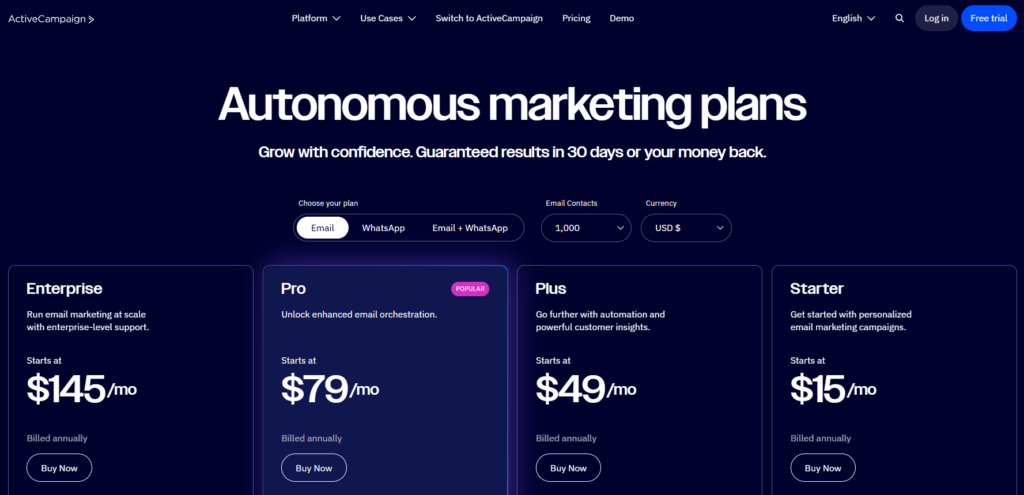
| Pricing | Starter $15/mo (1K contacts, monthly). Plus $49/mo. Pro $79/mo. Enterprise $145/mo. Annual billing saves ~20%. Contact tiers scale up; Starter unavailable above 25K contacts |
| Free Tier | Yes — 14-day free trial (100 contacts, 100 emails, email support only) |
| Key Strengths | 900+ automation workflow templates, unlimited automation steps on Plus and above, predictive sending and win probability AI, advanced segmentation with behavioral events, built-in CRM with pipeline management, 870+ integrations, conditional content blocks |
| Key Weaknesses | Starter plan restricts automations to 5 actions per workflow with no branching; CRM add-ons priced separately; November 2025 change now charges new users for all contacts including unsubscribed and bounced; steeper learning curve than simpler platforms |
| Best For Businesses | B2B companies, SaaS, agencies, and any business with complex multi-step nurture journeys and sales alignment requirements |
| Ecommerce Integration | Shopify, WooCommerce, BigCommerce (Pro and above), Magento |
| Multi-Channel | Email, SMS (add-on), WhatsApp (cross-channel plans) |
| Best Pairing | Salesforce or HubSpot CRM for large enterprise sales teams; Postmark for transactional email |
ActiveCampaign’s market position rests on a claim that is genuinely defensible: its automation workflow builder is the most capable available at its price point. With 900+ pre-built automation recipes covering every standard marketing and sales automation scenario — lead nurturing sequences, post-purchase flows, re-engagement campaigns, lead scoring automations, internal notification workflows, and sales handoff triggers — and the ability to build custom workflows with unlimited steps, branching conditions, wait times, and split testing on Plus and above, the platform supports automation complexity that would require enterprise marketing automation software from competitors.
The conditional logic is where ActiveCampaign’s automation depth becomes practically differentiated. An automation can branch based on whether a contact opened an email, clicked a specific link, visited a specific page, has a CRM deal in a specific pipeline stage, has a lead score above a threshold, matches a segment condition, or triggered a custom event via the API. These conditions can be combined with AND/OR logic across nested branches, creating automation trees that model the actual complexity of a customer lifecycle rather than the simplified linear sequences that beginner-friendly platforms support.
Predictive sending — which uses machine learning to determine the optimal time to deliver each email to each individual contact based on their historical engagement patterns — is available on the Pro plan and above. Unlike send-time optimization that segments contacts into broad delivery windows, predictive sending schedules each contact’s email at the specific time that historical data suggests they are most likely to open it. For automation sequences where timing significantly affects conversion — time-limited offers, webinar reminder sequences, sales follow-up workflows — this per-contact timing optimization produces meaningfully higher open rates than fixed-schedule sending.
The built-in CRM, available as an add-on to any base plan, tracks deals through customizable sales pipelines, scores leads based on behavioral events, and triggers automation actions based on pipeline stage changes. For businesses with both marketing and sales functions operating on the same contact database, this eliminates the data synchronization overhead between separate marketing automation and CRM systems — and the data lag and mapping errors that accompany it.
Where ActiveCampaign Falls Short
The November 2025 pricing change — now charging new users for all contacts in the account, including unsubscribed, bounced, and unconfirmed contacts — is a significant negative change that makes ActiveCampaign meaningfully more expensive for organizations with large but partially inactive lists than the headline contact-tier pricing implies. The Starter plan’s five-action automation limit with no branching is restrictive enough to disqualify it for most real automation use cases, making the effective starting plan for meaningful automation the Plus tier at $49/mo. CRM capabilities also require paid add-ons that start at $49/mo, adding to the total cost for businesses that need the sales pipeline alongside marketing automation.
The Verdict on ActiveCampaign
ActiveCampaign is the right email automation platform for businesses whose marketing strategy is defined by complex, multi-step automation workflows — B2B lead nurturing, SaaS onboarding sequences, multi-touch sales follow-up, and behavioral trigger campaigns that branch based on dozens of conditions. The Plus plan at $49/mo for 1,000 contacts is the practical starting point for real automation capability. For businesses with simpler needs and smaller budgets, MailerLite or Brevo deliver adequate automation at a fraction of the cost.
2. Klaviyo — Best Ecommerce Email and SMS Automation Platform
| Key Information | Overview |
|---|---|
| Best For | Ecommerce brands on Shopify, WooCommerce, or BigCommerce that need revenue-attributed email and SMS automation with the deepest available purchase behavior segmentation |
| Pricing | Free up to 250 active profiles (500 emails/mo). Email plan from $20/mo (251–500 profiles). Email + SMS from $35/mo (251–500 profiles). Scales by active profile count; pricing updated February 2025 to active-profile billing |
| Free Tier | Yes — 250 active profiles, 500 emails/mo, 150 SMS credits, access to all email features |
| Key Strengths | Native Shopify/WooCommerce integration with full purchase and browse data, predictive analytics for CLV, churn risk, and next order date, K:AI suite for autonomous campaign creation, advanced segmentation on purchase history, Segments AI from natural language prompts, multi-channel A/B testing, revenue reporting per flow and campaign |
| Key Weaknesses | February 2025 shift to active-profile billing increased costs for large lists with many unengaged contacts; free plan now strictly limited to 250 profiles; high cost at scale relative to Omnisend for comparable ecommerce features; learning curve steeper than Mailchimp or MailerLite |
| Best For Businesses | Direct-to-consumer ecommerce brands, Shopify and WooCommerce merchants, subscription commerce businesses |
| Ecommerce Integration | Shopify, WooCommerce, BigCommerce, Magento, Wix, Squarespace — deepest native integration |
| Multi-Channel | Email, SMS/MMS, mobile push, WhatsApp (beta) |
| Best Pairing | Shopify for ecommerce data foundation; Gorgias for customer service data alongside Klaviyo’s marketing automation |
Klaviyo’s position as the dominant email automation platform for ecommerce brands is built on a data architecture that no general marketing automation platform replicates: deep, real-time bidirectional integration with ecommerce platforms that makes every customer’s full purchase history, browse behavior, product affinity, and predicted lifetime value available as segmentation and personalization data in the automation engine.
The native Shopify integration does not simply push contact data from Shopify to Klaviyo — it maintains a live, synchronized customer profile that reflects every interaction across both platforms simultaneously. When a customer browses a product page three times without purchasing, that browse behavior triggers a browse abandonment flow. When they add items to their cart and leave, an abandoned cart sequence starts. When they complete a purchase, the post-purchase flow is triggered with product-specific content for exactly what they bought, and their segment membership updates in real time to reflect their new customer status. This level of purchase-behavior-driven automation is what generates the revenue attribution that makes Klaviyo’s higher price point defensible for ecommerce brands — most Klaviyo customers who actively use flows attribute 25 to 40 percent of their email-generated revenue to automated flows rather than broadcast campaigns.
The K:AI suite — Klaviyo’s AI layer — is the most comprehensive AI integration of any platform on this list. The Marketing Agent autonomously creates campaigns from the brand’s website data, generating copy, selecting segments, and scheduling without manual brief creation. Segments AI builds complex behavioral segments from plain-language prompts — “customers who have purchased twice in the last 90 days and have not opened an email in 30 days” creates a segment without requiring the user to manually configure each filter. The predictive analytics engine calculates each customer’s predicted lifetime value, churn risk, and next expected order date, enabling automations that trigger based on these predictions rather than past behavior alone.
Where Klaviyo Falls Short
Klaviyo’s February 2025 billing transition to active-profile-based pricing has increased costs meaningfully for brands with large but partially unengaged lists. Previously, brands paid only for contacts they actively emailed; now they pay based on all active profiles in their account, including those who have not received an email recently. For brands with strong list hygiene and engaged audiences, the impact is minimal. For brands with large legacy lists carrying significant email fatigue, the cost increase can be substantial. The free plan’s 250-profile limit is also now stricter than most competing free tiers — MailerLite, Mailchimp, and GetResponse all offer more generous free tiers for new businesses.
The Verdict on Klaviyo
Klaviyo is the right email automation platform for ecommerce brands that are serious about revenue attribution and behavioral personalization. The native Shopify and WooCommerce integrations are genuinely superior to those of any general marketing automation platform, the predictive analytics create automation triggers that purely historical platforms cannot match, and the revenue attribution reporting provides the commercial clarity that makes email automation an investment with a measurable return rather than a cost center. The $20/mo entry point is accessible for growing brands; the cost scales quickly enough that list hygiene becomes a financial discipline rather than just a deliverability one.
3. Brevo — Best for Large-List Senders on a Budget
| Key Information | Overview |
|---|---|
| Best For | Businesses with large contact lists that send at moderate frequency — where paying per email rather than per contact produces materially lower costs than list-based pricing models |
| Pricing | Free (300 emails/day, up to 100K contacts). Starter from $9/mo (5K emails/mo). Standard from $18/mo (5K emails + automation + landing pages). Profesional from $499/mo ( 15K emails/mo). Enterprise custom (350K+ emails/mo) |
| Free Tier | Yes — unlimited contacts, 300 emails/day (approx. 9,000/mo), marketing automation, CRM, web tracking |
| Key Strengths | Volume-based pricing that favors large lists with moderate send frequency, unlimited contacts on all plans, multi-channel platform (email, SMS, WhatsApp, live chat, push notifications), built-in CRM, marketing automation on all plans including free, transactional email via API, visual automation builder |
| Key Weaknesses | Brevo logo on all emails until paid branding-removal add-on ($12/mo) on Starter; landing pages locked behind Business plan; daily send cap on free plan (300/day) makes bulk campaigns impractical; automation depth less sophisticated than ActiveCampaign |
| Best For Businesses | SMBs and growing companies with large contact lists, businesses needing a multi-channel marketing platform at an accessible price, transactional email senders alongside marketing email |
| Ecommerce Integration | Shopify, WooCommerce, PrestaShop — adequate for standard flows |
| Multi-Channel | Email, SMS, WhatsApp (Business and Enterprise), live chat, push notifications |
| Best Pairing | Any dedicated ecommerce platform for deeper product data; Stripe or WooCommerce for transactional trigger events |
Brevo’s structural pricing advantage over every other platform on this list is simple: it charges by the number of emails sent per month, not by the number of contacts stored. Every other major platform charges based on contact or subscriber count, which means that having a large list — even if many contacts are only emailed infrequently — increases cost regardless of actual sending activity. Brevo’s model means a business with 50,000 contacts that sends one newsletter per month pays based on the 50,000 emails sent, not the 50,000 contacts stored. At Brevo’s Business tier pricing, that same send volume would cost a fraction of what Mailchimp, ActiveCampaign, or Klaviyo would charge for the same contact count.
This pricing model makes Brevo specifically attractive for two business profiles: companies with large acquired or legacy lists that they maintain but email infrequently (quarterly promotions, annual renewal reminders, event invitations to a large database), and early-stage businesses that want to build a large subscriber list without facing the cost penalization of contact-based pricing before that list becomes revenue-generating.
The free plan’s generosity is exceptional by category standards. Unlimited contact storage with 300 emails per day — approximately 9,000 per month — and access to marketing automation, CRM, web tracking, and multi-channel features at zero cost gives businesses a genuinely capable email marketing foundation without any of the meaningful feature restrictions that competing free tiers impose. The main practical limitation is the daily send cap, which prevents batch campaigns to large lists but does not constrain automation flows that send individual triggered emails throughout the day.
The marketing automation builder supports the standard trigger-based workflow scenarios — welcome sequences, abandoned cart reminders, post-purchase follow-ups, re-engagement campaigns — with a visual drag-and-drop interface that non-technical marketers can configure without engineering support. The automation logic is not as sophisticated as ActiveCampaign’s nested conditional branching, but it handles the majority of email automation use cases that most SMBs and mid-market businesses actually run.
Where Brevo Falls Short
The Starter plan’s Brevo branding on outgoing emails is a meaningful limitation for any business sending client-facing communications — removing it requires a $12/mo add-on that closes much of the cost gap between Starter ($9/mo + $12/mo branding removal = $21/mo) and MailerLite’s Growing Business plan ($10/mo). Landing pages are locked behind the Business plan ($18/mo), which means businesses that need landing pages alongside email cannot access them on the Starter tier. The automation depth, while adequate for standard sequences, does not support the behavioral complexity that growing businesses eventually require.
The Verdict on Brevo
Brevo is the right email automation platform for businesses with large contact lists that send at moderate frequency, and for any business that wants the most generous genuinely functional free email marketing plan available. The volume-based pricing model is the most important structural differentiator — it eliminates the contact-count penalty that makes list growth expensive on every other platform. For businesses whose primary automation need is standard triggered sequences rather than sophisticated behavioral branching, Brevo delivers complete functionality at the lowest cost in the category.
4. Mailchimp — Best for Ease of Use and Template Library Breadth
| Key Information | Overview |
|---|---|
| Best For | Small businesses and non-technical marketers who want the most accessible email marketing experience, the largest template library, and a platform that most integrations and third-party tools connect to natively |
| Pricing | Free (500 contacts, 1,000 emails/mo, 250 sends/day limit). Essentials from $13/mo (500 contacts, 5K emails). Standard from $20/mo (500 contacts, 6K emails, multi-step automation). Premium from $350/mo (10K contacts) |
| Free Tier | Yes — 500 contacts, 1,000 monthly emails, 1 audience, 30-day email support only |
| Key Strengths | Largest template library in the category (100+ email templates), intuitive drag-and-drop editor, marketing automation flows (formerly Customer Journey Builder), AI-generated content and subject line assistance, predictive segmentation on Standard and above, 300+ native integrations, widest third-party ecosystem |
| Key Weaknesses | Multi-step automations locked behind Standard plan ($20/mo); counts unsubscribed and non-subscribed contacts toward billing; free plan now reduced (250 contacts as of January 2026); automations less flexible than ActiveCampaign or Klaviyo; higher per-contact cost than MailerLite at comparable list sizes |
| Best For Businesses | Small businesses, bloggers, non-profits, and any organization where email marketing ease of use is the primary selection criterion |
| Ecommerce Integration | Shopify, WooCommerce, Squarespace — adequate for standard ecommerce flows |
| Multi-Channel | Email, SMS (add-on, US and Canada) |
| Best Pairing | Shopify for ecommerce data; Google Analytics 4 for campaign attribution tracking |
Mailchimp’s decade-plus position as the world’s most widely used email marketing platform rests on a combination that no competitor has matched for the specific audience it serves: the most accessible onboarding experience in the category, the largest library of pre-designed email templates, and the broadest ecosystem of native integrations — meaning that virtually every third-party tool, CRM, ecommerce platform, and web application has a Mailchimp integration available and tested.
For non-technical business owners, the value of this ecosystem is practical and immediate. A retail store that adopts Shopify, a small business that uses QuickBooks, a nonprofit that manages donors in Salesforce, an event organizer that sells tickets on Eventbrite — each of these can connect their existing tool to Mailchimp through a native integration that requires configuration rather than development. The contact and purchase data flows automatically into the Mailchimp audience, enabling basic automation that is far more sophisticated than the user’s technical skills would otherwise permit.
The Marketing Automation Flows — rebranded from Customer Journey Builder in June 2025 — provide a visual canvas for building multi-step sequences triggered by subscriber behavior, custom events, and data conditions. On the Standard plan and above, these flows support branching logic, conditional delays, and dynamic content that personalizes based on subscriber attributes. For a small business running standard automation scenarios — welcome sequence, abandoned cart, post-purchase follow-up, birthday email, re-engagement — the Mailchimp Standard plan provides fully adequate automation capability at $20/mo for 500 contacts.
Where Mailchimp Falls Short
Mailchimp’s contact counting model has become increasingly unfavorable. It counts unsubscribed contacts, non-subscribed contacts, and archived contacts toward the billing total — a policy that means organizations with significant list churn pay for contacts they can no longer email. Multi-step automation requires the Standard plan, meaning Essentials users are restricted to single-trigger automations that cover only the most basic workflow scenarios. The free plan was reduced in January 2026 to 250 contacts, making it less useful than competing free tiers from Brevo, MailerLite, and GetResponse. At scale, Mailchimp becomes one of the more expensive platforms in the category — a business with 50,000 contacts on Mailchimp Standard pays substantially more than the same business on Brevo or MailerLite.
The Verdict on Mailchimp
Mailchimp is the right email marketing platform for small businesses and non-technical marketers who prioritize ease of use, breadth of third-party integrations, and the largest available template library over raw automation capability or price efficiency at scale. For businesses whose primary constraint is getting started quickly and reliably, Mailchimp remains the most accessible option. For businesses that will grow to 10,000+ contacts and care about cost efficiency, migrating to MailerLite or Brevo before that point saves meaningful money. For businesses that need sophisticated automation, ActiveCampaign is the upgrade path.
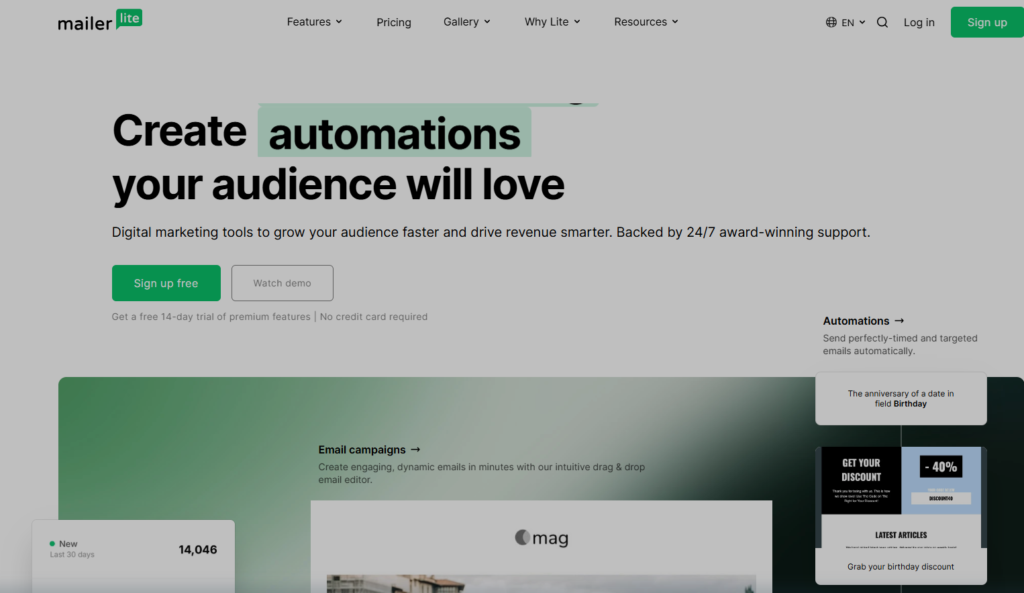
5. MailerLite — Best Value for Small-to-Mid-Size Businesses
| Key Information | Overview |
|---|---|
| Best For | Small and growing businesses that want a clean, capable email marketing and automation platform with landing pages, websites, and automation included — at the lowest cost among platforms that cover this full feature set |
| Pricing | Free (500 subscribers, 12K emails/mo). Growing Business from $10/mo (500 subscribers, unlimited emails). Advanced from $20/mo (500 subscribers, unlimited emails, unlimited users, AI writing). Annual billing saves 10%. Nonprofits save 30% |
| Free Tier | Yes — 500 subscribers, 12,000 emails/mo, 1 automation, landing pages, A/B testing |
| Key Strengths | Unlimited emails on all paid plans, clean drag-and-drop editor, automations and landing pages on all tiers, website builder included, ecommerce features with Shopify and WooCommerce, AI writing assistant (Advanced), sell digital products natively, excellent value relative to competing platforms |
| Key Weaknesses | Free plan reduced from 1,000 to 500 subscribers in September 2025; fewer native integrations than Mailchimp; automation triggers more limited than ActiveCampaign; no built-in CRM |
| Best For Businesses | Freelancers, bloggers, small businesses, growing e-commerce, nonprofits, and creators who want a comprehensive platform at an accessible price |
| Ecommerce Integration | Shopify, WooCommerce — standard integration with ecommerce automation triggers |
| Multi-Channel | Email only (no native SMS) |
| Best Pairing | Zapier for integrations not natively available; Stripe for digital product payments |
MailerLite’s value proposition in 2026 is straightforward: it delivers more capability per dollar than any competing platform at the small-to-mid-size business price point. The Growing Business plan at $10/mo for 500 subscribers includes unlimited email sends, automation workflows, landing pages, websites, pop-up forms, and ecommerce automation triggers. Every feature that competing platforms lock behind premium tiers or charge as add-ons — landing pages, website hosting, form builders, basic automations — is included in MailerLite’s entry-level paid plan.
The interface design philosophy is simplicity over feature density. Where ActiveCampaign’s automation builder supports hundreds of possible trigger conditions and branching paths, MailerLite’s automation builder covers the standard scenarios with a clean visual workflow that most non-technical users can configure on their first session without consulting documentation. For businesses whose automation requirements are a welcome sequence, a birthday email, an abandoned cart trigger, and a re-engagement campaign, MailerLite’s automation capabilities are not a limitation — they are exactly sufficient.
The digital products feature enables creators and small businesses to sell ebooks, templates, courses, presets, and other digital files directly from MailerLite’s infrastructure, collecting payment through Stripe and delivering the product automatically. For businesses with a digital product line that is currently managed through a separate platform — Gumroad, Payhip, or a custom checkout — MailerLite’s native digital products capability consolidates the delivery and subscriber management into the same platform, reducing the integration overhead and per-transaction cost of maintaining a separate delivery tool.
The unlimited email sends on all paid plans is a differentiating practical advantage at higher contact counts. Mailchimp limits Standard plan users to 12x their contact count per month; MailerLite Growing Business customers can send as many emails as they want to their subscriber list without volume surcharges. For businesses with high engagement lists that send multiple newsletters per week, this unlimited model avoids the volume-based cost escalation that constrains aggressive email cadences on capped platforms.
Where MailerLite Falls Short
MailerLite’s automation trigger library is more limited than ActiveCampaign’s — the Advanced plan adds more triggers than Growing Business, but neither approaches the event tracking and behavioral condition depth of ActiveCampaign or Klaviyo. There is no native SMS channel, which means businesses that need email-SMS coordination must use a separate SMS tool with a Zapier integration or manually manage multi-channel timing. The September 2025 reduction of the free plan from 1,000 to 500 subscribers has diminished its value for early-stage creators relative to Kit’s 10,000-subscriber free plan, though MailerLite’s free tier still includes more functional automation and landing page capability than Kit’s free plan.
The Verdict on MailerLite
MailerLite is the right email automation platform for small businesses, freelancers, bloggers, and growing ecommerce brands that want a genuinely comprehensive email marketing platform — with automation, landing pages, website hosting, and digital product sales included — at a price point that does not require justifying a significant monthly commitment before the channel is generating revenue. The Growing Business plan at $10/mo is the category’s best entry-level paid tier for the capability delivered.
6. HubSpot Marketing Hub — Best for B2B Sales and Marketing Alignment
| Key Information | Overview |
|---|---|
| Best For | B2B companies and SaaS businesses that need email automation tightly integrated with CRM data, sales pipeline activity, and multi-touch revenue attribution across the full customer lifecycle |
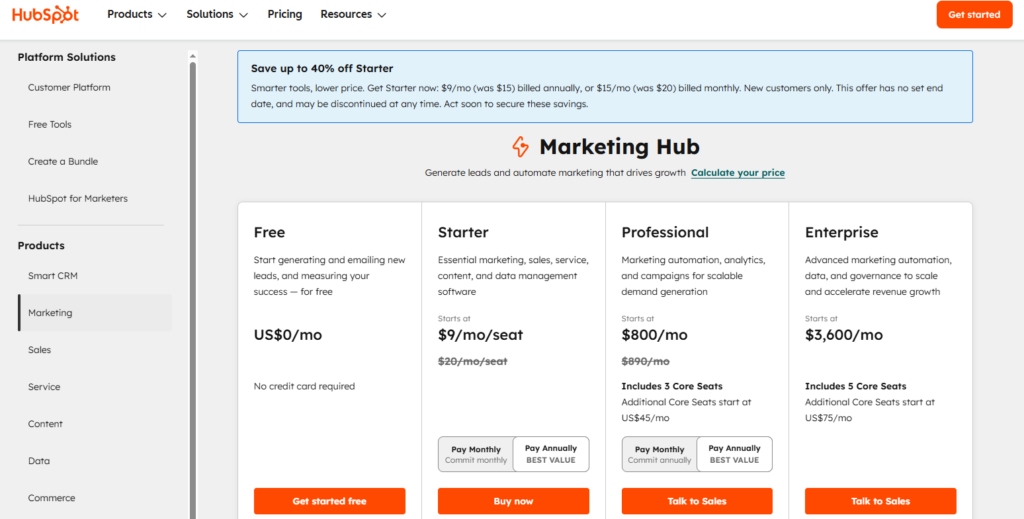
| Pricing | Free CRM with basic email tools. Marketing Hub Starter from $20/mo/seat (1K marketing contacts). Marketing Hub Professional from $890/mo (2K contacts). Enterprise from $3,600/mo. Pricing scales by marketing contact count |
| Free Tier | Yes — free CRM with email marketing, forms, live chat, and basic automation (HubSpot branding on emails) |
| Key Strengths | Native CRM with full lifecycle data feeding email segmentation and automation, multi-touch attribution reporting, AI-powered content generation and optimization, landing pages and forms, social media integration, sales sequence coordination, lead scoring with marketing and sales signals combined |
| Key Weaknesses | Marketing Hub Professional ($890/mo) is a major price jump from Starter ($20/mo/seat) — the full automation capability most B2B businesses need is locked at Professional or above; pricing scales steeply with marketing contact count; complex platform with significant onboarding investment |
| Best For Businesses | Mid-market and enterprise B2B companies, SaaS businesses with complex sales cycles, any organization using HubSpot CRM that wants native email automation on the same data |
| Ecommerce Integration | Shopify (via connector), WooCommerce — functional but not as deep as Klaviyo or Omnisend |
| Multi-Channel | Email, SMS (Professional and above), ads retargeting, social media |
| Best Pairing | HubSpot Sales Hub for complete CRM + sales sequence integration; HubSpot Service Hub for post-sale customer success automation |
HubSpot Marketing Hub’s differentiated value is the same across every product in the HubSpot ecosystem: the native CRM integration. Where every other email automation platform connects to a CRM through integrations that sync data on a schedule and map fields with inevitable imprecision, HubSpot Marketing Hub and HubSpot CRM share the same database. Every contact, every company, every deal, every sales interaction, every support ticket is in the same system. Email automation built on HubSpot can reference any CRM data point — deal stage, sales owner, last meeting date, support ticket status, subscription tier, product usage event — as a trigger or personalization variable without any synchronization lag or field mapping.
This unified data model produces the multi-touch attribution reporting that marketing teams at B2B companies typically cannot access on separate marketing automation and CRM platforms. HubSpot can trace the path from first marketing touchpoint through email engagement, sales development sequence, demo booking, proposal, and closed deal — and attribute revenue credit across the campaign and automation touches that influenced the customer journey. For B2B marketing teams that need to justify their email program’s contribution to pipeline and revenue rather than just reporting on opens and clicks, this attribution capability changes the conversation with sales and finance leadership.
The AI-powered content generation — Breeze AI in HubSpot’s current product naming — assists with email copy, subject lines, landing page content, and call-to-action text generation from prompts. Beyond content generation, HubSpot’s AI analyzes email performance patterns and suggests optimization actions — which segments are underperforming, which email variants are winning A/B tests, and which contacts in the database show signals of qualification that warrant sales outreach. For marketing teams operating without a dedicated email optimization analyst, this AI-guided optimization partially compensates for the analytical bandwidth that small teams lack.
Where HubSpot Falls Short
The price gap between Marketing Hub Starter ($20/mo/seat) and Professional ($890/mo) is one of the most severe in the software industry. The Starter plan covers basic email sending and limited automation; the full automation capabilities — multi-step workflows, behavioral branching, lead scoring, A/B testing, progressive profiling, and the reporting depth that justifies HubSpot’s positioning — require Professional or above. For most B2B businesses that need HubSpot because of its automation, the realistic minimum investment is $890/mo. Contact-based pricing on top of base plan costs also escalates quickly at higher marketing contact counts.
The Verdict on HubSpot Marketing Hub
HubSpot Marketing Hub is the right email automation platform for B2B companies already using HubSpot CRM, and for companies that want a single platform managing the complete marketing and sales technology stack without the integration overhead of connecting separate tools. The native CRM data integration and multi-touch attribution are capabilities that no standalone email automation platform replicates. For businesses with budgets that can justify the Professional tier, HubSpot is a transformative investment. For businesses at the Starter tier, the automation capability is too limited to justify the brand premium over ActiveCampaign or Brevo.
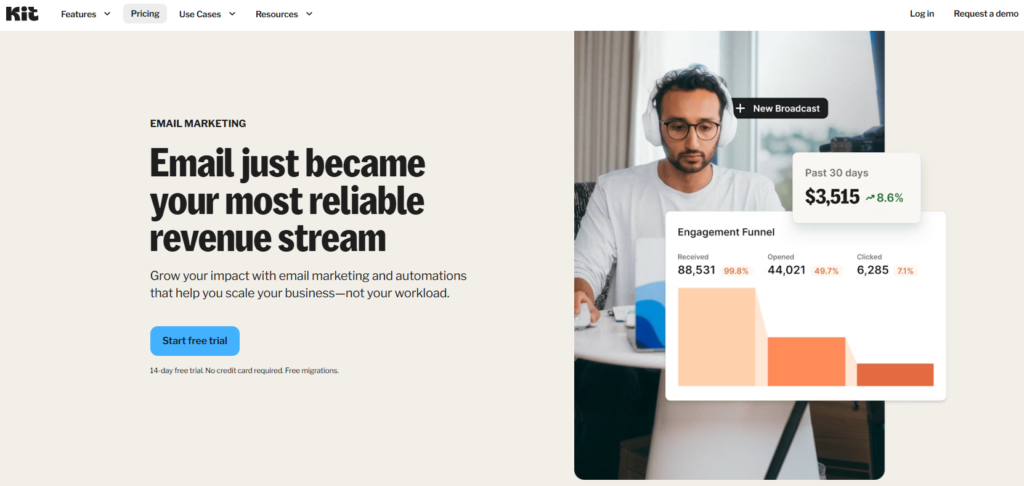
7. Kit (formerly ConvertKit) — Best for Creator Email Marketing and Monetization
| Key Information | Overview |
|---|---|
| Best For | Bloggers, YouTubers, podcasters, course creators, and newsletter writers who want email automation purpose-built for building audience relationships and monetizing digital products |
| Pricing | Newsletter plan free (10K subscribers, unlimited broadcasts, 1 automation sequence, 1 digital product). Creator plan from $39/mo (1K subscribers, unlimited automations and sequences). Creator Pro from $79/mo (1K subscribers, newsletter referral system, subscriber scoring). Annual billing saves ~20%. Note: September 2025 price increase |
| Free Tier | Yes — up to 10,000 subscribers with unlimited email broadcasts, 1 automation, and 1 digital product. Most generous free subscriber limit in the category |
| Key Strengths | 10,000-subscriber free plan, creator-focused automation with visual workflow builder, Creator Network for cross-promotion with other creators, Sparkloop referral integration, subscriber scoring and fan identification, digital product and course sales natively, tip payments, newsletter recommendations |
| Key Weaknesses | September 2025 price increase significantly raised paid plan costs (Creator jumped from $15 to $33/mo for 1K subscribers); free plan restricted to 1 automation and 1 digital product; A/B testing limited to subject lines; 90-day reporting window only; no native SMS |
| Best For Businesses | Full-time creators, newsletter businesses, bloggers with 1K–100K audiences, course creators and digital product sellers |
| Ecommerce Integration | Limited — Shopify integration available but not designed for product-catalog email automation |
| Multi-Channel | Email only (no native SMS or push) |
| Best Pairing | Gumroad or Teachable for course delivery alongside Kit’s audience management; Stripe for payment processing |
Kit — formerly ConvertKit, rebranded in 2024 — occupies a category position it has defined and dominated for nearly a decade: email marketing built specifically for the creator economy. Where general marketing platforms treat all subscribers as contacts in a database, Kit treats them as an audience — human beings with specific interests, content preferences, and purchasing behaviors that can be understood through tagging, scoring, and segmentation, and addressed with automations that respond to their individual journey through the creator’s content catalog.
The free plan is Kit’s most compelling single feature in 2026: up to 10,000 subscribers with unlimited broadcast emails, a single automation sequence, and one digital product for sale — all at zero cost. No other platform on this list comes close to this subscriber limit on its free tier. For creators who are building their audience before monetizing, Kit’s free plan provides a professional email marketing foundation with no time pressure to upgrade, eliminating the cost barrier that prevents many new creators from establishing a newsletter presence at all.
The Creator Network is a feature specific to Kit that enables email list growth through cross-promotion within a curated community of creators. Newsletter recommendations between Kit users drive subscriber acquisition that the creator’s own organic growth rate alone cannot match. For creators who have plateaued on organic subscriber growth through their content platform — the YouTube channel, the podcast, the blog — the Creator Network provides a discovery mechanism that compounds the list-growth return on the email tool investment.
The subscriber scoring and fan identification system identifies the most engaged subscribers in the audience — those who open consistently, click regularly, and purchase when given the opportunity — and surfaces them as the high-value segment that should receive first access to new products, premium content, and partnership opportunities. For creators whose business model depends on converting a fraction of their audience into paying customers, this engagement visibility is more valuable than raw subscriber count.
Where Kit Falls Short
The September 2025 price increase was substantial and has damaged Kit’s value position relative to competitors. The Creator plan moved from $15/mo to $39/mo for 1,000 subscribers, and scales to $139/mo at 5,000 subscribers — more than double MailerLite’s cost at the same list size for a platform with fewer automation capabilities. A/B testing is limited to subject lines, meaning body content, CTA placement, and email format cannot be tested. The 90-day reporting window prevents long-term trend analysis. For creators whose list has grown to the point where the paid plan represents a meaningful monthly expense, the value calculation has become harder to justify against MailerLite’s Growing Business plan.
The Verdict on Kit
Kit is the right email platform for creators who are building their audience and want to start without paying — the 10,000-subscriber free plan is without peer in the category. For creators whose monetization model depends on the Creator Network for list growth, the referral system, or the community of fellow creators that Kit has built, the paid tiers provide genuine ecosystem value that MailerLite or Brevo cannot replicate. For creators who simply need capable email automation at the lowest price point, MailerLite’s paid plans now provide better value than Kit’s Creator plan at equivalent list sizes.
8. Omnisend — Best Multi-Channel Ecommerce Automation for Shopify and WooCommerce
| Key Information | Overview |
|---|---|
| Best For | Ecommerce brands on Shopify or WooCommerce that want email and SMS automation in a single platform with ecommerce-native features at a more accessible price point than Klaviyo |
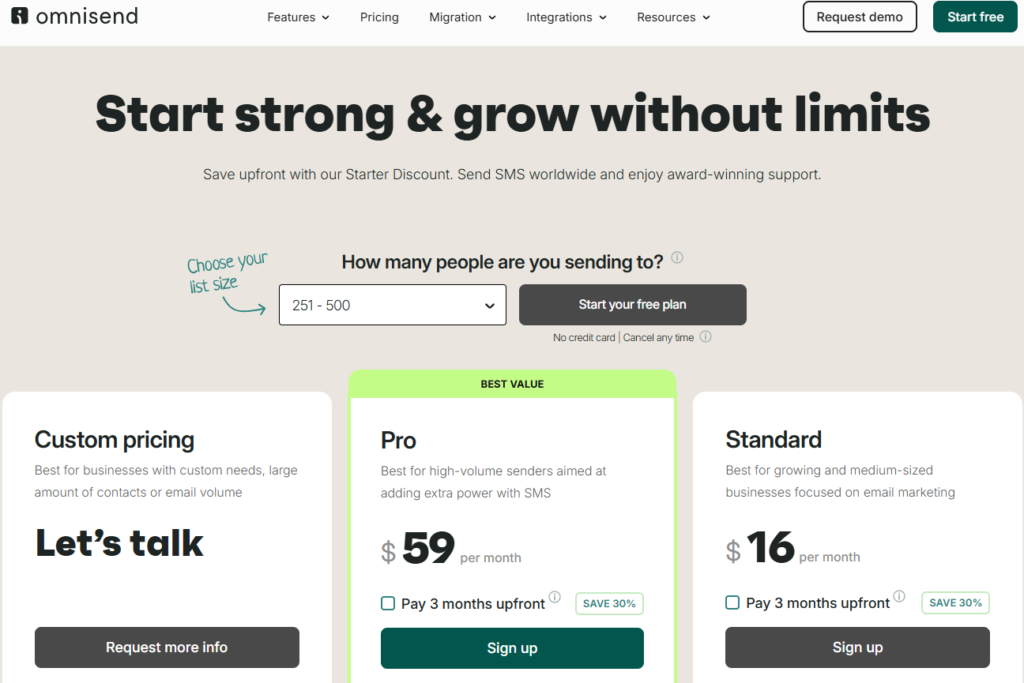
| Pricing | Free (500 emails/mo, up to 250 contacts emailed/mo, 60 SMS credits). Standard from $16/mo (6K emails/mo). Pro from $59/mo (unlimited emails, 3,933 SMS credits). Pricing scales by contact count |
| Free Tier | Yes — 500 emails/mo, 60 SMS credits, 60 web push, all features accessible |
| Key Strengths | Purpose-built ecommerce automation with abandoned cart, browse abandonment, post-purchase, product recommendation, and win-back flows; SMS and email in unified workflows; Shopify and WooCommerce deep integration; sales reporting per automation; AI-powered product recommendations; lower cost than Klaviyo for comparable ecommerce functionality |
| Key Weaknesses | Automation logic less sophisticated than Klaviyo for complex multi-branch flows; predictive analytics less developed than Klaviyo’s; limited outside ecommerce contexts |
| Best For Businesses | DTC ecommerce brands, Shopify and WooCommerce merchants, subscription box businesses, beauty, fashion, home goods brands |
| Ecommerce Integration | Shopify, WooCommerce, BigCommerce, Wix — deep ecommerce-native integration |
| Multi-Channel | Email, SMS/MMS, web push notifications |
| Best Pairing | Gorgias or Zendesk for customer service data integration; Postscript for SMS if SMS volume is very high |
Omnisend occupies the space between Mailchimp’s general-purpose accessibility and Klaviyo’s premium ecommerce sophistication — providing ecommerce-native email and SMS automation at a price point that DTC brands in their growth phase can access without the investment level that Klaviyo requires. The platform has been ecommerce-native from its founding, and every feature decision reflects that focus: the automation templates are all ecommerce scenarios, the integrations are all commerce platforms, and the analytics frame performance in revenue terms rather than purely email metrics.
The unified email and SMS automation builder is Omnisend’s most distinctive workflow advantage. A single automation can send an email immediately upon cart abandonment, wait 12 hours, check if the email was opened, and send an SMS to unopened contacts — all within the same workflow canvas, without maintaining separate email and SMS sequences and manually coordinating their timing. This unified channel management significantly simplifies the operational complexity of running multi-channel ecommerce automation compared to platforms where email and SMS are effectively separate systems.
The Standard plan’s $16/mo starting price, which includes all ecommerce automation templates, basic SMS, and web push notifications for a contact list of up to 500 subscribers, makes Omnisend meaningfully cheaper than Klaviyo for brands at the same stage. For a DTC brand doing $200,000 in annual revenue where email automation is established but not yet generating the per-unit revenue that justifies Klaviyo’s pricing premium, Omnisend provides 80 percent of the ecommerce automation capability at 40 percent of the cost.
Where Omnisend Falls Short
Omnisend’s automation conditional logic is less sophisticated than Klaviyo’s for brands whose automation needs extend beyond standard ecommerce flows into complex behavioral branching. Klaviyo’s predictive analytics — customer lifetime value prediction, churn probability scoring, and next order date forecasting — are more developed than Omnisend’s comparable features, which matters for brands whose automation strategy depends on predictive rather than purely historical behavioral triggers. For brands scaling past $10M in annual revenue where email automation is a primary growth lever, Klaviyo’s additional sophistication often justifies the cost differential.
The Verdict on Omnisend
Omnisend is the right email and SMS automation platform for growing ecommerce brands on Shopify or WooCommerce that need purpose-built ecommerce automation at a more accessible cost than Klaviyo. The Standard plan at $16/mo provides full ecommerce automation capability for small-to-mid-size stores; the Pro plan at $59/mo adds unlimited email volume and meaningful SMS credits for brands with established automation programs. Brands whose revenue growth justifies moving to Klaviyo’s predictive analytics layer should plan that migration as a deliberate strategic decision rather than an early-stage requirement.
9. Drip — Best for Advanced Behavioral Segmentation on Established Ecommerce Brands
| Key Information | Overview |
|---|---|
| Best For | Established ecommerce brands with 20K+ contacts that need complex behavioral segmentation, Liquid templating for dynamic personalization, and revenue attribution beyond what Klaviyo’s standard plans provide |
| Pricing | From $39/mo (2,500 contacts, unlimited email sends). Scales by contact count: 5K contacts $89/mo; 10K contacts $154/mo; 25K contacts $369/mo. All plans include all features |
| Free Tier | Yes — 14-day free trial |
| Key Strengths | Liquid templating engine for complex dynamic personalization, deep behavioral segmentation with custom events, revenue attribution per workflow and campaign, Shopify and WooCommerce integration, multi-channel (email, SMS, Facebook and Instagram ads), all features on every plan (no tier gates) |
| Key Weaknesses | Higher entry price than Omnisend or MailerLite; no free tier; smaller user base and community than Klaviyo; fewer pre-built integration connectors |
| Best For Businesses | DTC ecommerce brands with established email programs, brands needing Liquid-powered dynamic personalization, businesses with technical resources to leverage Drip’s API |
| Ecommerce Integration | Shopify, WooCommerce, Magento, BigCommerce |
| Multi-Channel | Email, SMS, Facebook and Instagram ad audience sync |
| Best Pairing | Shopify for primary product and purchase data; Segment for advanced event tracking feeding Drip’s segmentation engine |
Drip occupies a specific position in the ecommerce email automation market: it serves established brands that have moved beyond the standard flow templates that most platforms offer and need the technical depth to build personalization experiences that are specifically calibrated to their product catalog, customer purchase patterns, and brand voice. The Liquid templating engine — borrowed from the same open-source language that Shopify themes use — allows Drip users to build email templates where the content, product recommendations, copy blocks, and visual elements change dynamically based on any data attribute associated with the recipient.
A clothing brand using Drip can build a single abandoned cart email template that shows the specific abandoned item alongside three personalized recommendations calibrated to the customer’s size, brand affinity, and browsing history — all from one template, dynamically populated per recipient. The alternative, building separate emails for each product category or customer segment, requires exponentially more template management overhead as the product catalog and customer database grow. Liquid templating compresses that overhead by making the template itself intelligent.
The all-features-on-every-plan model eliminates the tiering frustration that most other platforms impose. Drip’s pricing is purely contact-count based — $39/mo for 2,500 contacts, $89/mo for 5,000, $154/mo for 10,000 — with every feature, every integration, and every workflow capability available at every tier. For brands that have been frustrated by Klaviyo’s feature gates or ActiveCampaign’s add-on structure, Drip’s transparent, no-gate pricing is a meaningful operational simplification.
Where Drip Falls Short
Drip’s $39/mo entry point is positioned above the ecommerce automation alternatives at small contact counts — Omnisend Standard costs $16/mo for comparable feature access at 500 contacts, and Klaviyo’s email plan starts at $20/mo. For ecommerce brands under 10,000 contacts without technical resources to leverage Liquid templating, Drip’s pricing premium over Omnisend is difficult to justify. The platform also has a smaller community and ecosystem than Klaviyo, meaning fewer community-developed templates, fewer agencies with platform expertise, and a smaller pool of third-party resources for brands building their automation program from scratch.
The Verdict on Drip
Drip is the right email automation platform for established ecommerce brands with technical marketing teams that have exhausted the personalization ceiling of their current platform and need the dynamic content flexibility that Liquid templating provides. For brands under 20,000 contacts or without a marketing technologist who can leverage the API and templating capabilities, Omnisend or Klaviyo provide better value at their growth stage.
10. GetResponse — Best All-in-One for Creators Running Email Alongside Webinars and Courses
| Key Information | Overview |
|---|---|
| Best For | Creators, coaches, and educators who want email marketing and automation alongside native webinar hosting, landing pages, and course delivery in a single platform |
| Pricing | Free (500 contacts, unlimited newsletters, 1 landing page, AI tools). Email Marketing from $19/mo (1K contacts). Marketing Automation from $59/mo (1K contacts). Ecommerce Marketing from $119/mo |
| Free Tier | Yes — 500 contacts, unlimited email sends, 1 landing page, 1 automation workflow, AI email and newsletter generator |
| Key Strengths | Native webinar hosting (up to 1,000 attendees on paid plans), AI-powered email and newsletter generator, visual marketing funnel builder, landing pages and website builder, conversion funnels, ecommerce features, marketing automation with 20+ triggers, abandoned cart and order confirmation flows |
| Key Weaknesses | Native webinar feature (previously a key differentiator) is now available as a standalone in many competing tools; automation logic less deep than ActiveCampaign; ecommerce integration less native than Klaviyo or Omnisend for Shopify-centric brands |
| Best For Businesses | Online coaches and educators, webinar marketers, course creators, small businesses running event-based marketing alongside standard email automation |
| Ecommerce Integration | Shopify, WooCommerce, BigCommerce, Etsy, PrestaShop |
| Multi-Channel | Email, SMS (paid plans), web push, live chat |
| Best Pairing | Zoom for webinars if the GetResponse webinar capacity is exceeded; Teachable or Kajabi for course delivery at higher production values |
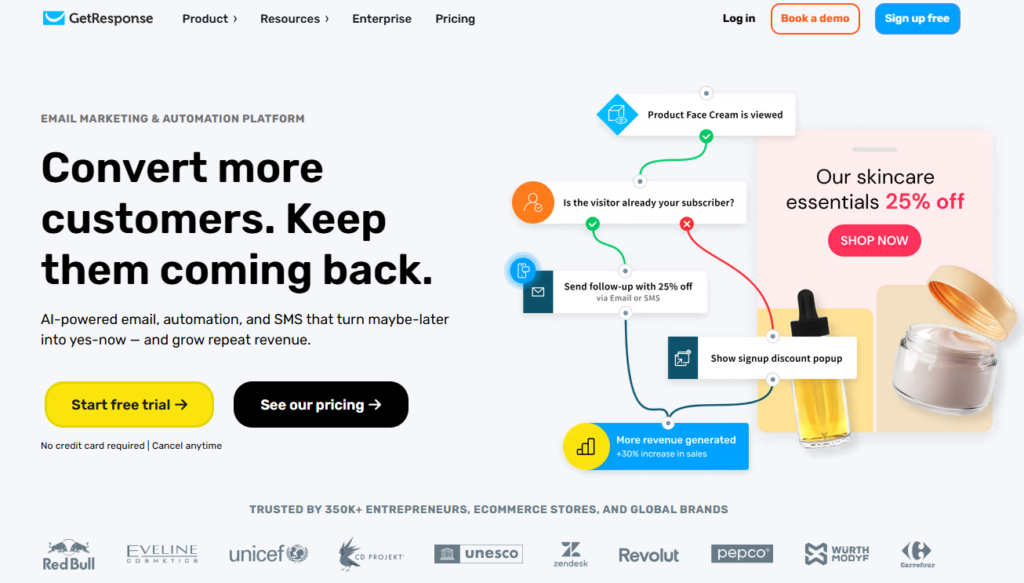
GetResponse’s differentiated position in the email automation market is the native webinar feature — a capability that no other platform on this list provides without a separate tool subscription. For coaches, educators, and marketers whose primary lead generation mechanism is the live webinar, the ability to manage the webinar registration page, automated reminder sequences, live event hosting, post-webinar replay delivery, and follow-up automation workflows all from a single platform represents a meaningful operational simplification over the alternative stack of a dedicated webinar tool, a separate email platform, and the Zapier integration connecting them.
The visual funnel builder extends the webinar infrastructure into a complete conversion architecture: a lead magnet landing page that captures email subscribers, a webinar registration page that converts subscribers into attendees, a webinar hosting environment that delivers the educational content, and a post-webinar automation that converts attendees into course or service buyers — all built and managed within GetResponse without any external tools. For coaches and educators building their first automated sales funnel, this integrated environment removes the technical complexity that typically prevents implementation.
The AI-powered email and newsletter generator is one of the more capable AI writing implementations in the category, generating full email campaigns from a brief description of the campaign objective, the target audience, and the product or service being promoted. The generator produces subject line, preview text, and body copy in a style calibrated to the brand’s tone — saving non-writers the blank-page friction that delays campaign creation when manual writing is required.
Where GetResponse Falls Short
GetResponse’s marketing automation capability, while functional for standard workflows, does not match ActiveCampaign’s behavioral branching depth for complex multi-step nurture programs. The ecommerce integrations are adequate but less sophisticated than Klaviyo’s or Omnisend’s for brands that need deep purchase-behavior-driven automation. For businesses whose primary use case is standard email marketing without the webinar or funnel builder components, MailerLite or Brevo provide better cost efficiency at comparable capability levels.
The Verdict on GetResponse
GetResponse is the right email automation platform for coaches, educators, and webinar marketers who want to consolidate email automation and webinar hosting in a single subscription without sacrificing meaningful capability in either function. The Marketing Automation plan at $59/mo for 1,000 contacts represents a higher per-contact cost than MailerLite, but the inclusion of native webinar hosting that would otherwise require a $50–$100/mo additional subscription makes the combined economics competitive. For users who do not need the webinar or funnel builder, the Email Marketing plan at $19/mo is a capable mid-tier email platform at a reasonable price.
Which Email Automation Tool Should You Choose? A Decision Framework
The right email automation platform depends primarily on your business model, technical requirements, and the contact volume at which cost becomes a significant factor.
If you need the most powerful automation logic and CRM integration: ActiveCampaign Plus ($49/mo) for SMB through enterprise. The automation depth and conditional logic have no equal at this price point.
If you run a Shopify or WooCommerce store: Klaviyo for brands with 5,000+ contacts and serious revenue attribution requirements. Omnisend Standard ($16/mo) for growing brands where Klaviyo’s cost is premature. Both are meaningfully better for ecommerce than general marketing platforms.
If you have a large contact list but send infrequently: Brevo — the only major platform that charges by email volume rather than contact count. Saves significantly at 20,000+ contacts with moderate send frequency.
If you are a beginner prioritizing ease of use: Mailchimp Standard ($20/mo) for the most accessible onboarding experience. MailerLite Growing Business ($10/mo) for the best capability-per-dollar.
If you are a creator or newsletter writer: Kit’s free plan up to 10,000 subscribers. Upgrade to Creator ($33/mo) when the Creator Network’s list growth capability and unlimited automations justify the investment.
If you are a B2B company with a HubSpot CRM: HubSpot Marketing Hub Starter as a baseline, with Professional ($890/mo) when attribution reporting and advanced automation are required.
If you need webinar-native email automation: GetResponse Marketing Automation ($59/mo) combines the two workflows in a single platform at a price that competes with separate webinar plus email tool subscriptions.
If you are an established ecommerce brand needing advanced personalization: Drip from $39/mo, specifically for the Liquid templating engine and all-features-on-every-plan model.
Recommended Email Automation Stacks by Business Type
| Business Type | Primary Platform | Supporting Tools | Monthly Cost | Coverage |
|---|---|---|---|---|
| B2B / SaaS (Advanced) | ActiveCampaign Pro ($79/mo) | HubSpot CRM, Postmark transactional | $150–$300/mo | Deep automation + CRM + transactional |
| Ecommerce (Established) | Klaviyo Email + SMS ($100+/mo) | Gorgias for CS data | $100–$500/mo | Revenue-attributed ecommerce flows + SMS |
| Ecommerce (Growing) | Omnisend Standard ($16/mo) | Shopify, basic SMS included | $16–$59/mo | Ecommerce flows + email + SMS |
| Small Business / Blogger | MailerLite Growing Business ($10/mo) | Zapier for integrations | $10–$30/mo | Full email + automations + landing pages |
| Creator / Newsletter | Kit Newsletter (free) → Creator ($33/mo) | Stripe for payments | $0–$33/mo | Audience-building + monetization |
| Large-List Moderate Sender | Brevo Business ($18/mo) | SMS add-on as needed | $18–$60/mo | Volume-based pricing + multi-channel |
| Webinar / Course Creator | GetResponse Marketing Automation ($59/mo) | Teachable for courses | $59–$119/mo | Email + webinars + funnels |
| Enterprise B2B | HubSpot Marketing Hub Professional ($890/mo) | HubSpot Sales Hub | $890–$3,600/mo | Full CRM + attribution + automation |
Head-to-Head: Which Platform Wins Each Category?
| Category | Winner | Runner-Up | Notes |
|---|---|---|---|
| Automation Logic Depth | ActiveCampaign | HubSpot Marketing Hub | ActiveCampaign on workflow flexibility; HubSpot on CRM integration |
| Ecommerce Email Automation | Klaviyo | Omnisend | Klaviyo on revenue attribution and predictive AI; Omnisend on price accessibility |
| Multi-Channel Ecommerce | Omnisend | Klaviyo | Omnisend on unified email + SMS builder; Klaviyo on AI personalization |
| B2B and CRM Integration | HubSpot | ActiveCampaign | HubSpot on native CRM data; ActiveCampaign on automation depth without HubSpot ecosystem |
| Best Value for Small Business | MailerLite | Brevo | MailerLite on features per dollar; Brevo on large-list cost advantage |
| Free Plan Generosity | Kit | Brevo | Kit on subscriber count (10K); Brevo on contact storage (100K) and send volume |
| Volume-Based Pricing (Large Lists) | Brevo | N/A | Only platform charging by emails sent rather than contacts stored |
| Creator and Newsletter Tools | Kit | MailerLite | Kit on Creator Network and monetization; MailerLite on feature breadth |
| Webinar + Email in One Platform | GetResponse | N/A | Only platform with native webinar hosting at this price point |
| Advanced Personalization (Ecommerce) | Drip | Klaviyo | Drip on Liquid templating; Klaviyo on predictive analytics |
| AI Capabilities | Klaviyo | ActiveCampaign | Klaviyo’s K:AI is most comprehensive; ActiveCampaign on predictive sending |
| Easiest Onboarding | Mailchimp | MailerLite | Mailchimp on templates and ecosystem; MailerLite on interface simplicity |
Frequently Asked Questions
What is email automation and how is it different from regular email marketing?
Regular email marketing is broadcast-based — sending the same message to a list of contacts at a time the sender chooses. Email automation is trigger-based — sending specific messages automatically in response to subscriber behaviors, time intervals, or data conditions, without the sender manually initiating each send. A welcome sequence that sends automatically when someone subscribes, an abandoned cart email that fires when a shopper leaves items in their cart, or a re-engagement campaign that triggers when a subscriber has not opened in 90 days are all email automations. The commercial advantage of automation over broadcast is scale and relevance — automated emails are more contextually appropriate to the recipient’s current relationship with the business, and they generate revenue without ongoing manual effort.
How does contact-based pricing vs. send-volume-based pricing affect total cost?
Most platforms charge based on the number of contacts stored — meaning cost scales with list size regardless of how frequently those contacts are emailed. Brevo charges based on emails sent per month, meaning cost scales with actual sending activity rather than list size. For businesses that send frequently to a small, active list, contact-based pricing is often cheaper. For businesses with large lists that they email infrequently — monthly newsletters to a 50,000-contact database, for example — Brevo’s volume-based model produces meaningfully lower monthly costs than competing contact-based platforms at the same list size.
What email authentication requirements do I need to meet in 2026?
Following Google, Yahoo, and Microsoft’s 2024 bulk sender requirements, all senders of more than 5,000 emails per day must have SPF (Sender Policy Framework), DKIM (DomainKeys Identified Mail), and DMARC (Domain-based Message Authentication, Reporting, and Conformance) records configured on their sending domain. All senders must include a one-click unsubscribe link in every email. Spam complaint rates must remain below 0.3% to avoid delivery restrictions. Most email automation platforms now walk users through domain authentication setup during onboarding and monitor complaint rates. Failing to meet these requirements results in email delivered to spam folders or blocked entirely by major inbox providers.
What is the difference between email marketing automation and a CRM?
Email marketing automation manages the communication workflows that engage and convert contacts through email and other messaging channels — automated sequences, behavioral triggers, segmentation, and campaign management. A CRM (Customer Relationship Management) system tracks the complete relationship between a business and its customers — deals, sales activities, support tickets, account history, and contact data across all touchpoints. Many email automation platforms include basic CRM features. Dedicated CRMs like Salesforce, HubSpot, and Pipedrive include email sending capabilities. The overlap is significant, and the correct question for most businesses is whether their primary operational system is sales-driven (where a CRM with email capabilities is appropriate) or marketing-driven (where an email automation platform with CRM features is appropriate).
Key Points Recap: Build Automations That Run While You Sleep
The platform decision matters less than most marketers expect. The difference between the best and worst email automation tools on this list is meaningful — but it is smaller than the difference between a business that has built, tested, and optimized a complete automation program and a business that has subscribed to a premium platform and not built anything beyond a basic welcome email.
Two principles should guide email automation investment. First, match the platform to your current business stage, not your aspirational future state. A creator with 3,000 subscribers does not need the ActiveCampaign Pro tier — MailerLite’s Growing Business plan at $10/mo provides fully adequate automation capability for that audience size and will continue to for years of growth. Paying for platform capability the business has not yet earned through list size and revenue is overhead, not investment.
Second, build one automation at a time and optimize it before moving to the next. The welcome sequence that converts subscribers into first-time buyers, fully built and tested, generates more revenue than ten automations that each exist as half-built drafts. The abandoned cart flow that runs at a 15% conversion rate, optimized over six months of A/B testing on timing and copy, generates more revenue than a platform with 50 automation templates that are never activated.
The Email Automation Stack That Works for Most Businesses
For most small businesses and growing ecommerce brands: MailerLite Growing Business ($10/mo) for email list under 5,000; Omnisend Standard ($16/mo) if ecommerce automation is the primary use case. Build a five-step welcome sequence, an abandoned cart flow, and a monthly newsletter program before evaluating whether more sophisticated platforms are warranted. For B2B businesses with CRM dependencies: ActiveCampaign Plus ($49/mo) paired with whatever CRM is already in use. The automation depth justifies the investment the moment the sales cycle has more than two touchpoints.
The best email automation tool is the one that is configured, running, and generating revenue today — not the most capable platform still being evaluated six months from now.


