

Running SEO for a single website is hard enough. Running it across 30 client accounts simultaneously — each with different industries, different keyword targets, different competitive landscapes, and different stakeholders who want different things from their monthly report — is an entirely different operational challenge. The tools that work well for in-house SEO teams frequently break down at agency scale: dashboards that only show one domain at a time, rank trackers that charge per keyword regardless of how many clients share the budget, audit tools that cannot export white-labeled reports, and link prospecting workflows that require starting from scratch for every new engagement.
Agency SEO tools need to solve a different problem than individual SEO tools. The core requirement is not just capability — it is the ability to deliver that capability efficiently across a portfolio of clients, with reporting that communicates value clearly to non-technical stakeholders, with white-label options that reinforce the agency’s brand rather than advertising the tool vendor’s, and with user and permissions management that lets multiple team members work across multiple accounts without creating data conflicts or accidental cross-client contamination.
The SEO platform market in 2026 has largely recognized this distinction. Several platforms have built agency-specific tiers and feature sets from the ground up. Others have bolted on multi-client management as an afterthought that technically works but creates enough friction that agencies end up building their own reporting infrastructure around it. This guide identifies which is which, helping you choose the best SEO tools for agencies based on real workflow demands.
We evaluated 10 SEO platforms specifically against the demands of agency workflows — multi-client management, rank tracking at scale, site auditing, link building, client reporting, white-label capability, and total cost of ownership across a realistic 20 to 50 client portfolio.
Quick Comparison: Top 10 SEO Tools for Agencies in 2026
| Platform | Primary Use | Starting Price | Free Tier | Best Feature | Our Rating |
|---|---|---|---|---|---|
| Semrush | All-in-one SEO and competitive intelligence | $139.95/mo | No (7-day trial) | Deepest competitive intelligence in the category | 9.3/10 |
| Ahrefs | Backlink analysis and content research | $129/mo | No (limited free tools) | Most accurate backlink database available | 9.2/10 |
| Moz Pro | SEO platform with strong local and DA metrics | $49/mo | No (30-day trial) | Domain Authority and local SEO for agencies | 8.8/10 |
| Screaming Frog | Technical SEO site auditing | Free / $279/yr | Yes (500 URLs) | Deepest technical crawl in the category | 9.1/10 |
| SE Ranking | Agency-focused SEO platform | $69/mo | (14-day trial) | Purpose-built agency management with white-label | 9.0/10 |
| AgencyAnalytics | Client reporting and SEO dashboards | $16/mo per client | (14-day trial) | White-label client reporting across all channels | 9.1/10 |
| BrightLocal | Local SEO and citation management | $39/mo | No (14-day trial) | Best local SEO platform for multi-location clients | 9.0/10 |
| Surfer SEO | Content optimization and NLP-based writing | $119/mo | No (7-day trial) | Data-driven content briefs and on-page optimization | 8.9/10 |
| Mangools | Rank tracking and keyword research | $30.50/mo | No (10-day trial) | Accessible, accurate rank tracking for growing agencies | 8.6/10 |
| Google Search Console | First-party search performance data | Free | Yes (free) | Direct Google data no third-party tool can replicate | 9.0/10 |
How We Evaluated These SEO Platforms for Agency Use
Every platform in this guide was assessed across six dimensions that reflect the specific operational demands of running SEO at agency scale — not the needs of a single in-house team managing one domain.
Multi-client management architecture: We evaluated how each platform structures client accounts — whether clients are genuinely isolated projects or awkwardly segmented within a single account, how easy it is to switch between clients, and whether billing and permissions can be managed cleanly across a growing client portfolio without creating the account management overhead that erodes agency margins.
White-label reporting quality: Agencies sell results, not tool subscriptions. We evaluated the quality and flexibility of each platform’s white-label reporting — branded dashboards, custom domain options, report scheduling, and the degree to which client-facing outputs communicate the agency’s expertise rather than advertising the tool being used.
Rank tracking accuracy and scale: Rank tracking at agency scale means tracking thousands of keywords across dozens of domains simultaneously, with localized results for clients in different geographic markets. We evaluated tracking accuracy, localization capability, update frequency, and the cost implications of scaling keyword tracking across a full client portfolio.
Site audit depth and actionability: Technical SEO audits are one of the most consistently billable deliverables in agency work. We evaluated audit coverage — the breadth of technical issues detected — and the actionability of audit output, meaning whether findings are prioritized and explained in terms that clients and implementation teams can act on rather than requiring expert interpretation.
Link building and backlink analysis: For agencies building links as a core service, the quality of the backlink database determines the quality of the prospecting workflow. We evaluated database size, freshness, spam score accuracy, and the practical utility of competitor backlink analysis for link prospecting.
Total cost of ownership at agency scale: Per-seat and per-keyword pricing can create cost structures that are attractive at small scale and punishing at 30+ client portfolios. We evaluated the realistic monthly cost for an agency managing 20 to 50 clients with typical keyword volumes and team sizes — not just the advertised entry price.
Why the Agency SEO Tools Landscape Has Changed in 2026
Three developments define the agency SEO tools market in 2026 that distinguish it from three years earlier.
The first is the normalization of AI-assisted content optimization. The content creation and optimization workflow has changed fundamentally. Agencies that previously delivered content briefs based on manual keyword analysis now deliver AI-generated briefs that include semantic entity coverage, competitor content gap analysis, NLP-optimized heading structures, and expected word count ranges — all generated in minutes rather than hours. Platforms like Surfer SEO have moved from optional add-ons to core workflow components for agencies with content production at scale. The agencies that have not integrated AI-assisted content tooling into their workflow are delivering briefs in hours that competing agencies are delivering in minutes.
The second is the acceleration of local SEO as a distinct agency service line. The expansion of Google’s local search features — map pack prominence, review signals, local pack filtering, neighborhood-level ranking differentiation — has made local SEO a technically complex discipline that commands dedicated tooling. Agencies serving brick-and-mortar clients, healthcare providers, legal practices, and service businesses with multiple locations need platforms that handle citation management, local rank tracking with specific geo-targeting, and Google Business Profile optimization at scale. BrightLocal and similar specialized platforms have formalized local SEO into a service line that generalist SEO tools cannot adequately support.
The third is the consolidation of multi-channel client reporting into unified dashboard platforms. Clients have never been satisfied with ranking reports alone, and in 2026 they increasingly expect their agency to report on the full digital marketing picture — organic search, paid search, social media, email, and web analytics — in a single dashboard that connects SEO activity to business outcomes. Platforms like AgencyAnalytics have built the multi-channel reporting infrastructure that allows agencies to deliver this unified view without building custom reporting systems for every client.
Detailed Reviews: Best SEO Tools for Agencies in 2026
1. Semrush — Best All-in-One SEO Platform for Competitive Intelligence
| Key Information | Overview |
|---|---|
| Best For | Agencies that need a single platform covering keyword research, competitive analysis, rank tracking, site auditing, and content marketing at depth |
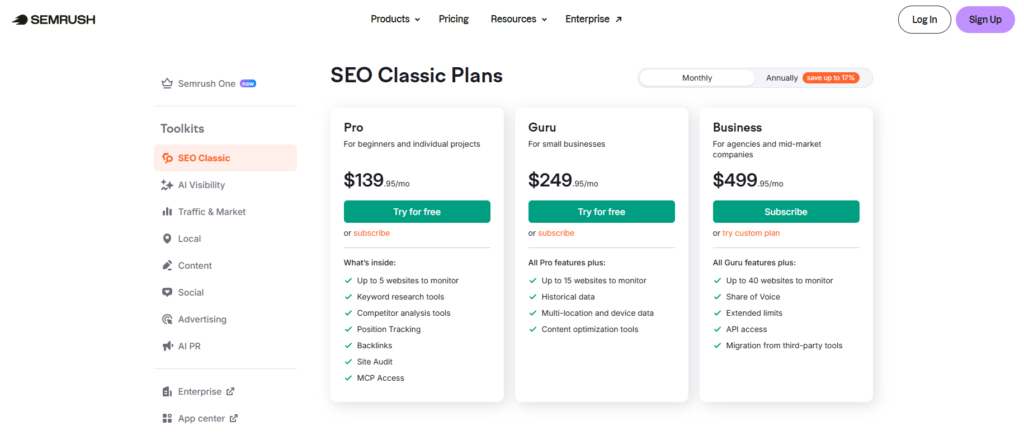
| Pricing | Pro $139.95/mo. Guru $249.95/mo. Business $499.95/mo. Agency-specific add-ons available |
| Free Tier | No — 7-day free trial |
| Key Strengths | Deepest competitive intelligence database, Position Tracking with SERP feature monitoring, Domain Overview for client competitive analysis, Site Audit, Backlink Analytics, Content Marketing Toolkit, Agency Growth Kit |
| Key Weaknesses | Expensive at scale with multiple seats and client projects; keyword data accuracy occasionally lags Ahrefs on fresh terms; white-label reporting requires Guru tier and above |
| Best For Agencies | Full-service SEO agencies, agencies with competitive intelligence as a core deliverable, agencies managing 10–50 clients with varied service needs |
| White Label | Yes — branded PDF reports and custom reporting via Guru and Business tiers |
| Multi-Client | Yes — Projects structure with client-level organization |
| Best Pairing | AgencyAnalytics for enhanced white-label client reporting, Screaming Frog for deeper technical crawls |
Semrush’s position as the default all-in-one platform for agency SEO comes from a combination that no direct competitor has fully replicated: the broadest functional coverage in the category — keyword research, competitive analysis, rank tracking, site auditing, backlink analysis, content marketing, social media monitoring, and advertising intelligence — delivered at a data depth that individual specialist tools often match but rarely exceed across all functions simultaneously.
The competitive intelligence capability is where Semrush genuinely differentiates for agencies. The Domain Overview report gives any agency, within seconds of onboarding a new client, a complete competitive landscape picture: the client’s current organic keyword portfolio, their top organic competitors, the keywords where competitors outrank them, the pages driving competitor organic traffic, and the backlink profiles of every competitor in the space. This client onboarding intelligence — which would take days to assemble manually or with weaker tools — enables agencies to walk into a kickoff meeting with a data-driven strategy framework already constructed.
The Agency Growth Kit, available at the Business tier, adds client portal functionality, white-label capability, and lead generation tools specifically for agency growth — including a tool that agencies can embed on their website to offer prospective clients an automated SEO audit of their site, driving qualified inbound leads without manual effort. For agencies investing in their own growth alongside client delivery, this integrated business development functionality is a meaningful differentiator from tools that focus exclusively on delivery capability.
Where Semrush Falls Short
Semrush’s pricing structure punishes agencies that need multiple seats. The Business plan at $499.95 per month allows three users; additional users cost extra. For agencies with five or more SEOs working across client accounts, the per-seat cost can make the monthly total significantly higher than the advertised plan price. The backlink database, while comprehensive, occasionally surfaces newer links more slowly than Ahrefs — meaningful for agencies where the freshest backlink data is operationally important for time-sensitive link building campaigns.
The Verdict on Semrush
Semrush is the right primary SEO platform for agencies that need breadth of capability across the full SEO workflow and for whom competitive intelligence is a core component of the service they deliver to clients. At the Guru tier for growing agencies and Business tier for established ones, the platform covers the majority of the technical SEO, content, and competitive analysis work without requiring a second primary SEO tool. Supplement with AgencyAnalytics for white-label client reporting and Screaming Frog for the deepest technical audits.
2. Ahrefs — Best Backlink Database and Content Research Platform
| Key Information | Overview |
|---|---|
| Best For | Agencies where link building and content gap analysis are primary service deliverables, requiring the most accurate backlink data available |
| Pricing | Lite $129/mo. Standard $249/mo. Advanced $449/mo. Enterprise $1,499/mo |
| Free Tier | No — limited free tools available (Ahrefs Webmaster Tools for owned sites) |
| Key Strengths | Industry-leading backlink database with fastest index refresh, Content Explorer for content research at scale, Keywords Explorer with click-through data, Site Audit, Rank Tracker, accurate search volume estimates |
| Key Weaknesses | More expensive than Semrush for equivalent functionality at some tiers; reporting and white-label features less developed than Semrush; no native social or PPC data |
| Best For Agencies | Link building agencies, content marketing agencies, agencies where backlink analysis is the primary technical workflow |
| White Label | Limited — report exports available but no full white-label dashboard |
| Multi-Client | Yes — workspaces at higher tiers; project-based organization |
| Best Pairing | AgencyAnalytics or SE Ranking for white-label reporting, Screaming Frog for technical SEO alongside Ahrefs’s content and link work |
Ahrefs built its reputation on a single foundational capability that the SEO industry has validated consistently across years of independent testing: the most accurate and most comprehensively indexed backlink database available. The Ahrefs crawler is the second most active web crawler after Google itself, processing billions of URLs per day and maintaining a live index of the web’s link graph that refreshes faster and with fewer gaps than any competing database. For agencies where the quality of backlink analysis directly determines the quality of link building strategy and competitor analysis, this database accuracy is not an incremental advantage — it is the foundation on which every backlink-dependent deliverable is built.
The Content Explorer tool is where Ahrefs extends its link intelligence into content strategy in a way that makes it particularly valuable for content-focused agencies. Searching for any topic in Content Explorer returns every piece of content about that topic that has accumulated significant backlinks, social shares, or organic traffic — with filtering by domain rating, publication date, word count, traffic, and dozens of other parameters. For agencies building content strategies based on proven topical demand and demonstrated link acquisition potential, this research capability compresses what would otherwise be days of manual research into minutes of structured exploration.
Keywords Explorer’s click-through rate data adds dimension to keyword research that volume-only tools cannot provide. Two keywords with identical search volume may have dramatically different click-through rates if one is dominated by featured snippets, shopping ads, or map packs that absorb clicks before organic results are reached. Ahrefs’s traffic potential metric — which estimates the actual organic traffic a page could receive at position one accounting for SERP features — produces more realistic traffic forecasts for client proposals than raw volume numbers alone.
Where Ahrefs Falls Short
Ahrefs’s reporting and white-label capabilities are meaningfully weaker than Semrush’s. There is no native white-label dashboard, client portal, or automated scheduled reporting — agencies using Ahrefs as their primary tool typically need to build their client reporting workflow in a separate platform like AgencyAnalytics. The lack of PPC and social data also means Ahrefs is a pure SEO tool rather than the broader digital marketing intelligence platform that Semrush attempts to be. For agencies that need to report across channels or that have clients asking about competitor paid search strategies, Ahrefs requires supplementation.
The Verdict on Ahrefs
Ahrefs is the right SEO platform for agencies where backlink analysis, link building prospecting, and content gap research are the primary technical workflows. The backlink database accuracy advantage over Semrush is meaningful for these use cases. For agencies that need competitive intelligence breadth, white-label reporting, or PPC data alongside their SEO workflow, Semrush provides better overall value. Many established agencies run both — Ahrefs for link and content research, Semrush for competitive intelligence and reporting.
3. SE Ranking — Best Purpose-Built SEO Platform for Agencies
| Key Information | Overview |
|---|---|
| Best For | Growing agencies that want a comprehensive SEO platform with native agency management features at a price point below Semrush and Ahrefs |
| Pricing | Essential $69/mo. Pro $89/mo. Business $149/mo |
| Free Tier | 14-day free trial |
| Key Strengths | White-label SEO platform with custom branding, client access portals, agency-specific user permissions, rank tracking with local and mobile results, site audit, backlink monitoring, keyword research |
| Key Weaknesses | Backlink database smaller than Ahrefs; competitive intelligence less deep than Semrush; less name recognition than the category leaders |
| Best For Agencies | Small to mid-size agencies (5–50 clients), agencies that prioritize white-label client delivery over raw data depth |
| White Label | Yes — custom domain, branded client portal, white-label reports at all paid tiers |
| Multi-Client | Yes — purpose-built client management with sub-accounts and permissions |
| Best Pairing | Screaming Frog for deeper technical audits, AgencyAnalytics for multi-channel reporting alongside SE Ranking’s SEO-specific data |
SE Ranking occupies a specific and underserved position in the agency SEO tools market: a platform that was designed from the ground up for agency workflows rather than retrofitting agency features onto a tool built for individual use. The white-label capability is not an add-on requiring the most expensive tier — it is available across all paid plans, with custom domain-hosted client portals, branded reports, and the ability to present the platform entirely as the agency’s own proprietary SEO technology rather than a third-party subscription.
The client management architecture reflects genuine understanding of how agencies operate. Each client exists as a genuinely separate workspace with its own keyword tracking, audit history, backlink monitoring, and reporting — not a loosely defined project within a shared account. Team member permissions can be scoped to specific clients, which means a junior SEO can access and work on their assigned clients without visibility into the full client portfolio. A separate client login provides each client with access to their own performance dashboard without requiring the agency to share their full platform access.
The rank tracking engine handles the localization requirements that agencies with multi-location or franchise clients depend on. Tracking rankings at the city, ZIP code, or coordinate level — essential for local SEO clients whose ranking performance varies meaningfully between nearby locations — is built into the tracking architecture rather than requiring workarounds. Daily ranking updates across all tracked keywords ensure that agencies and clients are working from current data rather than week-old snapshots.
Where SE Ranking Falls Short
SE Ranking’s backlink database is smaller and refreshes less frequently than Ahrefs’s, which limits its utility for agencies where detailed competitor link analysis is a core workflow. The competitive intelligence capabilities — traffic estimations, keyword gap analysis, competitor content research — are useful but do not match the depth of Semrush’s database. For agencies whose primary differentiator is the sophistication of their competitive research, SE Ranking is better positioned as a supplementary management and reporting platform alongside a primary research tool than as a standalone comprehensive solution.
The Verdict on SE Ranking
SE Ranking is the right primary SEO platform for growing agencies that prioritize native white-label client delivery, clean multi-client management, and a complete SEO workflow at a price point substantially below the category leaders. The agency-first design philosophy is evident in every feature — the platform was built by people who understood the agency workflow problem, not by a product team that added client management as a feature request. For agencies managing 5 to 50 clients who find Semrush’s pricing prohibitive, SE Ranking delivers the majority of the practical functionality at a fraction of the cost.
4. Screaming Frog SEO Spider — Best Technical SEO Audit Tool
| Key Information | Overview |
|---|---|
| Best For | Technical SEO specialists and agencies delivering deep technical audits as a core service |
| Pricing | Free (up to 500 URLs). Paid license £199/yr (~$279/yr) for unlimited crawling |
| Free Tier | Yes — 500 URL crawl limit with core features |
| Key Strengths | Deepest technical crawl available, JavaScript rendering, custom extraction with XPath and regex, integration with Google Analytics and Search Console, structured data validation, redirect chain analysis, custom crawl configuration |
| Key Weaknesses | Desktop application — no cloud hosting or team collaboration features; outputs require technical interpretation; no rank tracking or keyword research |
| Best For Agencies | Technical SEO agencies, agencies delivering site migration work, agencies auditing large or complex web applications |
| White Label | No — findings require manual formatting for client-facing reports |
| Multi-Client | Yes — separate crawl configurations saved per client, no native project management |
| Best Pairing | Semrush or Ahrefs for keyword and competitive data, AgencyAnalytics for client reporting incorporating Screaming Frog findings |
Screaming Frog SEO Spider is the technical SEO tool that every serious SEO agency has installed, regardless of what other tools are in the stack. At £259 per year — roughly $330 at current exchange rates — it is also the highest-value tool on this list relative to its price. The gap in technical crawl depth between Screaming Frog and the built-in site audit tools of comprehensive platforms like Semrush and Ahrefs is meaningful for technically complex sites, large crawls, and custom analysis scenarios where the platform audit tools reach their limits.
The custom extraction capability is where Screaming Frog separates itself from every other technical audit tool. Using XPath, CSS path selectors, or regex patterns, any element from any page in the crawl can be extracted into the crawl data — custom meta tags, structured data fields, product prices, review counts, hreflang tags, canonical references, or any other on-page element that needs to be audited at scale. For agencies auditing large e-commerce sites, news publishers, or complex web applications where the technical SEO work extends beyond standard meta tag and link checking, this custom extraction capability enables audits that platform-based tools simply cannot perform.
JavaScript rendering via Screaming Frog’s integrated Headless Chromium browser allows technical SEOs to crawl web applications that render content client-side — the increasingly common scenario where a traditional crawler would return empty pages because the content is injected by JavaScript after initial page load. For agencies auditing React, Angular, Vue.js, or other JavaScript-heavy applications, this JS rendering capability is the difference between an audit that reflects the actual crawl experience and one that misses a significant fraction of the site’s content.
Where Screaming Frog Falls Short
Screaming Frog is a desktop application that runs on the auditing machine’s local hardware — there is no cloud-based team collaboration, no shared project management, no client portal, and no automated scheduling unless configured through command-line scripting. For agencies where multiple SEOs need to run audits on the same client simultaneously, or where crawl history needs to be preserved and compared over time, the tool’s single-machine architecture requires workarounds. Client-facing reporting also requires manual work — Screaming Frog exports data in spreadsheet format that must be formatted and interpreted before it becomes a client-ready deliverable.
The Verdict on Screaming Frog
Screaming Frog is the right technical SEO audit tool for every agency with technical SEO in its service offering. At £259 per year for the paid license, it is the most cost-efficient professional tool on this list by a significant margin. Every agency SEO who performs technical audits should have Screaming Frog in their toolkit — the question is not whether to use it but which complementary tools provide the rank tracking, keyword research, and client reporting infrastructure that Screaming Frog deliberately does not.
5. AgencyAnalytics — Best White-Label Client Reporting Platform
| Key Information | Overview |
|---|---|
| Best For | Agencies that need professional, white-label client reporting across SEO and all other digital marketing channels in a single client-facing dashboard |
| Pricing | Freelancer $16/mo per client. Agency $24/mo per client. Enterprise custom |
| Free Tier | 14-day trial |
| Key Strengths | 80+ integrations including Google Analytics 4, Search Console, Semrush, Ahrefs, Google Ads, Facebook, Instagram, and more; custom branded dashboards; automated report scheduling; client portal access; campaign-level tracking |
| Key Weaknesses | Not an SEO research tool — no keyword research, backlink database, or rank tracking of its own; per-client pricing adds up at large portfolio scale |
| Best For Agencies | Agencies of all sizes that need to deliver professional multi-channel client reporting; agencies managing 5–100+ clients across SEO, PPC, and social media |
| White Label | Yes — custom domain, logo, colors, and fully branded client portals |
| Multi-Client | Yes — purpose-built for multi-client management with client-level dashboards |
| Best Pairing | Semrush or Ahrefs for SEO data feeding into AgencyAnalytics, Google Ads and Meta Ads for paid channel data, Google Analytics 4 for traffic data |
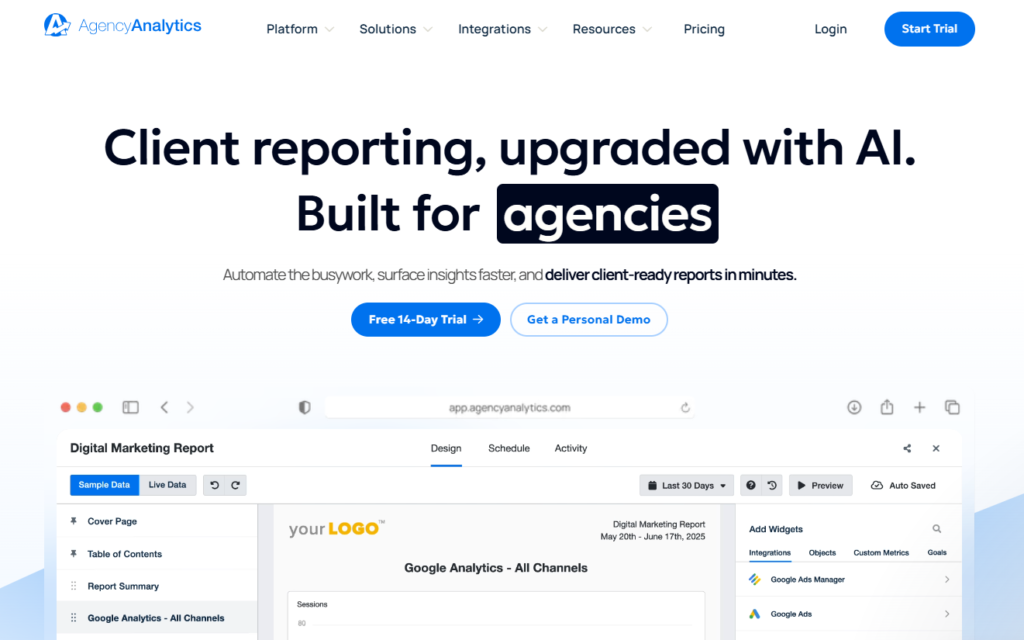
AgencyAnalytics occupies a distinct and necessary position in the agency SEO stack: it is not an SEO research tool but a client reporting platform that aggregates data from every tool the agency uses — Semrush, Ahrefs, Google Search Console, Google Analytics 4, Google Ads, Facebook Ads, Instagram, LinkedIn, Mailchimp, and 80 other integrations — into a single white-labeled client dashboard that the client experiences as the agency’s proprietary reporting system.
The fundamental insight behind AgencyAnalytics is that client reporting is itself a service, not just an operational necessity. A client who can log into a live, branded dashboard and see their organic traffic trending up, their keyword rankings improving, and the direct correlation between the agency’s work and measurable business results is a client who renews contracts and provides referrals. A client who receives a PDF report once a month with no interactive capability and no context for what the numbers mean is a client who eventually questions the ROI. AgencyAnalytics makes the difference between these two outcomes operationally achievable without requiring agencies to build custom reporting infrastructure.
The automated report scheduling eliminates the manual reporting overhead that consumes significant agency time every month. Custom report templates built once deploy across every client on the portfolio, populated with that client’s actual data and branded with their color scheme and the agency’s logo. Monthly reports send automatically on a defined schedule. Clients with questions about their dashboard get answers without requiring the account manager to pull the data manually. The time savings compound across a full client portfolio into meaningful capacity recovered from reporting overhead.
Where AgencyAnalytics Falls Short
AgencyAnalytics is a reporting and visualization platform, not an SEO research tool. It has no keyword research database, no backlink index, no competitor analysis capability, and no rank tracker of its own — it displays rank tracking data pulled from Semrush or other integrated tools. Agencies that try to use AgencyAnalytics as their primary SEO tool rather than their reporting layer will find it incomplete. The per-client pricing, while reasonable at small portfolio sizes, creates a cost structure that escalates for agencies with large client rosters where the $18 per client per month Agency tier adds up to significant monthly recurring cost.
The Verdict on AgencyAnalytics
AgencyAnalytics is the right client reporting platform for agencies that want to deliver professional, multi-channel, white-label reporting without building custom dashboards. It is not a primary SEO tool and should not be evaluated as one — it is the reporting layer that sits on top of Semrush, Ahrefs, or SE Ranking and converts their data into client-facing outcomes. For agencies where client retention and perceived value are the primary growth constraints, the investment in professional reporting infrastructure consistently pays off in renewal rates and referral volume.
6. BrightLocal — Best Local SEO Platform for Multi-Location Clients
| Key Information | Overview |
|---|---|
| Best For | Agencies managing local SEO for brick-and-mortar clients, multi-location businesses, franchise networks, and service-area businesses |
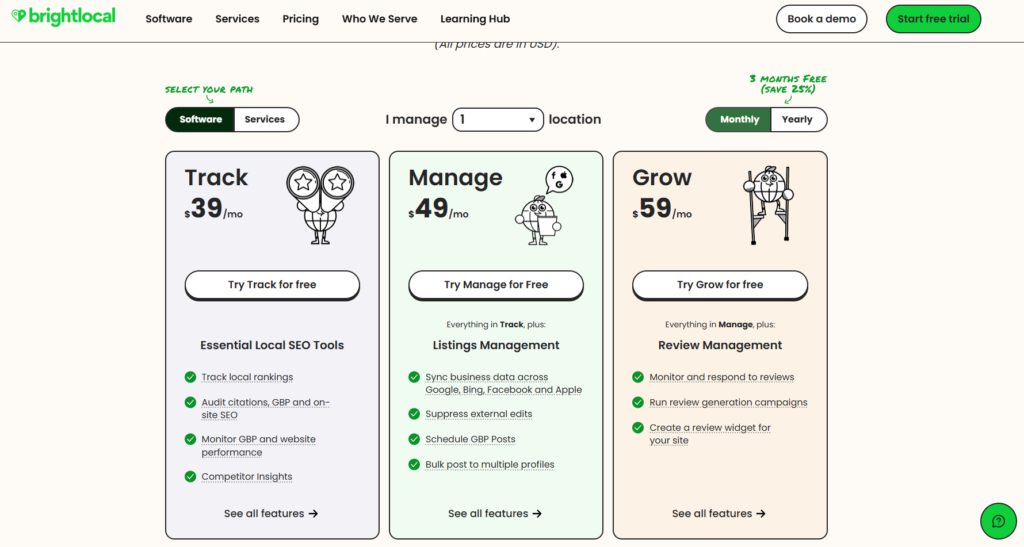
| Pricing | Track $39/mo. Manage $49/mo. Grow $59/mo. Multi-location packages available |
| Free Tier | No — 14-day trial |
| Key Strengths | Local rank tracking with precise geo-targeting, citation building and auditing, Google Business Profile management at scale, review monitoring and management, white-label local SEO reports |
| Key Weaknesses | Not a general SEO tool — national keyword tracking and backlink analysis require separate platforms; limited value for non-local SEO engagements |
| Best For Agencies | Agencies with a local SEO service line, agencies managing multi-location or franchise clients, agencies serving healthcare, legal, home services, and retail sectors |
| White Label | Yes — branded reports and client-facing dashboards available |
| Multi-Client | Yes — designed for multi-location management at scale |
| Best Pairing | Semrush or Ahrefs for national SEO alongside BrightLocal’s local coverage, AgencyAnalytics for multi-channel reporting incorporating BrightLocal data |
BrightLocal has built the strongest platform for local SEO management by focusing exclusively on the specific requirements of local search optimization rather than attempting to be a general-purpose SEO tool. The distinction matters because local SEO is genuinely different from national SEO in ways that make general-purpose tools inadequate for serious local work. Ranking at position one nationally for a keyword does not mean ranking in the local pack for that same term in a specific city. Citation accuracy affects local ranking in ways that have no parallel in national SEO. Review signals influence local pack visibility in ways that general-purpose tools do not model.
The local rank tracking engine tracks rankings at the granularity that local SEO requires — specific cities, ZIP codes, or even street-level coordinates for clients where ranking variation within a city is commercially meaningful. A dental practice in Chicago ranks differently in the River North neighborhood than in Wicker Park, and tracking that distinction requires the precise geo-targeting that BrightLocal provides and that general-purpose rank trackers typically do not.
The citation management capability handles the operational volume of local SEO work that makes it challenging to scale without dedicated tooling. Building and maintaining consistent NAP (Name, Address, Phone) data across hundreds of local directories, data aggregators, and industry-specific listings for dozens of clients simultaneously is exactly the type of high-volume, repetitive work that breaks down in spreadsheet management and becomes manageable in a purpose-built system. BrightLocal’s citation builder and audit tools handle this work systematically, with monitoring that flags citation inconsistencies as they appear across the web.
Where BrightLocal Falls Short
BrightLocal is a local SEO platform, and its utility for agencies without a local SEO service line is limited. National keyword research, backlink analysis, and competitive intelligence for non-local businesses are outside its scope. Agencies that primarily serve e-commerce, SaaS, publishing, or other non-location-dependent businesses will find BrightLocal of little value. Even agencies with strong local SEO practices need a second primary SEO platform — Semrush, Ahrefs, or SE Ranking — for the keyword research, technical auditing, and link analysis that BrightLocal does not cover.
The Verdict on BrightLocal
BrightLocal is the right local SEO platform for agencies with a significant local client base. The platform’s combination of precise local rank tracking, citation management, Google Business Profile oversight, and review monitoring covers the technical requirements of local SEO in ways that general-purpose tools cannot match. For agencies where local SEO is a primary service line, BrightLocal is not an optional add-on — it is the operational foundation on which the service is delivered.
7. Surfer SEO — Best Content Optimization Platform for Agencies
| Key Information | Overview |
|---|---|
| Best For | Agencies delivering content strategy and content creation services that need data-driven on-page optimization and content brief generation at scale |
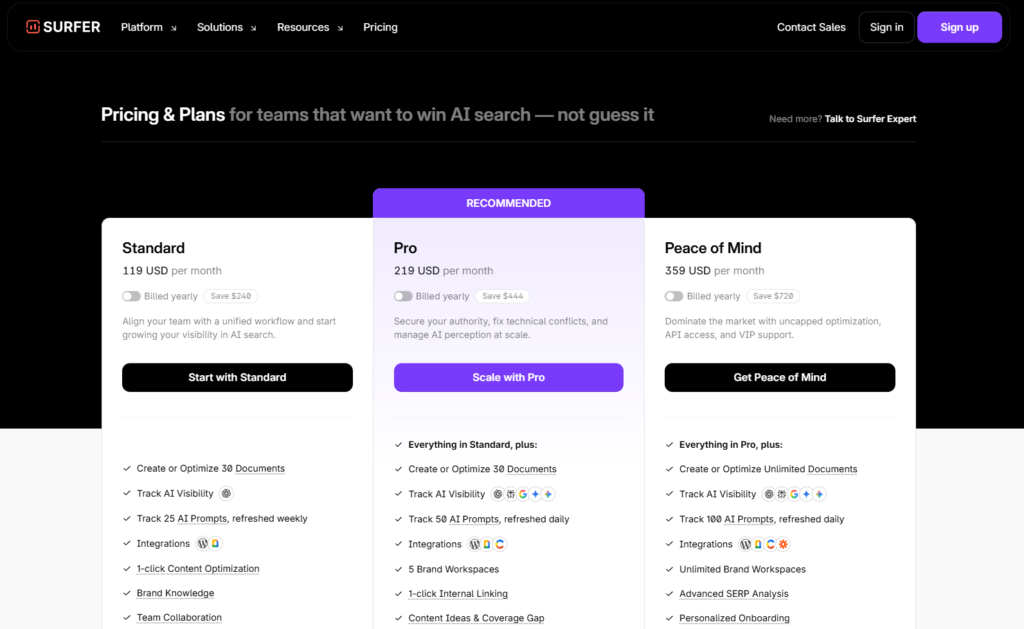
| Pricing | Standard $119/mo. Pro $219/mo. Peace of Mind $359/mo. Enterprise custom |
| Free Tier | No — 7-day trial |
| Key Strengths | NLP-based content scoring, SERP-driven content briefs with entity and keyword coverage recommendations, content editor with real-time optimization scoring, keyword clustering, Content Planner, AI writing with Surfer AI |
| Key Weaknesses | Not a rank tracker or backlink tool; AI content quality requires editorial review; value concentrated in on-page optimization rather than full-funnel SEO |
| Best For Agencies | Content marketing agencies, agencies with content production as a core service, agencies managing content teams or freelancer networks |
| White Label | Limited — audit reports can be shared but no full white-label dashboard |
| Multi-Client | Yes — organization-level management with multiple workspaces |
| Best Pairing | Semrush or Ahrefs for keyword research feeding into Surfer’s optimization workflow, AgencyAnalytics for reporting on content performance results |
Surfer SEO has become the standard content optimization tool for agencies producing SEO content at scale because it solves the specific problem that pure keyword research tools do not: knowing not just which keywords to target but what a page needs to contain to rank competitively for those keywords given the current SERP landscape. The Content Score — a real-time metric that evaluates a piece of content against the top-ranking pages for its target keyword across NLP entities, term frequency, heading structure, word count, and dozens of other signals — gives content writers an objective optimization target rather than relying on their judgment about what a well-optimized piece looks like.
The content brief generation workflow is where Surfer delivers the most immediate operational efficiency for agencies managing content production. A brief built in Surfer includes the semantic entities that need coverage, recommended heading structures derived from top-ranking competitor pages, internal and external linking recommendations, target word count range, and the specific keyword variations that should appear throughout the piece — all generated in under five minutes from a target keyword input. Content briefs that previously took an experienced SEO an hour to construct manually are produced in minutes, at a quality that is consistently better because they are grounded in empirical SERP analysis rather than intuition.
The keyword clustering capability organizes large keyword sets into topical clusters — grouping keywords that should be targeted by the same page versus keywords that warrant separate pages — at a scale and speed that manual clustering cannot match. For agencies building out content strategies for clients with hundreds or thousands of target keywords, this automated clustering provides the information architecture foundation on which the full content plan is built.
Where Surfer SEO Falls Short
Surfer SEO is a content optimization and planning tool, not a full-spectrum SEO platform. It has no rank tracker, no backlink database, no technical audit capability, and no competitive intelligence beyond the SERP analysis that feeds its content scoring. Agencies that try to use Surfer as their primary SEO platform will find it missing the capabilities that constitute the majority of SEO work. It is correctly positioned as the content production layer within a broader stack that includes Semrush or Ahrefs for research and tracking, and reporting infrastructure for client delivery.
The Verdict on Surfer SEO
Surfer SEO is the right content optimization platform for agencies that produce SEO content as a primary service and where the quality and efficiency of content brief creation directly affects delivery capacity and client results. The NLP-based optimization scoring provides a level of content quality assurance that purely keyword-frequency approaches cannot deliver. For agencies managing content teams or freelancer networks where brief quality determines output quality, Surfer’s brief generation workflow pays for itself quickly in reduced revision cycles and improved first-draft optimization scores.
8. Moz Pro — Best for Domain Authority Benchmarking and Local SEO Integration
| Key Information | Overview |
|---|---|
| Best For | Agencies that rely on Domain Authority as a client communication metric and that need a capable all-in-one SEO platform with strong local integration |
| Pricing | Starter $99/mo. Standard $179/mo. Medium $299/mo. Large $599/mo |
| Free Tier | No — 30-day trial |
| Key Strengths | Domain Authority as the industry-standard client-facing metric, Link Explorer backlink analysis, Keyword Explorer, Rank Tracker, Site Crawl, MozBar browser extension, local SEO integration via Moz Local |
| Key Weaknesses | Backlink database smaller and refreshes more slowly than Ahrefs; keyword data accuracy trails Semrush and Ahrefs; innovation pace slower than category leaders |
| Best For Agencies | Agencies that heavily use DA as a client benchmark and communication metric, agencies serving clients who understand Moz’s authority metrics |
| White Label | Limited — report exports available; no full white-label dashboard at standard tiers |
| Multi-Client | Yes — campaign-based organization across the platform |
| Best Pairing | AgencyAnalytics for white-label reporting incorporating Moz’s DA data, Screaming Frog for technical audits, Ahrefs for backlink depth |
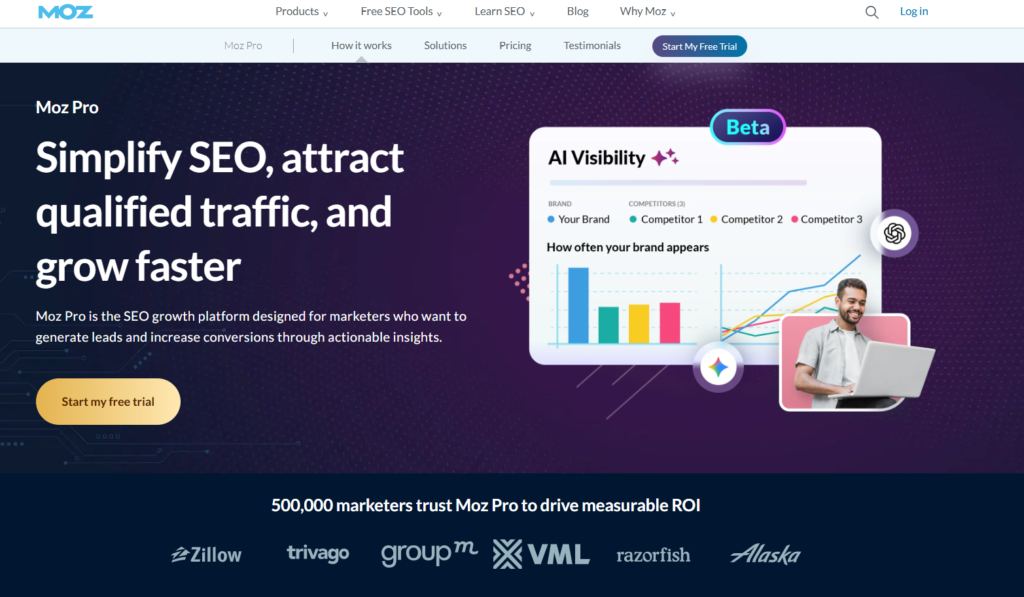
Moz Pro’s most durable contribution to the agency SEO toolkit is not a feature — it is a metric. Domain Authority, Moz’s logarithmic scale of website authority from 1 to 100, has become the universal language through which agencies communicate website strength to clients who are not SEO practitioners. When a client asks “how strong is my website compared to my competitors?” the answer is most easily communicated through DA scores, because every stakeholder in the room — the marketing director, the CEO, the sales team — understands intuitively that 65 is stronger than 45 and that the goal is to increase the number over time. This metric’s universality in client communication makes Moz Pro relevant to agencies even when they supplement it with stronger tools for research and analysis.
The Link Explorer backlink tool provides the backlink analysis foundation that the DA metric is built on, with a database that covers the major web domains with sufficient accuracy for most agency use cases. For agencies that need to quickly assess the link profile of a prospect’s site during the sales process, benchmark client link growth over time, or identify high-DA linking opportunities for outreach campaigns, Link Explorer delivers adequate data at a speed that fits the sales conversation.
The MozBar browser extension is a practical productivity tool that surfaces DA, Page Authority, and key on-page SEO data directly in the browser for any URL visited — enabling quick competitive assessments, SERP analysis, and link prospecting research without requiring a full platform session. For SEOs who want quick authority context while browsing competitor sites, reading industry publications, or evaluating link prospects, MozBar makes Moz Pro tangibly useful beyond the platform’s formal workflows.
Where Moz Pro Falls Short
Moz Pro’s backlink database and keyword data accuracy have consistently trailed Ahrefs and Semrush in independent comparisons, and the platform’s pace of feature innovation has been slower than both primary competitors over the past several years. Agencies that need the most accurate backlink data for link building prospecting or the deepest competitive keyword intelligence for strategy development will find Moz Pro less capable than alternatives at comparable or lower price points. DA as a metric, while universally recognized, is also increasingly criticized as a proxy that can be gamed — and sophisticated clients are beginning to ask about first-party Google metrics alongside it.
The Verdict on Moz Pro
Moz Pro is the right SEO platform for agencies where DA is a central client communication metric and where the integrated toolset covers the agency’s practical SEO workflow at a price point and complexity level the team can operationalize effectively. For agencies where backlink analysis depth and competitive intelligence accuracy are primary requirements, Ahrefs and Semrush provide stronger tools at comparable price points. Moz’s real competitive advantage remains the DA metric’s universal recognition as a client-facing benchmark.
9. Mangools — Best Accessible Rank Tracking for Growing Agencies
| Key Information | Overview |
|---|---|
| Best For | Small to mid-size agencies and freelancers needing accurate, affordable rank tracking and keyword research without the complexity of enterprise platforms |
| Pricing | Basic $30.50/mo. Premium $40.50/mo. Agency $70.50/mo |
| Free Tier | 10-day free trial |
| Key Strengths | KWFinder for keyword research with accurate search volumes, SERPChecker for SERP analysis, SERPWatcher for rank tracking with Dominance Index metric, LinkMiner for backlink analysis, clean and intuitive UI |
| Key Weaknesses | Backlink database significantly smaller than Ahrefs; limited site audit capability; not suitable as a primary tool for large enterprise agencies; no white-label features |
| Best For Agencies | Freelance SEOs, small agencies (1–15 clients), agencies prioritizing affordability and ease of use |
| White Label | No |
| Multi-Client | Basic — project-level organization without dedicated multi-client management |
| Best Pairing | Screaming Frog for technical audits, AgencyAnalytics for client reporting, Semrush for competitive intelligence on specific client campaigns |
Mangools serves a specific and real market segment: the freelance SEO or small agency that needs a reliable, accurate rank tracking and keyword research tool without paying for enterprise capabilities they do not need and will not use. At $29 per month for the Basic plan or $89 per month for the Agency plan, Mangools provides KWFinder — consistently rated among the most accurate keyword research tools for search volume data and keyword difficulty scoring — alongside rank tracking, SERP analysis, and basic backlink analysis in a UI that new users can navigate productively within an hour.
KWFinder’s keyword difficulty scoring is the capability that earns Mangools consistent positive reviews from SEO practitioners. Where many keyword research tools generate difficulty scores that correlate poorly with actual ranking difficulty in practice, KWFinder’s difficulty metric tracks more closely with what agencies actually experience when targeting specific keywords — reducing the disconnect between keyword research recommendations and real-world ranking timelines that erodes client trust in agency strategy.
SERPWatcher’s Dominance Index — a composite metric that weights rank positions by estimated click-through rate to provide a single score for overall SERP performance — gives agencies a simple trend metric that communicates ranking progress to clients more intuitively than a list of individual keyword positions. For agencies managing clients who want a single number that answers “are we getting better?” without reviewing 200 keyword positions, the Dominance Index provides that summary view.
Where Mangools Falls Short
Mangools is not an enterprise agency platform. There is no white-label capability, no client portal, no multi-seat team management beyond basic project access, and no site audit functionality beyond surface-level checks. The backlink database is substantially smaller than Ahrefs’s, limiting its utility for serious link building programs. Agencies that grow beyond 15 to 20 clients or that need to deliver white-label reporting, deep technical audits, or competitive backlink analysis will outgrow Mangools’s capabilities and need to migrate to Semrush, Ahrefs, or SE Ranking.
The Verdict on Mangools
Mangools is the right SEO tool for freelance SEOs and small agencies that need accurate keyword research and rank tracking at the lowest viable price point, without the complexity overhead of enterprise platforms. The $29 per month entry price is the most accessible on this list for a genuinely useful professional tool. Growing agencies should treat Mangools as the right starting tool and plan for the migration to a more capable platform when the client portfolio and service complexity justify it.
10. Google Search Console — Best First-Party Data Source Every Agency Must Use
| Key Information | Overview |
|---|---|
| Best For | Every agency — GSC provides first-party Google performance data that no third-party tool can replicate and that should underpin every organic search analysis |
| Pricing | Free |
| Free Tier | Yes — completely free for verified site owners |
| Key Strengths | Direct Google impression, click, CTR, and position data; index coverage and crawl error reporting; Core Web Vitals monitoring; manual action notifications; rich result status; URL Inspection tool |
| Key Weaknesses | 16-month data retention limit; aggregated query data hides long-tail detail; no competitor data; requires site ownership verification; data sampling on high-traffic properties |
| Best For Agencies | Every agency managing SEO for clients — GSC access is a prerequisite for informed organic search analysis |
| White Label | No — raw data can be exported and incorporated into branded reports |
| Multi-Client | Yes — via Google Search Console management or third-party reporting tools |
| Best Pairing | Every other tool on this list — GSC data should be the foundation layer for all organic search reporting; AgencyAnalytics or Looker Studio for client-facing visualization |
Google Search Console is the only SEO tool on this list that every agency, without exception, must have access to for every client domain they manage. The reason is architectural: GSC provides data that no third-party tool — Semrush, Ahrefs, or any other — has access to, because it comes directly from Google’s index. The queries for which a page is ranking, the exact impression and click counts Google records for each query, the crawl errors Google’s bot encounters, the index coverage issues that are preventing pages from ranking, the Core Web Vitals performance signals that Google is using as ranking factors — all of this exists only in GSC, and no amount of third-party tool sophistication compensates for not having it.
The search query data in GSC enables two analyses that are uniquely valuable for agency work. First, CTR optimization — identifying queries where the site ranks in positions 3 through 10 with below-average CTR, indicating that the meta title or description is underperforming relative to competing results, and prioritizing those pages for meta optimization to recover traffic without improving rankings. Second, content expansion opportunities — identifying queries where Google is matching a page to search intent the page does not explicitly address, surfacing unmet audience demand that can be incorporated into the page’s content to capture incremental impressions.
The Core Web Vitals integration provides field data — real user performance measurements, not lab simulations — that tells agencies which pages on a client’s site are failing Google’s performance thresholds and which are likely experiencing ranking suppression as a result. For agencies that include Core Web Vitals optimization in their technical SEO service offering, GSC’s field data is the authoritative measurement source that justifies the optimization work and validates its impact.
Where Google Search Console Falls Short
GSC’s 16-month data retention limit means that historical trend analysis beyond that window is impossible within the platform — a meaningful constraint for agencies demonstrating long-term SEO value to clients with multi-year relationships. The query data is aggregated and sampled for high-traffic properties, hiding the full long-tail keyword picture that third-party tools attempt to reconstruct through external measurement. There is no competitor data, no keyword research capability, no backlink analysis, and no rank tracking for keywords where the site does not already have impressions — making GSC a data source rather than a complete SEO workflow tool.
The Verdict on Google Search Console
Google Search Console is not optional for any agency managing SEO professionally. It is free, it contains data that no other tool provides, and operating without it means making strategy decisions with incomplete information. Every agency should verify GSC access as part of client onboarding, export and preserve data regularly to work around the 16-month retention limit, and use AgencyAnalytics or Looker Studio to incorporate GSC data into client-facing reporting dashboards that communicate the value of organic search performance in the context of the full marketing picture.
Which SEO Tool Should Your Agency Choose? A Decision Framework
The right agency SEO stack depends on your service mix, client base, team size, and budget. No single tool covers everything — the most effective agency stacks are three to five tools with clearly defined roles.
If your agency offers full-service SEO with competitive intelligence as a core deliverable: Semrush as the primary platform. Add AgencyAnalytics for white-label client reporting. Add Screaming Frog for deep technical audits.
If link building and content strategy are your primary service lines: Ahrefs as the primary platform. Add AgencyAnalytics or SE Ranking for client management and reporting. Add Surfer SEO for content brief production.
If you want the most capable agency-native platform at a competitive price: SE Ranking as the primary platform. Supplement with Screaming Frog for technical depth and AgencyAnalytics for multi-channel reporting.
If you have a significant local SEO service line: BrightLocal for local rank tracking, citation management, and GBP oversight. Semrush or Ahrefs as the national/technical SEO layer alongside it.
If content production is your agency’s core service: Surfer SEO for content briefs and on-page optimization. Semrush or Ahrefs for keyword research feeding the brief workflow.
If you are a small agency or freelancer building toward scale: Mangools for affordable rank tracking and keyword research. Screaming Frog for technical audits. Google Search Console as the free data foundation. Graduate to Semrush or SE Ranking when client revenue justifies the investment.
Recommended Agency SEO Stacks by Agency Type
| Agency Type | Primary Tool | Supporting Tools | Monthly Cost | Coverage |
|---|---|---|---|---|
| Full-Service SEO Agency | Semrush Business | AgencyAnalytics, Screaming Frog | $600–$900/mo | Research + Reporting + Technical Audits |
| Link Building Agency | Ahrefs Advanced | AgencyAnalytics, Screaming Frog | $600–$800/mo | Backlinks + Reporting + Technical |
| Content Marketing Agency | Semrush + Surfer SEO | AgencyAnalytics | $600–$900/mo | Research + Content + Reporting |
| Local SEO Agency | BrightLocal + SE Ranking | AgencyAnalytics | $200–$400/mo | Local + National SEO + Reporting |
| Technical SEO Agency | Screaming Frog + Ahrefs | Semrush, AgencyAnalytics | $500–$800/mo | Deep Technical + Links + Reporting |
| Small Agency / Freelancer | SE Ranking or Mangools | Screaming Frog, GSC | $100–$300/mo | Core SEO + Technical + Free Data |
| Growing Agency (10–30 clients) | SE Ranking Pro | AgencyAnalytics, BrightLocal | $250–$500/mo | Agency-Native Platform + Reporting + Local |
Head-to-Head: Which Tool Wins Each Category?
| Category | Winner | Runner-Up | Notes |
|---|---|---|---|
| All-in-One SEO Platform | Semrush | Ahrefs | Semrush on breadth; Ahrefs on backlink and content depth |
| Backlink Database Accuracy | Ahrefs | Semrush | Ahrefs has fastest index and most accurate link data |
| Technical SEO Auditing | Screaming Frog | Semrush Site Audit | Screaming Frog on crawl depth; Semrush on managed cloud audits |
| White-Label Client Reporting | AgencyAnalytics | SE Ranking | AgencyAnalytics on multi-channel breadth; SE Ranking on native SEO integration |
| Local SEO Management | BrightLocal | SE Ranking | BrightLocal purpose-built for local; SE Ranking adequate for light local work |
| Content Optimization | Surfer SEO | Semrush Writing Assistant | Surfer on NLP depth and brief quality; Semrush on integration with keyword research |
| Agency-Native Platform | SE Ranking | Semrush (Agency Kit) | SE Ranking designed for agencies from ground up; Semrush adds agency features to enterprise tool |
| Keyword Research | Semrush | Ahrefs | Semrush on volume and intent data; Ahrefs on click-through modeling |
| First-Party Google Data | Google Search Console | N/A | No competitor — GSC is the only source of this data |
| Budget / Best Value | Screaming Frog | SE Ranking | Screaming Frog on capability per pound; SE Ranking on all-in-one value |
Key Takeaways: The Right Stack Scales Your Agency, Not Just Your Work
The SEO tools landscape offers genuinely capable options at every budget — from the zero-cost combination of Google Search Console and free Screaming Frog to enterprise Semrush and Ahrefs deployments that give agency SEOs access to data resources that were previously available only to the largest in-house teams. The tools are not the constraint on agency growth. The operational infrastructure that allows the agency to deliver consistent quality across a growing client portfolio — at the margins that make the business sustainable — is the constraint.
Two principles should guide agency tool selection. First, match the tool investment to the service line it supports. Paying for Surfer SEO without content production as a core service is wasted spend. Operating a local SEO service line without BrightLocal is a service quality compromise. The tools that belong in an agency stack are those that directly support a billable service and that make delivering that service better, faster, or more profitable. Tools that are purchased because they are impressive but do not map to actual service delivery are overhead.
Second, invest in reporting infrastructure before you feel the pain of not having it. The moment a client asks “can I see how my rankings are trending over the last six months in one place?” and the answer requires pulling three separate exports and building a spreadsheet, the agency has a reporting infrastructure problem. AgencyAnalytics or a comparable reporting platform should be in the stack before the fifth client, not after the fifteenth.
The Agency SEO Stack That Works at Most Stages
For an agency managing 10 to 30 clients across varied SEO service lines, this stack covers the critical workflows: Semrush Guru or SE Ranking Business as the primary research and tracking platform, Screaming Frog for technical audit depth, AgencyAnalytics for white-label client reporting, and Google Search Console integrated for every client domain. Add BrightLocal when local clients become a meaningful share of the portfolio and Surfer SEO when content production reaches a volume where brief quality and efficiency directly affect margin.
The agencies that consistently retain clients and grow through referrals are not the ones with the most sophisticated tool stack — they are the ones that use their tools to deliver results, communicate those results clearly, and make the client feel informed and confident rather than confused and dependent. The right tools make all three of those outcomes more achievable. The wrong tools, or too many of the right ones operated superficially, make none of them more achievable.
Frequently Asked Questions
What is the minimum SEO tool stack for a new agency?
The minimum viable stack for a new agency is three tools: Google Search Console for first-party performance data on every client domain (free), Screaming Frog for technical audits (£259/yr), and either Semrush Pro, Ahrefs Standard, or SE Ranking Pro for keyword research, rank tracking, and competitive analysis ($99–$249/mo). This combination covers the core deliverables of most SEO engagements — technical audit, keyword strategy, rank tracking, and performance reporting — at a total monthly cost under $280. Add AgencyAnalytics for white-label reporting when the client count makes manual reporting overhead a meaningful time cost, typically at five or more active clients.
Is it better to use one comprehensive SEO platform or multiple specialist tools?
Both approaches have merit depending on agency size and service depth. A single comprehensive platform like Semrush reduces context switching, simplifies billing, and ensures that data across functions (keywords, rankings, backlinks) is consistent. Multiple specialist tools allow each function to use the best available tool — Ahrefs for backlink analysis, Screaming Frog for technical audits, Surfer for content optimization — at the cost of integration overhead and higher combined spend. Most successful agencies land on a hybrid: one primary research and tracking platform (Semrush or Ahrefs), a dedicated technical audit tool (Screaming Frog), a reporting layer (AgencyAnalytics), and specialist tools for specific service lines (BrightLocal for local, Surfer for content).
How should agencies handle SEO tool costs in client pricing?
Tool costs should be factored into the agency’s overhead and recovered through service pricing rather than billed as pass-through line items to individual clients. A client paying $2,000 per month for SEO services is buying the agency’s expertise and output — not a fractional share of a Semrush license. Agencies that itemize tool costs in client invoices create price sensitivity around the wrong variable. Instead, calibrate the monthly service fee to cover the agency’s fully loaded cost — including tool subscriptions, team time, and overhead — plus the target margin, and treat tool selection as an internal operational decision rather than a client billing conversation.
What SEO metrics should agencies report to clients?
The metrics that matter most for agency reporting are organic traffic (from Google Analytics 4 and GSC), keyword ranking positions for target keywords (from the agency’s rank tracker), conversion metrics tied to organic traffic (leads, calls, purchases), and keyword visibility trend over time. Domain Authority is widely used because clients understand it intuitively, but it should be presented as a directional signal rather than a definitive outcome metric. Backlink growth metrics are relevant for agencies with link building programs. Core Web Vitals scores are relevant for clients with technical performance mandates. The common mistake is reporting too many metrics — clients lose confidence in agencies who report 40 KPIs because it obscures whether the work is actually driving business outcomes.
How do agencies manage SEO tool access for clients without sharing full platform credentials?
Most enterprise SEO platforms support client-level access management through read-only user roles, client portal features, or separate client login credentials with scoped access. Semrush, SE Ranking, and Moz Pro all support user permission management that allows clients to log in and view their own data without accessing other clients’ information or the agency’s master account settings. AgencyAnalytics provides the cleanest solution: a fully branded client portal that clients access directly, without ever seeing the AgencyAnalytics interface or the underlying tool integrations. For agencies concerned about clients seeing their tool stack or pricing, the white-label portal approach is the cleanest operational solution.


